Food & Regional Cuisine · Peru
A desert coast, a mountain range, a rainforest, and five centuries of immigration walk into a kitchen. The result is the most decorated restaurant city on Earth — and, more importantly, a food culture you can eat your way through for a few dollars a plate.
In 2025, Lima’s Maido was named the best restaurant in the world, with Central, Kjolle and Mayta keeping it company near the top of the global lists — a single city holding a position no food capital, not Paris, not Tokyo, has ever quite held. The rankings themselves (The World’s 50 Best maintains them) matter less than what they point at: Peruvian cuisine spent two decades going from national pride to global phenomenon, and Lima is where you go to understand why.
But the tasting menus are only the visible peak. The more interesting story — and the better trip — is the whole pyramid: the cevicherías and market stalls, the Chinese-Peruvian chifas and Japanese-Peruvian Nikkei houses, the picanterías of Arequipa and the jungle kitchens of Iquitos. Peru is arguably the only country where you can eat world-class food at every price point, including two dollars. Here’s the explanation, and then the eating strategy.
The Explanation Three geographies, five immigrations
Geography first. Peru contains three utterly different larders stacked within a day’s drive. The Pacific coast is one of the richest fisheries on the planet — the Humboldt Current delivers the anchoveta, corvina and shellfish that make ceviche possible. The Andes contribute altitude agriculture on a scale unmatched anywhere: potatoes in thousands of native varieties (Peru is the crop’s homeland), corn in colours from white to purple, quinoa and kiwicha, ají peppers in a spectrum from fruity to ferocious. And the Amazon adds the strangest and most exciting ingredients in the national pantry — paiche (an arapaima the size of a person), camu camu, aguaje, chilis like the citrusy ají charapita. No other cuisine starts with this raw material.
Then the layering. Indigenous Andean cooking met Spanish ingredients and techniques after 1532. Enslaved Africans, brought to the coast, shaped creole dishes — anticuchos (grilled beef-heart skewers) and tacu tacu are Afro-Peruvian inheritances. Chinese indentured labourers arrived in the nineteenth century and their wok logic fused with local ingredients into chifa — Peruvian-Chinese food, so thoroughly national that lomo saltado (beef stir-fried with soy, tomato and fries) is now a creole standard. Japanese migrants did the same with fish: their precision with raw seafood merged with lime and ají into Nikkei cuisine and arguably refined ceviche itself. Later came Italian immigration (hence the pasta course at Peruvian family lunches). Five food cultures, one pantry of extraordinary ingredients, a century and a half of intermarriage — that’s the recipe.
And then the chefs. Gastón Acurio is the pivotal figure: trained in Paris, he returned in the 1990s and made the deliberate argument that Peruvian food belonged on the world’s fine-dining stage, then built the institutions (restaurants, festivals, a generation of protégés) to prove it. Virgilio Martínez of Central pushed further, building a tasting menu around ecosystems and altitudes; his wife Pía León runs Kjolle; Mitsuharu Tsumura’s Maido perfected Nikkei. The top of the pyramid is real, but it stands on the country’s ordinary lunch counters — which is the point the rankings miss and the traveller shouldn’t.
The Canon What to eat, in rough order of importance
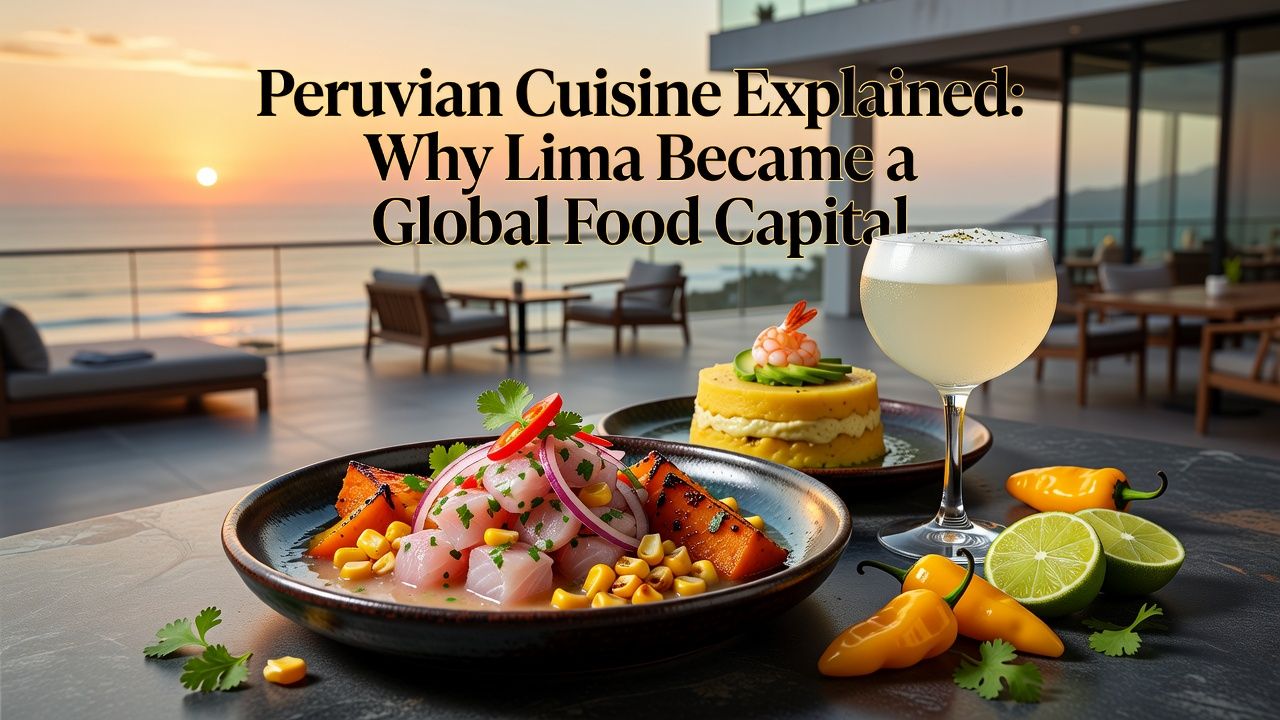
Ceviche. The national dish and its own food group: raw fish cured in leche de tigre — lime, ají, red onion, salt — served with sweet potato and choclo (giant corn). Rules: it’s lunch food (the catch is morning-fresh; a cevichería open late is a cevichería to avoid), the classic is simple (fish, not a seafood medley, for your first), and the leche de tigre left in the bowl is a drink, not a sauce — lift it.
The Chinese-Peruvian canon. Lomo saltado, chaufa (fried rice that puts most fried rice to shame), and a proper chifa Sunday lunch, which is a Lima institution as fixed as church.
Anticuchos and the grill. Beef heart, marinated in ají panca and vinegar, charred over coals — the best versions come from street carts and specialist anticucherías like the storied Grimanesa in Miraflores.
The Andean table. In Cusco and Arequipa: cuy (guinea pig — order it al horno, roasted, at a specialist, and judge it as the delicacy it is), chupe de camarones (Arequipa’s great river-shrimp chowder), adobo on a Sunday morning, and pachamanca — meat and tubers cooked in an earth oven with hot stones, the Andes’ oldest feast.
The Amazon. In Lima’s Amazonian restaurants or in Iquitos itself: juane (rice and chicken wrapped in bijao leaves), paiche in every preparation, and everything spiked with ají charapita.
Dessert and drink. Picarones (squash-and-sweet-potato doughnuts in syrup), suspiro a la limeña, and the pisco sour — whose Peruvian parentage is a matter of national identity; order it, enjoy it, and don’t raise the Chilean counterclaim at the table. Also drink chicha morada (purple corn, pineapple, cinnamon) and, in the Andes, respect chicha de jora, the fermented corn beer that has been the region’s social lubricant for a millennium.
The Eating Strategy By budget, because that’s what matters
The $3–8 tier. Markets and menu del día counters. Lima’s mercados (Surquillo No. 1 is the food-lover’s one) have stall kitchens turning out ceviche, sudado and arroz con mariscos for a few dollars; the fixed-price menú (soup, main, drink) is how Peru eats lunch and the single best food value in South America. In Cusco, the San Pedro market; in Arequipa, the picanterías — traditional lunch houses, some centuries old, where the day’s stews arrive in clay pots.
The $10–25 tier. The famous mid-range: cevicherías like the coastal institutions (the ones with queues of Limeño families at 1 p.m. on Sunday), pollerías for the rotisserie chicken Peruvians rate above most national dishes, and the Acurio-group mid-range houses (Tanta, Panchita) that deliver creole classics at gentle prices.
The splurge tier. Central’s altitude-menu, Maido’s Nikkei omakase-style progression, Kjolle, Mayta — these run US$150–300+ per person with drinks, require reservations months out (book the moment your dates are fixed), and are, by global fine-dining standards, still priced kindly. If you do one, Maido or Central; if you do one and can only get a bar seat or the lunch service, take it.
“Peru is the only country where the world’s best restaurant and the world’s best $4 lunch are the same cuisine. Eat at both ends.”
Beyond Lima The other food cities
Arequipa argues, with some justice, that it has Peru’s deepest food culture: the picantería tradition is so significant it’s recognised as national heritage, and dishes like rocoto relleno and adobo are local religions. Cusco feeds the Andean table — cuy, pachamanca, chicherías marked by a red plastic bag on a pole — and its restaurant scene has matured enormously. Iquitos, reachable only by air or boat, is the Amazon’s kitchen and the most adventurous eating in the country. And the north — Trujillo and Chiclayo — claims the country’s finest ceviche tradition and its own canon (cabrito, seco de chabelo), virtually tourist-free.
Practical Notes for the Food Traveller Stomach, season, bookings
The stomach question. The rule set that works: ceviche and raw fish at busy, reputable places at lunch only; street food that’s cooked in front of you and served scalding; bottled or treated water outside top establishments; and a gentle first 48 hours while your gut adjusts. Cuy and anticuchos from established specialists, not anonymous carts. Most visitors who follow this eat adventurously and stay healthy.
Altitude and appetite. In Cusco (3,400 m), appetite and digestion change; heavy meals and alcohol hit harder on day one. Eat light, hydrate, and save the pisco flight for day three.
Bookings. The top-tier restaurants take reservations months ahead via their websites; the cevicherías don’t take them at all — queue before 1 p.m. Markets close by late afternoon. Sunday is the great eating day; many top places close Sunday night and Monday.
Timing a trip around food. September brings Mistura — Lima’s enormous food festival, when it runs — and the coastal summer (December–April) is peak ceviche weather. Peru’s official tourism portal peru.travel tracks festival dates and regional food routes.
Learning to Cook It The souvenir that keeps working
Lima and Cusco both run excellent cooking classes, and for food travellers they’re the highest-value half-day in the country. The standard format — a market tour first (this is where the education happens: the ají taxonomy, the potato varieties, the vendor relationships), then a kitchen session producing ceviche, causa and a pisco sour — runs US$40–80 and sends you home with recipes that actually work in a foreign kitchen. Book classes that include the market; a class without one skips the best part. Serious cooks can go further: multi-day culinary programmes in Lima, Nikkei technique workshops, and, in the Sacred Valley, pachamanca experiences where you help build the earth oven itself. The deeper value is calibration: once you’ve made ceviche properly — the fish, the cut, the ninety-second cure, the precise aggression of the leche de tigre — you can read any cevichería’s quality at a glance for the rest of your life.
Neighbourhood Eating in Lima A working map
Lima is spread out, and where you eat shapes what you eat. Miraflores holds the famous mid-range and several top-tier tables, plus the tourist scaffolding to match — good, but venture out. Barranco, the bohemian quarter, is where Lima’s young chefs open the places that matter next, between the murals and the old casonas. Surquillo is the market district for serious grazing. Centro histórico rewards a weekday lunch: century-old cevicherías and chifas around the mercado, eaten at counters next to office workers. San Isidro is the polished business-district tier. And the fishing district of Chorrillos, at the city’s south end, is where Limeños themselves go for the definitive ceviche lunch — the day’s catch, in the port, with the pelicans supervising. The traveller’s rhythm: one splurge dinner booked far ahead, lunches at the markets and cevicherías, and one long Sunday chifa. The taxis between districts are cheap; the appetite, pace yourself, is not.
A Four-Day Eating Itinerary If food is the reason you’re going
Day one: Surquillo market breakfast; Barranco lunch; pisco sour workshop before a Barranco dinner. Day two: Centro histórico lunch at a classic cevichería (arrive 12:30); afternoon coffee in Pueblo Libre’s museum district; anticuchos for dinner. Day three: cooking class with market tour; evening free for the recovery your schedule needs. Day four: Chorrillos port lunch — the ceviche summit — then the splurge dinner you’ve had booked for three months. Then, ideally, onward to Arequipa for the picantería chapter, because Lima is the capital of Peruvian food but not its whole geography.
The Point, Restated
Food capitals usually gatekeep: the great meals are for the few who book and can pay. Lima’s revolution is that it democratised greatness — the same cuisine runs from the world’s most decorated tasting menu to a market counter where the ceviche costs four dollars and the cook has made it ten thousand times. Come for Central if you can get the table. Come for the market stall even if you can’t. Either way, you’ll leave understanding why a country that fed empires on potatoes finally got the culinary credit — and why Peruvians, asked about their food, don’t boast. They just invite you to lunch.
Drinking Peru The other half of the table
Start with pisco, and start it correctly: the pisco sour is the national handshake — pisco, lime, syrup, egg white, bitters — and a well-made one in a Lima bar at dusk is one of the hemisphere’s great small pleasures. Two rules. First, pace: the foam hides the strength, and the second one arrives faster than the first one’s warning. Second, diplomacy: Chile also claims pisco, both countries make it, the argument is centuries deep and absolutely unwinnable, and the traveller’s correct position is appreciative silence. The purist’s move is asking for a bottle of quebranta or italia neat — pisco is a proper grape brandy, and sipping it unmixed is how Peruvians who love it actually drink it.
Then the older drinks, the ones the conquest didn’t replace. Chicha de jora — lightly alcoholic, pre-Inca, brewed from germinated maize — survives in the Sacred Valley’s chicherías, announced by a red plastic bag on a pole above the door: the oldest open sign in the Americas. You drink it from a gourd, you pour the first sip on the ground for the Pachamama, and you do not ask about the traditional brewing method until after you’ve finished. Its softer sister, chicha morada, is non-alcoholic, purple-corn sweet and served with lunch everywhere; same family, no baggage. In the highlands, maté de coca is the altitude ritual — legal, gentle, and woven into every hotel lobby from Cusco to Puno.
The modern layer: Lima’s Barranco district has built a genuine craft-beer and cocktail scene, the city’s bars now rank with the restaurants, and Peru’s own coffee — long exported entire while locals drank instant — has finally come home, with origin-roaster cafes across Miraflores. And yes, Inca Kola: fluorescent yellow, bubble-gum sweet, the only national soft drink on earth that outsells Coca-Cola at home. Order it once, with something fried, and understand a small national pride. Nobody’s asking you to love it twice.
If the pisco bug bites, the source is a day trip or overnight south: the Ica valley, three to four hours from Lima, where the bodegas sit among the vines and the tasting rooms pour the range from quebranta’s muscle to italia’s perfume. March is the season to aim for — the vendimia, the grape harvest festival, when the region throws its party and the pressing is underway — but any month works for the bodega circuit, which pairs unnervingly well with the Huacachina oasis next door. Hire the driver or take the tour; the tasting pours are generous, the roads are fast, and the sensible traveller treats pisco country like wine country everywhere: somebody else steers.
Restaurant rankings referenced reflect The World’s 50 Best lists as of 2025; reservations, prices and festival dates change — book top tables the moment your travel dates are set. Food-safety guidance is general practice, not medical advice. This article contains no affiliate links. All outbound links checked live in August 2026.
Leave a Reply