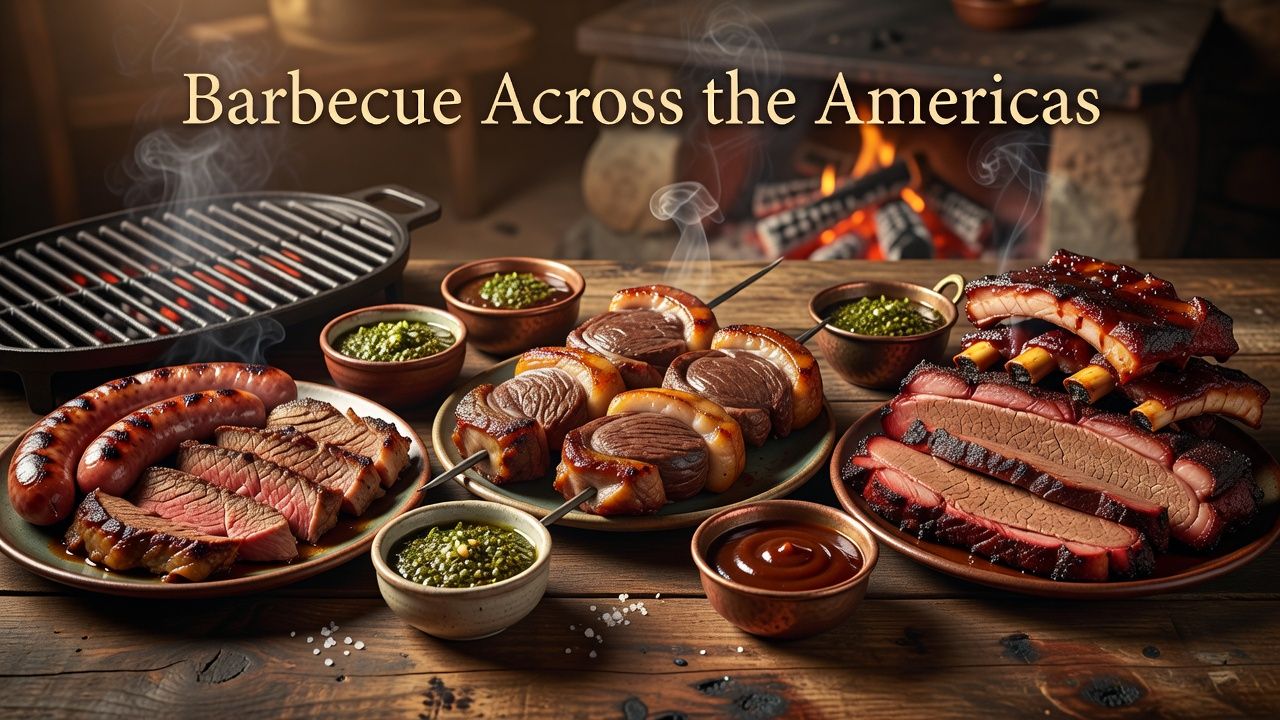
Food & Regional Cuisine · Smoke & Fire
From Texas brisket to a Patagonian lamb splayed on an iron cross, the Americas run on slow meat and older rituals. A continent-spanning guide to who cooks what over which fire — and how to get yourself invited to the good ones.
Every culture in the Americas that takes barbecue seriously believes two things: that theirs is the one true fire, and that everyone else is doing something admirable but slightly wrong. The Texan eyes the Argentine’s salt-only beef with suspicion. The Argentine watches a Carolina pitmaster baste pork in vinegar and files it under “sauce crimes.” The Brazilian gaúcho considers both to be overthinking a skewer. They’re all right, which is to say: barbecue in the Americas is not one tradition but a family of them, and eating across the family is one of the continent’s great edible itineraries.
This is that itinerary: the four great US regional styles, Argentina’s asado, Brazil’s churrasco, and the essential outliers — Uruguay, Mexico’s barbacoa (a different technology entirely), Colombia’s llanera and Jamaica’s jerk. What each tradition actually is, what to order, and how to find the real thing rather than the version staged for visitors.
The United States: Four Fires, One Religion Know your regions before you argue
Texas is about beef and patience. Central Texas brisket — salt-and-pepper rub, post-oak smoke, twelve-plus hours — is the style that turned barbecue into a pilgrimage, with the famous Austin-area institutions drawing lines before they open. The test of a Texas joint is the brisket, sliced, on butcher paper, no sauce needed or particularly wanted. The state’s other pillar is beef rib, a Fred Flintstone cut that costs accordingly and is worth it once.
Kansas City is about variety and sauce. The style that puts everything in the pit — ribs, pork, chicken, sausage — and finishes with a thick, sweet tomato-and-molasses sauce. Its signature invention is burnt ends: the re-smoked brisket point, cubed into caramelised nuggets that are, objectively, one of America’s great dishes.
The Carolinas are about whole hog and vinegar. The oldest tradition: whole pig, chopped or pulled, dressed in eastern North Carolina with a thin vinegar-and-pepper sauce, or in the Midlands of South Carolina with a mustard-based “Carolina gold.” This is barbecue as community event — the pig pickin’ — and the vinegar cuts the fat in a way that converts sceptics in one bite.
Memphis is about ribs and “dry” rub. Ribs served dry (spice-crusted, no sauce) or wet, with pulled-pork sandwiches and the civic pride of the World Championship contest every May.
The traveller’s note: the best of American barbecue is inconvenient. The famous places sell out by early afternoon, the great ones are often in unglamorous buildings, and the line is part of the product. Arrive before eleven, order brisket in Texas and whole hog in the Carolinas without deviation, and never ask a Texan where the sauce is.
Argentina: Asado as Social Institution The meal that is a day
Asado is not Argentine barbecue. Asado is Argentina, expressed through fire. The ritual matters as much as the meat: the asador builds the fire from wood or quebracho charcoal well before anyone is hungry; the meat goes on a parrilla (grill) or, for whole lamb in Patagonia, splayed on an iron cross (asado al palo) leaning toward the coals; and the afternoon unfolds in a strict, unhurried sequence — chorizo and morcilla (blood sausage) first, then achuras (offal: chinchulines, mollejas/sweetbreads for those who know), then the main cuts, then, hours later, the salad course nobody touches and the wine that everyone does. It is a four-hour minimum social technology, and Sunday lunch is its sacred slot.
What to order in a parrilla restaurant: bife de chorizo (sirloin — the workhorse), ojo de bife (ribeye), vacio (flank — the asador’s own favourite, crispy outside), asado de tira (short rib cut across the bone), provoleta (grilled provolone) to start, and chimichurri and salsa criolla as the only sauces permitted by custom. Beef is ordered by the cut, not the weight; a single cut feeds two when the achuras have done their work. The great parrillas range from Buenos Aires institutions to truck-stop grills on Ruta 40 where the bife is better than the capital’s and the room is full of gauchos. For building an asado route into an Argentina trip, argentina.travel is a useful planning base.
Brazil: Churrasco and the Gaúcho Nation Skewers, salt, and the green card
Churrasco is the gaúcho tradition of the southern pampas — meat on long skewers, roasted vertically around open flame, seasoned with coarse salt and nothing else — industrialised into one of the world’s great restaurant formats: the rodízio. You know the mechanics if you’ve been to a Brazilian steakhouse abroad: a small card, green side up, and passadores circulating with swords of meat, carving tableside until you surrender. What travel adds is calibration. In Brazil itself, seek the picanha — the top sirloin cap with its fat layer intact, the national cut, carved in crescents — and understand the hierarchy: a serious churrascaria’s picanha, costela (beef rib cooked for hours until it collapses) and fraldinha (flank) are the point; the fifty-item salad bar is a trap for amateurs with limited capacity.
For the deeper version, go south: Rio Grande do Sul is churrasco’s homeland, where the fire culture is identity rather than cuisine, and the churrasco of the countryside — whole ribs around a ground fire, mate tea passed hand to hand — is the asado’s Brazilian cousin with the accent changed.
The Essential Outliers Four more fires worth the trip
Uruguay quietly claims the world’s highest beef consumption and takes asado as seriously as its larger neighbour — Montevideo’s Mercado del Puerto, a nineteenth-century market hall full of wood-fire parrillas, is one of South America’s great meat rooms, loud with smoke and locals at lunch.
Mexico’s barbacoa is a different technology and must not be confused with grilling: lamb or goat (or beef head, or in the north, cabrito) wrapped in maguey leaves and slow-cooked in an earth pit overnight — pre-Hispanic barbecue, the ancestor of everything else in this article. Sunday-morning barbacoa in Hidalgo or the Estado de México, eaten as consommé then tacos, is a pilgrimage meal. And Jamaican jerk — pork or chicken marinated in allspice and Scotch bonnet, smoked over pimento wood — is the Caribbean’s fire tradition, best eaten at Boston Bay in Portland parish, where it was born.
Colombia’s llanera rounds out the map: in the eastern plains, mamona (veal) is butterflied on stakes around open fire, llanero-style, with the same cross-and-coals geometry as Patagonian lamb — evidence that the continent’s cowboys solved the same problem the same way, a hemisphere apart.
“Barbecue across the Americas is one technology — slow meat, live fire — wearing six national costumes. The invitation, not the recipe, is the real tradition.”
Reading the Fire A quick comparative grammar
| Tradition | Fuel & method | The canonical order | Where to eat it |
|---|---|---|---|
| Texas (US) | Post oak, offset pit, 12+ hrs | Brisket, beef rib; sauce optional | Austin & Central Texas joints, before sellout |
| Carolinas (US) | Whole hog, hardwood coals | Chopped pork, vinegar or mustard sauce | Whole-hog houses, eastern NC & SC Midlands |
| Kansas City (US) | Mixed pit, thick sauce | Burnt ends, ribs | The historic joints around 18th & Vine |
| Asado (AR/UY) | Quebracho/wood embers, parrilla or al palo | Chorizo, achuras, then vacío or bife; chimichurri | Neighbourhood parrillas; Mercado del Puerto, Montevideo |
| Churrasco (BR) | Skewers around open flame | Picanha, costela, fraldinha | Rodízios; Rio Grande do Sul for the homeland version |
| Barbacoa (MX) | Maguey-wrapped, earth pit, overnight | Consommé, then lamb tacos | Hidalgo & Estado de México, Sunday morning |
| Jerk (JM) | Pimento wood smoke | Jerk pork, festival bread | Boston Bay, Portland |
Getting to the Real Thing Traveller’s tactics
Follow the smoke, then the locals’ cars. In every country on this list, the best fire is identified the same way: wood smoke (not gas), a queue or a full lot of local vehicles, and a room with no interest in impressing you. The Argentine truck-stop parrilla, the Texas joint in a former gas station, the roadside jerk drum — the aesthetic is the credential.
Respect the schedule. Barbecue runs on fire time: Texas sells out by two, barbacoa is Sunday morning, asado is a weekend lunch that ends at dusk, and the Mercado del Puerto is a lunch institution. Show up at the wrong hour and you’ll eat the reheated evidence of what you missed.
Say yes to the invitation. The single best barbecue experience available to a traveller is the private one — the family asado, the rancho churrasco, the pitmaster’s day off. These cuisines are social contracts as much as cooking methods, and they are extended to visitors with surprising frequency to anyone who shows genuine interest and brings wine, beer or dessert as asked. Estancia stays in Argentina and Uruguay, and ranch visits in Texas and Rio Grande do Sul, are the bookable version of that door.
Learn five words per country. “Punto” and “jugoso” for doneness in the south; “fatty or lean” in Texas (the answer is fatty, or “moist”); “con todo” at the barbacoa stand; “picanha, por favor” in Brazil. Fire people respond to fluency.
Doing It Yourself The traveller’s backyard options
One of the quiet pleasures of travelling this continent is how accessible the fire itself is. Argentine rental apartments and estancias come with parrillas as standard equipment, and the local butcher will sell you vacío and chorizo with cooking advice thrown in — building your own asado, even a clumsy one, is a rite of passage the culture actively encourages. Brazilian supermarkets sell picanha at prices that make visitors gasp, and any rented house with a churrasqueira (they’re everywhere in the south) turns into a rodízio of one. In the US, the barbecue pilgrimage inverts: you don’t cook, you queue — but the backyard version is reachable through the farmers’ markets and the astonishing regional grocery stores, and Texas will sell you post oak by the bag if you’re serious. The rules of self-catering fire are universal: wood or real charcoal, never gas for this; salt the meat more than feels prudent; the fire is ready when you can hold your hand above it for three seconds, not zero; and rest the meat — the ten minutes nobody waits are the ten minutes that matter.
Fire Etiquette The unwritten rules, written
Every barbecue culture has them, and breaking them marks you instantly. At an asado: never touch the grill — the asador’s authority is absolute and teasing is fine, adjusting is not; arrive when invited but expect meat an hour after you think; bring wine or dessert and accept the apron-wearing patriarch’s jokes with grace. In Texas: don’t ask for sauce first, don’t order brisket “well done” where anyone can hear you, and understand that the line is a social institution — hold places for friends, share tables, talk to strangers. At a rodízio: pace yourself through the early skewers (the chicken and sausage are the warm-up act for picanha), use the tongs to receive the slice, and learn that flipping your card to red is a strategic pause, not surrender. In Jamaica: eat jerk with your hands, expect the Scotch bonnet to win, and never call it “jerk sauce chicken” within earshot of the pit. And everywhere: the person tending the fire has been awake since before you were. Compliment the meat. Mean it.
The Verdict Nobody Will Accept
Which tradition is best is the argument that has powered a thousand cookouts, and this article declines to settle it. But a pattern is visible from the road: the US styles perfected the pit and the slice; the South Americans perfected the occasion. The traveller who queues for brisket in Lockhart on Friday, eats barbacoa in Hidalgo on Sunday, and spends a long afternoon two weeks later at a family asado outside Mendoza has had the full education — and will never again use the word “barbecue” to mean a gas grill and a hurry. That, in the end, is what the whole continent is trying to tell you: the fire is slow because the fire is the point.
The Sides, the Sauces, the Signals Reading the rest of the table
Barbecue cultures announce themselves in their accompaniments, and learning to read them tells you where you are before the meat arrives. In the United States the map is drawn in sauce: vinegar and pepper in eastern Carolina, mustard-based gold in the state’s south, thick sweet tomato in Kansas City, and in Texas a thin peppery mop or — the confident houses — nothing at all, the brisket carrying the argument alone. The sides are identity too: cheap white bread and pickles in Texas (the bread is a utensil), slaw on the sandwich in Carolina, burnt ends with beans in Kansas City.
Argentina sets a different table. Chimichurri — parsley, garlic, oil, vinegar — and the fresh tomato-onion salsa criolla sit in their bowls, but watch the regulars: the best beef gets salt and nothing else, and the sauces are for the chorizo and the bread. The opening courses are the tell of a serious parrilla: provoleta (grilled provolone, oregano, a little char), morcilla and chorizo before the costillas, a simple salad to keep the conscience quiet, and Malbec, because some pairings are law. Brazil’s churrascaria answers with farofa (toasted cassava flour, the essential texture), a sharp vinaigrette salsa, pão de alho off the skewer, and the little two-sided card — green means the skewers keep coming, red means surrender, and knowing when to flip it is the whole strategy.
The outliers signal the same way. Mexican barbacoa arrives with its consommé — the rich broth from the pit, the part first-timers skip and regulars order first — plus nopales, onion, cilantro and salsa borracha. Colombian asado means arepa, ají and a beer; Peruvian anticuchos come with their ocopa or huacatay sauces and a piece of corn on the skewer’s end like a signature. The universal rule across all of them: what the house serves first, and what it serves unasked, is what it’s proudest of. Eat in that order and you’ll rarely go wrong.
Restaurant scenes and specific institutions change constantly; the styles and orders described here are stable tradition, but verify opening days and sellout times locally. Prices vary widely by country and city. This article contains no affiliate links. All outbound links checked live in August 2026.
Leave a Reply