Food & Regional Cuisine · Eat Smart
The standard advice — never eat anything from a street cart — costs you the best meals of the trip and doesn’t even keep you safe. Here’s the system experienced travellers actually use, and what to do when it fails anyway.
Somewhere in Mexico City right now, a traveller is eating a sad hotel sandwich because a guidebook told them street food was Russian roulette. Two blocks away, another traveller is eating the best tacos of their life from a cart that has served the same office workers for thirty years. One of them is taking the bigger risk, and it isn’t the one at the cart.
The truth about street food safety in Latin America is more useful than the fear: travellers’ diarrhoea is real, common, usually self-limiting — and only loosely correlated with whether food came from a cart. Some of the riskiest meals in the region are served in mid-range restaurants with quiet dining rooms, and some of the safest come off griddles on the pavement. What actually predicts a bad outcome isn’t the venue. It’s a handful of observable facts about how the food is handled, and you can learn to read them in about the time it takes to finish an empanada.
The Physics of the Problem Why heat and turnover are everything
Foodborne illness in the region comes overwhelmingly from bacteria (and occasionally parasites or viruses) that multiply in food held at lukewarm temperatures or get transferred via contaminated water and hands. That single sentence generates the entire rule set:
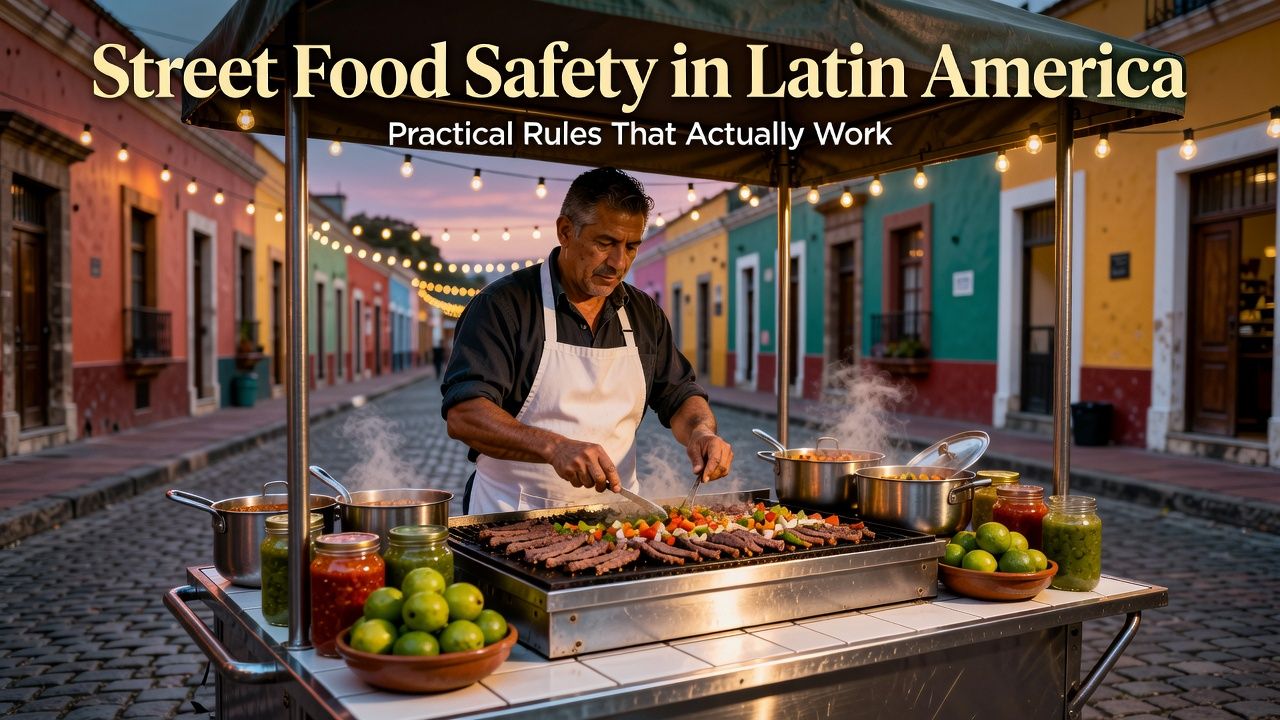
Cooked-to-order, served scalding, is nearly bulletproof. A taco whose meat hit the plancha sixty seconds before you ate it has no bacterial history to speak of. Heat kills; time at warm temperature breeds. The implication inverts the tourist instinct: the busy cart with a line of locals and a roaring griddle is safer than the empty restaurant where the chicken has been sitting in a tray since noon.
Turnover is the master signal. A stall feeding a constant stream of office workers is cycling ingredients too fast for anything to age. This is why the oldest rule — eat where the locals queue — survives every update of the science: it’s not about authenticity, it’s about inventory velocity. The WHO’s food safety guidance reduces to the same core: cook thoroughly, keep at safe temperatures, use safe water — a queue of locals is your visible proxy for all three.
Water is the stealth variable. Ice, unpeeled fruit, salads and juices are water delivery systems. The rule isn’t “never” — it’s “know the local water culture.” In Mexico City, Santiago or Lima’s better districts, ice is factory-made and fine; in a rural Guatemalan market, the juice cart’s water deserves a second thought. Peelable fruit (bananas, oranges, mangoes you peel yourself) is always safe; cut fruit sitting in a display is a judgment call about turnover again.
The Working Rule Set Ten rules, ranked by importance
1. Follow the queue. Busy stalls, local crowds, fast turnover. The single highest-value habit.
2. Watch it cook. If it goes from raw to your hand across visible high heat, the venue barely matters. Plancha, fryer, grill, soup at a rolling boil — all green lights.
3. Time your raw fish. Ceviche is lunch food across the region for a reason: the catch is morning-fresh and the day’s preparation sells out by mid-afternoon. A cevichería with a packed 1 p.m. local crowd is the gold standard; ceviche at 9 p.m. from an empty room is the classic mistake.
4. Read the hand dance. Watch a stall for two minutes before ordering. Does one person handle money and another handle food? Is there a water jug or soap in evidence? Are plates washed or wiped? Vendors who’ve solved the hygiene problem display the solution openly.
5. Respect the danger zone. Buffets, steam trays and pre-cooked pots held warm for hours are the region’s true risk zone — this includes some perfectly nice-looking restaurants. Lukewarm is the enemy; piping hot or properly cold are both fine.
6. Peel it, boil it, or watch it cook. The old saw “cook it, peel it or leave it” needs the update: street food you watch being cooked to order is in the safe column, which is most of what you actually want to eat.
7. Calibrate ice and drinks by place, not by dogma. Factory ice (tubular, with the hole) is safe in the cities that have it. Agua fresca from a busy jug in a big city is generally fine; the same drink in a remote village is a different calculation. Bottled and canned drinks are always safe; check seals.
8. Hands before mouth. The most common contamination vector isn’t the vendor’s hygiene — it’s yours. Hand sanitizer or a wash before eating street food matters more than any single choice of stall, because your hands have been on every rail and peso note in the country.
9. Acclimatise your gut gradually. Day one is not the day for the most adventurous cart in the market. Give your system 48 hours of the safer end — cooked, busy, simple — then expand. Much “food poisoning” on day two is a gut meeting new bacteria in volume, and ramping up genuinely reduces it.
10. Know your own risk. Pregnant travellers, the immunocompromised, and people on acid-reducing medication (which removes the stomach’s bacterial barrier) should run a stricter version of this list. Everyone else can run the standard one and eat gloriously.
“The busy cart with a roaring griddle is safer than the quiet restaurant where the chicken’s been sitting since noon. Turnover is the whole game.”
Regional Notes Same rules, different emphases
Mexico. The great street-food nation and the gentlest learning curve: tacos al pastor carved to order, quesadillas fried in front of you, elotes, tamales from steaming pots. Watch for the salsa bar (shared, room temperature — take small amounts from busy stands) and be modest with raw seafood tostadas outside coastal lunch hours.
Peru. Ceviche discipline as above; anticuchos from specialist carts are grilled to order and excellent; be more cautious with jungle-market juices and with cuy from anywhere that doesn’t specialise in it.
Central America. Pupusas in El Salvador are cooked-to-order by design — the perfect safe street food; market comedores everywhere run on turnover; tap water and ice deserve the conservative setting in rural areas, and this is the region where bottled water is the default habit.
Colombia, Ecuador, Bolivia. Arepas, empanadas and salchipapas from hot fryers are safe harbours; the altitude cities (Bogotá, Quito, La Paz) have generally reliable urban water but the markets’ cut fruit and juices still merit the turnover test.
Brazil and Argentina. Pastéis fried to order at feiras, choripán off the grill — straightforward. Brazil’s buffet-por-quilo restaurants are the exception to the buffet warning: high-turnover pay-by-weight places at lunch rush cycle food fast enough to work.
When the System Fails Because sometimes it will
Even disciplined travellers get caught — estimates suggest a substantial share of visitors to the region experience some travellers’ diarrhoea on a longer trip. The response protocol, which the CDC’s travellers’ health resources lay out in detail:
Hydrate, properly. The danger of TD is dehydration, not the bug. Oral rehydration salts (buy them at any farmacia on arrival, before you need them) mixed into safe water; sip constantly. This is the entire treatment for most cases.
Bismuth or loperamide for function. Bismuth subsalicylate settles mild cases; loperamide gets you through a bus ride (don’t use it with high fever or blood in the stool — that’s the red-flag combination).
Know the red flags. Fever above 39°C, blood or mucus in stool, symptoms beyond a few days, or signs of real dehydration (dizziness, very dark urine) mean a doctor, and in this region that’s easy: cities have good private clinics, and a consultation plus medication typically costs US$30–60 out of pocket. Many travellers carry a standby antibiotic (azithromycin is the common current choice) prescribed by their travel clinic for exactly the severe case — ask yours before departure.
Rebuild gently. A day of crackers, bananas, rice and weak tea, then back to the carts — with the queue rule still in force.
The Water Question, Properly Drinking, brushing, and the ice exception
Water anxiety generates more traveller confusion than any other single topic, so let’s be precise. The blanket rule — drink only sealed bottled water — is the right default in most of the region, with meaningful nuance. Several cities have treated tap water that locals drink (Santiago, much of Costa Rica, parts of urban Mexico and Brazil); your hotel can tell you the local answer, and when locals drink the tap, you generally can too after your first acclimatisation days. Brushing teeth with tap water is low-risk almost everywhere that has treated municipal supply — the quantities are tiny; it’s a reasonable default to use bottled in rural areas and not stress about it in the capitals. Ice deserves the correction it never gets: factory-produced ice (the cylindrical cubes with holes) is made from purified water and is standard in bars and restaurants across the region’s cities — refusing it is theatre. The ice to think twice about is block ice hand-chipped in rural settings, which is rare and recognisable. And a sustainability note that doubles as a safety upgrade: a purifying bottle (UV or filter-purifier types) eliminates the bottled-water question entirely, pays for itself in two weeks, and keeps a small mountain of plastic out of the countries you’re visiting. Long-term travellers nearly all end up carrying one.
Before You Leave Home The clinic visit that pays for itself
Four to six weeks before departure, book a travel-medicine consultation — not just for vaccinations (though hepatitis A and typhoid, both food-and-water-borne, are the classic street-food-adjacent shots, and this article’s whole subject argues for them), but for the kit. A good clinic will send you off with: a standby antibiotic prescription for severe travellers’ diarrhoea with written instructions on when to use it; oral rehydration salts; a bismuth or loperamide plan; and advice calibrated to your itinerary and medical history. Add a small first-aid kit, hand sanitizer for the pocket, and any personal medications in original packaging with copies of prescriptions (some common medications are controlled in various countries — check yours). The whole appointment costs less than one derailed week of a trip, and it converts the “what if” section of your brain from anxiety source to solved problem. Food adventures are more fun with a safety net — that’s not caution, it’s how you stay brave for a month instead of a week.
The Balance Sheet Why the risk is worth it
Run the arithmetic honestly. A cautious-but-not-fearful approach might cost you one rough day in a month of travel. The fearful approach costs you every taco al pastor carved off the trompo at midnight, every pupusa in a Suchitoto market, every tinto-and-empanada breakfast standing at a Bogotá counter — which is to say, the daily texture of the region and a disproportionate share of its best food. Street food is also where the money goes straight to the cook, where the conversation happens, and where a city tells you the truth about itself. The rules above aren’t a compromise between safety and experience. Applied properly, they deliver both.
The Stall Types, Ranked A field guide by cooking method
Once you understand that heat and turnover do the safety work, the stalls sort themselves into a rough league table. Tier one — cooked to order, in front of you, at high heat: tacos al pastor sliced off the trompo and finished on the plancha, anticuchos over coals, arepas on the griddle, tlayudas, choripán. The food goes from fire to hand in seconds; there is no safer format in street food anywhere on earth. Tier two — held at a boil: the soup and stew stalls, pozole, caldo de gallina, sopa de maní. Anything maintaining a rolling simmer is self-sterilising, and the grandmothers running these pots have queues for a reason.
Tier three — high-turnover fried or baked goods: salteñas in the mid-morning rush (the Bolivian rule of eating them before 11 a.m. is a freshness rule wearing a cultural costume), empanadas from a busy fryer, pão de queijo, churros done to order. The fryer’s heat is reliable; the turnover is what you verify with your eyes. Tier four — assembled-to-order cold: tortas, ceviche at a busy market stall with the fish on ice and the lime doing its work, fruit cups you watched being cut. Fine when busy, dicey when idle — an empty ceviche cart at dusk on a beach is the region’s most beautiful bad idea.
Tier five — the caution zone: anything pre-made and mayonnaise-based sitting ambient (the chicken-salad sandwich, the potato salad at the bus station), cold rice dishes, seafood cocktails from a quiet cart, and cut fruit pre-bagged hours ago. None of these is automatically dangerous; they’re simply where the odds concentrate, and the full-strength version of the rule applies: busy stall, local queue, food made in front of you. The two footnotes that don’t fit the tiers: whole fruit you peel yourself is always safe (the banana is nature’s sealed packaging), and the blended juice question resolves the same as everything else — busy juice stand, machine running constantly, fruit cut to order: yes. Quiet stand, pre-cut fruit sweating in the sun: admire it and walk on.
And a tactic that belongs at the top of any first-time traveller’s list: the guided street-food or market tour on day one. Every major food city in the region has them now — a local guide, three or four hours, a rolling classroom of stalls — and they function as calibration. You learn which markets are beloved, what a busy stall looks like in that particular city, which dishes are point-and-pray friendly, and you eat through it all under supervision while your judgement boots up. It costs roughly a nice dinner and returns the investment for the rest of the trip. After that, the rules above are yours, the markets are yours, and the best meals of your journey will come from carts whose names you never knew, eaten standing up, for the price of a coffee back home.
This article is general traveller guidance, not medical advice; consult a travel-medicine clinic before departure, especially if pregnant, immunocompromised or managing a chronic condition. Clinic costs cited are typical ranges as of 2026. This article contains no affiliate links. All outbound links checked live in August 2026.
Leave a Reply