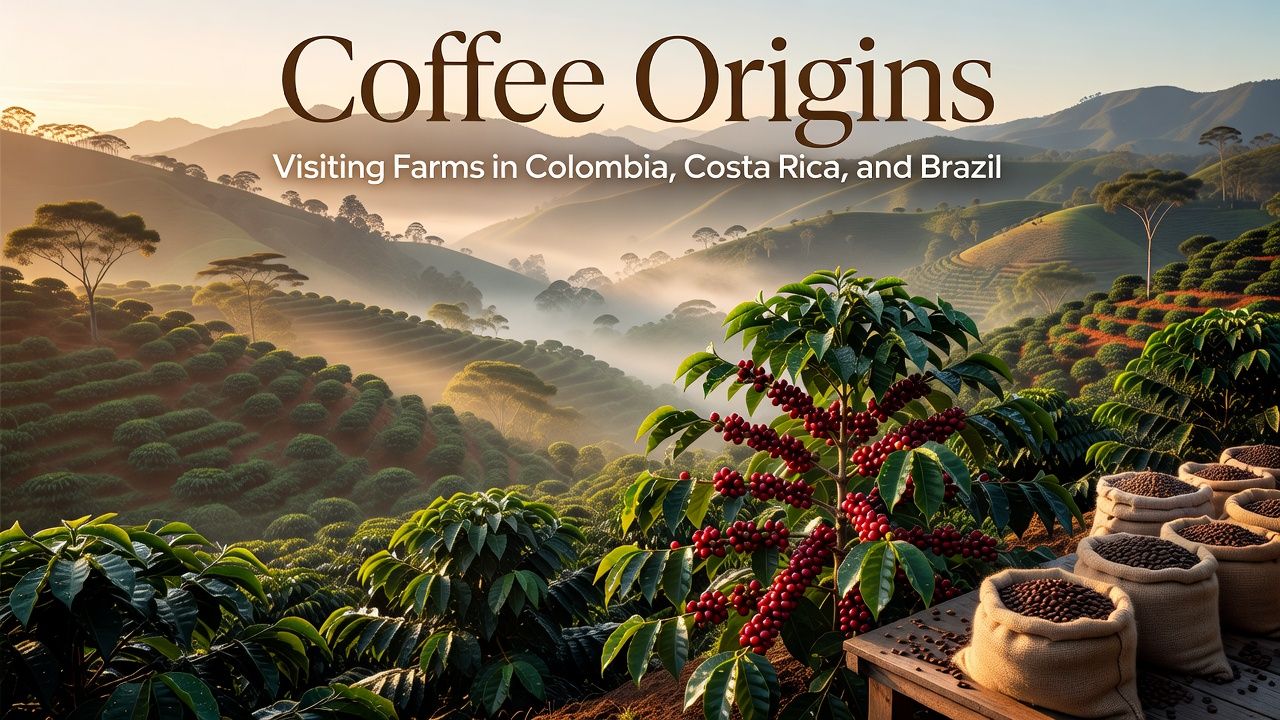
Food & Regional Cuisine · Coffee
The cup you had this morning travelled further than most people do in a year. Visiting the farms where coffee actually grows is the rare food pilgrimage that’s cheap, beautiful and easy to arrange — if you time the harvest and know what kind of visit you’re booking.
There is a small shock waiting at every good coffee farm, and it isn’t the tasting. It’s the picking. A guide hands you a basket, points you at a row of bushes, and twenty minutes later you’ve harvested enough ripe cherry for perhaps two cups of coffee — while the picker working the next row, who does this at professional speed all day, fills a basket in the time you filled a pocket. That arithmetic — the sheer manual labour inside a three-dollar latte — is what a farm visit actually teaches, and it changes how you buy coffee for the rest of your life.
The Americas grow most of the world’s arabica, and three countries offer the traveller three distinct versions of the origin visit: Colombia’s smallholder romance, Costa Rica’s polished eco-tourism machine, and Brazil’s industrial scale. Here’s how each works, when the harvest runs, what the tours include, and how to buy beans at the source without getting fleeced.
Colombia: The Smallholder’s Landscape The most beautiful classroom
Colombia is the pilgrim’s first choice for a reason: it’s a country of small farms — the average coffee holding is around two hectares, family-run, perched on slopes too steep for machines — set in scenery that UNESCO recognised in 2011 as the Coffee Cultural Landscape, a World Heritage listing of a working farmscape rather than a monument. The Eje Cafetero (Salento, Filandia, and the fincas around them) is the famous circuit: dozens of farms run tours, and many offer farm-stay nights where you eat with the family and walk the rows at dawn. (Our full guide to the region covers the bases, buses and Cocora Valley.)
A Colombian finca tour typically runs two to three hours: the nursery beds, the picking (you’ll try; you’ll be slow), the depulper, the fermentation and washing tanks, the drying beds or mechanical dryers, and a cupping at the end where you learn to taste the difference altitude and process make. The detail that stays with people: Colombia’s harvest peaks are roughly October–December and a secondary fly crop around April–June in much of the Eje — visit in a harvest window and the farm is alive with activity; visit off-season and you get the machinery without the motion. Beyond the Eje, the San Agustín and Huila region and the Sierra Nevada’s organic farms around Minca offer the same visits with a fraction of the tourist traffic.
Cost of entry: farm tours typically US$8–20; farm-stays with meals from roughly US$40–80. The value is absurdly good, and it goes mostly to the family — this is the model of food tourism done right.
Costa Rica: The Polished Version Coffee with infrastructure
Costa Rica invented coffee tourism as a product. An hour or two from San José, in the Central Valley’s volcanic foothills and the high country of Tarrazú — the country’s most famous growing region — estates run scheduled tours with bilingual guides, tasting labs, restaurants and gift shops. It’s less intimate than Colombia and considerably more organised: you can book online, arrive on a tour bus schedule, and get a genuinely excellent education in processing methods (Costa Rica is a pioneer of the honey process and of micro-mill experimentation) in two hours flat.
The harvest runs roughly November through March, and picking in the high country is a national event — schools once scheduled vacations around it. The best visits get you into the fields during the cosecha; the rest of the year, the mills and roasteries still make a strong half-day, easily combined with the Poás or Irazú volcanoes. Prices run higher than Colombia — tours commonly US$25–45 — but so does the polish, and Costa Rica’s broader trip infrastructure is the most frictionless in Central America; the official tourism site visitcostarica.com maintains current listings of farm tours by region. One legal curiosity that improves the cup: Costa Rica permits only arabica cultivation by law, a century-old quality rule that shows in the tasting lab.
Brazil: The Scale of the Thing The world’s engine room
Brazil produces roughly a third of the world’s coffee, and visiting it teaches the opposite lesson from Colombia: coffee as landscape-scale agriculture. In Minas Gerais — Sul de Minas around Carmo de Minas, the Cerrado Mineiro near Patrocínio — farms measure in hundreds of hectares, harvest rows with machines, and run their own dry mills, quality labs and export operations. The farm-tourism scene is younger and more scattered than Colombia’s or Costa Rica’s, but it exists and it’s fascinating: fazenda stays on historic coffee estates (some in the Paraíba Valley, with their nineteenth-century slave-era architecture presented increasingly honestly), harvest-season visits in May through August, and cupping sessions with the people who supply the world’s specialty roasters.
Brazil is also where you learn what “specialty” costs: the same Cerrado region selling commodity beans by the container hosts micro-lot auctions where small lots sell for prices that make the commodity price look like a rounding error — and seeing both ends of that market on one farm day explains your grocery shelf better than any article.
What a Farm Tour Actually Teaches The five-minute coffee education
Wherever you go, the same curriculum unfolds, and it’s worth knowing in advance so you can ask better questions:
Cherry to bean. Coffee is a fruit. The bean is the seed, and everything between — skin, mucilage, parchment — must come off. How it comes off is the whole game: washed process (fruit removed before drying; clean, bright cups), natural process (dried inside the fruit; fruity, wild), honey process (in between; Costa Rica’s specialty). When a guide offers you a taste of fresh mucilage, take it — it’s honey-sweet and explains everything.
Altitude is flavour. Higher, cooler farms ripen cherry slowly, denser beans, brighter acidity. This is why the prized origins — Tarrazú, Huila, the high Eje — sit between 1,200 and 2,000 metres, and why your farm visit involves so much uphill.
The economics. Ask what the farm gets per pound and what the export price is. The gap between them — and between both and your café price — is the coffee value chain made visible, and good guides walk you through it honestly. It’s the conversation that turns a tourist into a better buyer.
Cupping. The slurping, spoon-clinking tasting ritual at the tour’s end is professional technique, not pretension — slurping sprays coffee across the whole palate. You’ll feel silly for one sip and converted by the third.
“Twenty minutes of picking teaches you more about coffee than twenty years of drinking it. The basket stays empty; the lesson doesn’t.”
Timing Your Visit Harvest calendars by country
| Destination | Main harvest | Notes |
|---|---|---|
| Colombia (Eje Cafetero) | Oct–Dec; secondary Apr–Jun | Two crops in much of the region — easiest to catch |
| Colombia (Huila / south) | Roughly Mar–Jun & Oct–Dec | Varies by valley; less touristed |
| Costa Rica (Tarrazú, Central Valley) | Nov–Mar | Peak picking Dec–Feb; pairs with dry season |
| Brazil (Minas Gerais, Cerrado) | May–Aug | Mechanised harvest; dry, sunny winter |
Buying Beans at the Source Do it right
Buy at the farm gate or the farm’s own roastery, roasted within the week, whole bean, valve bag. Prices at origin run well below export retail for the same beans, and your money lands directly with the producer — the most ethical coffee purchase available anywhere. Practical notes: check your home country’s agricultural import rules (roasted coffee for personal use is generally fine into the US, Canada and the EU; declare it), keep beans in carry-on in their sealed bags to spare your luggage the aroma transfer, and buy less than you think — roasted coffee peaks within weeks, and the farm will ship you more or point you to their importer. The point of origin buying isn’t a year’s supply; it’s a month of mornings that taste like the trip.
Reading the Labels What certifications actually mean at the farm gate
Farm visits make you a label-literate buyer, and a little vocabulary prevents paying boutique prices for commodity coffee. Single origin means one country; the good stuff specifies a region or a single farm (finca, fazenda, estate) — the narrower the origin, the more you’re tasting a place. Altitude appears as SHG/SHB (strictly high grown / hard bean) in Central America — a genuine quality marker tied to slower ripening. Process (washed, natural, honey) tells you more about flavour than any roast date prose. Certifications deserve honest treatment: Fairtrade guarantees a price floor to cooperatives; Rainforest Alliance certifies environmental and labour standards at scale; organic signals no synthetic inputs — all meaningful, all imperfect, and all less direct than the relationship coffee you’ll encounter at the farms themselves, where a roaster (or you) buys from a named producer at a negotiated price. The farm tour collapses the abstraction: after you’ve walked a two-hectare Colombian finca, the question “who grew this?” stops being rhetorical, and you start paying the extra two dollars for the bag that answers it.
The Bonus Origins Mexico and Hawaii
Two more origins round out a coffee-traveller’s map of the Americas. Mexico grows excellent coffee in Chiapas, Veracruz and Oaxaca, much of it by Indigenous smallholder cooperatives — the farm-visit scene is less formal than Colombia’s but the co-op tours around Pluma Hidalgo and the Chiapas highlands are among the most socially interesting coffee visits anywhere, pairing naturally with a Oaxaca food itinerary. And Hawaii — Kona, on the Big Island’s volcanic slopes — offers the only US-grown coffee, with polished farm tours and tastings an hour from Kailua-Kona. The catch is arithmetic: Kona’s labour costs produce premium prices, and “Kona blend” on a mainland shelf can legally contain as little as ten percent Kona beans — a labelling lesson the farm tours explain with some feeling. Buy 100% Kona at the farm or not at all. Both bonus origins prove the article’s point from two directions: coffee travel scales from a US$12 Chiapas co-op visit to a Hawaiian estate tasting, and the education — the picking, the processing, the people — is the same at every price.
Choosing Your Origin Trip A matchmaking guide
Choose Colombia for the deepest experience: smallholder farms, stunning landscape, farm-stay nights, gentle prices, and a region built for independent travellers. Choose Costa Rica for ease: short hops from San José, flawless bilingual tours, and effortless combination with beaches and volcanoes on a one-week trip. Choose Brazil for scale and sophistication: historic fazendas, industrial-meets-artisan production, and a coffee scene (São Paulo’s and Belo Horizonte’s cafés) that will recalibrate your expectations of Brazilian coffee at home.
Whichever you choose, the same thing happens on the flight home: the airline coffee arrives, you taste it, and you understand in one sip exactly what the picker on the next row was trying to tell you. Some souvenirs are edible. The best one is a standard.
The Harvest Calendar Timing a trip to the picking season
A coffee farm visit during harvest and one between harvests are different experiences, and the difference is worth planning around. Colombia picks its main crop roughly October through January with a mid-year fly crop around April to June — the equatorial privilege of two harvests, and the reason the country almost always has activity somewhere. Costa Rica runs November to February; Guatemala roughly November to March, later at higher altitude. Peru harvests April through September on the eastern Andean slopes, and Brazil May through September — the dry, mechanised giant, where harvest means machines in the flat Cerrado and hand-picking only in the hills. Mexico’s crop comes in from December to March, and Hawaii’s Kona belt picks August into January.
What harvest timing buys you: pickers in the rows you can join for an hour (harder than it looks; the good ones fill a basket while you’re choosing your first cherries), the wet mill running — the fruity smell of fermenting mucilage is the scent of origin — drying patios covered in parchment coffee, and cupping tables loaded with the freshest lots. Between harvests you still get the walk, the process tour and the tasting, and flowering season — a few fragrant weeks after the rains, when the hills go white — is the connoisseur’s alternative. Either way, call or message ahead: these are working farms, and the difference between a real visit and a disappointment is one WhatsApp message the day before.
Brewing the Souvenir What to bring home and how not to waste it
The coffee you buy at origin is, by a wide margin, the freshest you will ever own — and also the easiest to ruin. Buy whole bean, roasted, in a valve bag, from the farm or its roaster; skip the decorative ground coffee in gift shops, which was stale before it was sealed. Customs is rarely a problem: roasted coffee travels legally into the US, Canada and the EU in reasonable personal quantities (keep it sealed and declared if asked), while green, unroasted beans are the ones that attract agricultural inspection — leave those to the importers. How much to carry is a personal equation, but two kilos fits a carry-on, survives the trip, and lasts a disciplined drinker about two months.
At home, the farm’s lesson continues: coffee is produce, not pantry goods. Rest the beans a few days after roasting (they’re degassing; the farm will tell you the roast date), keep them sealed, cool and unground, and grind only what you’re brewing. The brewing method matters less than the ratios and the water — a digital scale and water just off the boil will improve any device you own, and a simple pour-over or an AeroPress will show you more of what you tasted at the finca than an expensive machine used carelessly. The real souvenir, though, isn’t the bag. It’s that every cup you brew afterwards has a valley attached to it, and you’ll find you can taste the altitude. That’s not sentiment. That’s just what the farm does to you.
Harvest windows vary with altitude and weather; confirm timing with your specific farm before building an itinerary around it. Tour prices reflect 2025–2026 ranges. Import rules for roasted coffee are generally permissive for personal quantities but check your home country’s current regulations. This article contains no affiliate links. All outbound links checked live in August 2026.
Leave a Reply