History & Indigenous Cultures · Cities
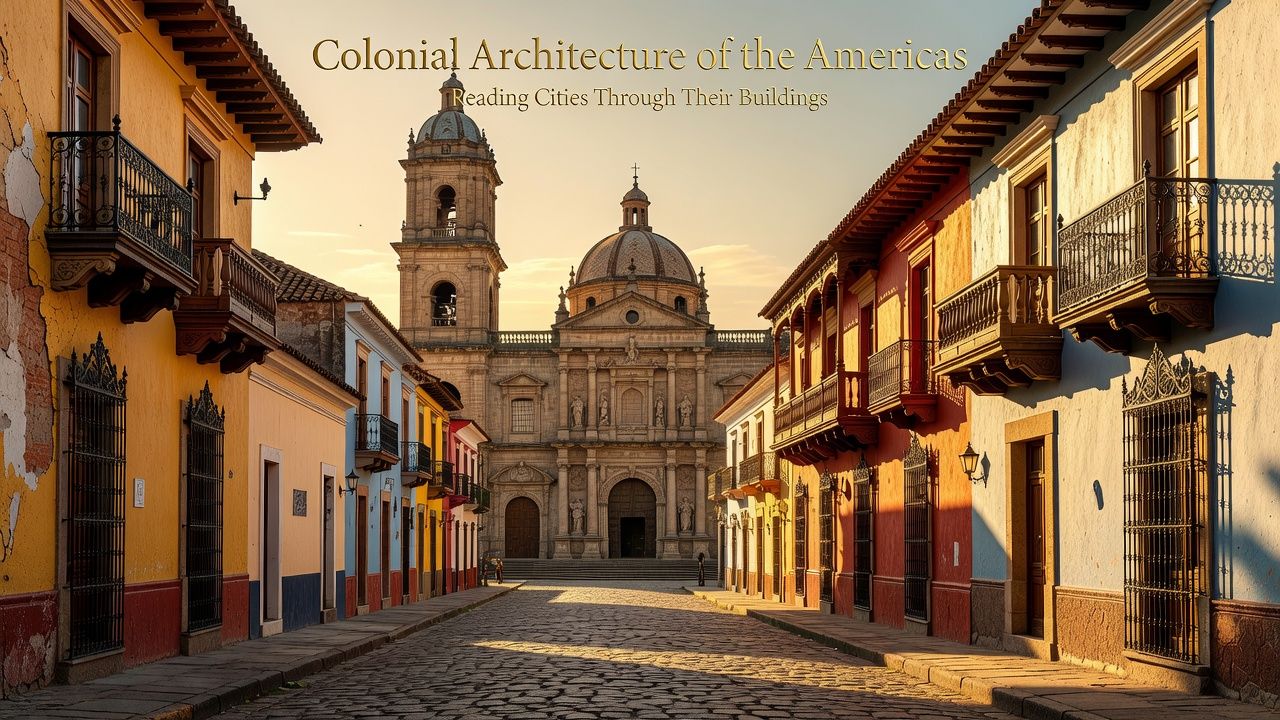
Three centuries of empire are written into the streets of Cartagena, Quito, Havana, Salvador and a dozen other cities — in gold leaf and slave-built stone, in balconies and fortifications. Learn a handful of visual grammar rules and every plaza becomes a document.
Every colonial city in the Americas tells the same joke on its visitors: you arrive for the pretty balconies and end up reading three hundred years of conquest, silver, faith and rebellion off the walls. These cities are not open-air museums of a decorative style. They’re primary sources — the physical record of the largest empire project the hemisphere has seen — and they reward a traveller who knows how to look at them far beyond the postcard value.
This article teaches the looking. First the grammar: the recurring elements you’ll find from Santo Domingo to Potosí. Then the cities themselves, ranked by what each one teaches best. Along the way, the honest complication — that this beauty was built by enslaved and coerced labour, and that the best of these cities no longer hide the fact.
The Grammar Six things to look for anywhere
The grid and the plaza. Spain’s Laws of the Indies prescribed the colonial city like a recipe: a grid of streets centred on a plaza mayor, with the church on one side, the government (cabildo) on another, the wealthy in arcaded houses around it. Find the main square and you’ve found the city’s founding document. The further from the plaza, the humbler the address — the grid was a map of the social order, and it still is.
The church as mountain. Colonial churches weren’t just placed in cities; they dominated them — and, provocatively, they were often built directly on or from Indigenous sacred sites. The cathedral of Cusco rises over an Inca palace; Cholula’s church crowns the largest pyramid base on Earth. When a church seems strangely elevated or strangely massive, ask what it’s standing on. The answer is usually a statement.
Baroque as arms race. The Spanish Americas produced a baroque more extravagant than Europe’s — and then went further, into the churrigueresque, where facades dissolve into carved ecstasy. Mexico City’s Metropolitan Tabernacle, Zacatecas’s cathedral, and above all the gold-drowned interior of Quito’s La Compañía show what happened when American silver met Counter-Reformation fervour. If a church interior makes you blink, that’s baroque doing its job: overwhelming the senses as theology.
The portal and the balcony. Civil architecture’s telltales: massive carved doorways (the family’s coat of arms above = old money), interior courtyards behind blank street walls, and the wooden balcony — the Americas’ own contribution, from Lima’s boxed Moorish-style miradores to Cartagena’s flower-draped overhangs. The courtyard house was climate engineering and social theatre at once; peek through open doors, it’s expected.
Fortifications as a map of fear. Where the empire’s wealth concentrated, walls followed. Cartagena spent two centuries building the hemisphere’s most complete fortifications; Havana, San Juan and Campeche walled themselves against pirates and rival empires. Walk the walls and you’re reading a map of what the silver fleet feared.
The nineteenth-century layer. After independence, the new republics re-dressed their colonial cores in neoclassical and French academic styles — domes, opera houses, presidential palaces. Cities like Buenos Aires, Santiago and Rio are conversations between the two layers, and learning to date a facade by eye (baroque curve versus neoclassical column) turns any walk into a timeline.
The Cities What each one teaches best
Cartagena, Colombia — the complete package
The UNESCO-listed port where the silver fleet gathered is the Americas’ most intact fortified colonial city: eleven kilometres of walls, the vast San Felipe fortress with its infiltration-proof tunnel system, and a walled centre of mansions-turned-boutique-hotels that has become the continent’s most fashionable old town. It teaches the military and mercantile city perfectly — and its Getsemaní quarter, outside the aristocratic walls, tells the working city’s story in murals and drum squares. Come for the architecture, stay past the day-trippers, and read the Palenquera fruit-sellers’ history: San Basilio de Palenque, founded by escaped enslaved Africans, is an hour away and UNESCO-recognised in its own right.
Quito, Ecuador — the baroque summit
The first city ever inscribed on the World Heritage list (with Kraków, in 1978), Quito keeps the best-preserved colonial centre in South America at 2,850 metres, strung along its valley like a litany. San Francisco’s vast complex, the gold interior of La Compañía — seven years of gilding, the most ornate church interior in the Americas — and the Virgin-topped Panecillo hill above it all. Quito teaches the religious city: the Andean baroque where Indigenous carvers snuck their own iconography — local fruits, sun symbols, faces — into the approved program.
Old Havana, Cuba — the living ruin
Habana Vieja is the most beautiful decaying city in the hemisphere: five hundred years of plazas (Vieja, de Armas, de San Francisco, de la Catedral — each a different century’s answer), baroque cathedral towers, and a restoration program that has been rescuing the old town square by square for decades while ordinary life continues inside it. Havana teaches what the others can’t: a colonial city as a functioning, struggling, musical present tense. The contrast between restored and unrestored blocks is itself the lesson.
Salvador da Bahia and Ouro Preto, Brazil — the Portuguese counterpoint
Brazil’s colonial architecture runs on a different empire’s logic. Salvador’s Pelourinho — pastel palaces on steep cobbles, the gold of São Francisco church, the first capital of Brazil — is also the Afro-Brazilian capital of the Americas, and the candomblé houses and acarajé stands are as much the heritage as the facades; the district’s very name (pelourinho, the whipping post) insists on the whole truth. Three hundred kilometres inland, Ouro Preto spills down its ravines in white and ochre: the masterpiece of Brazilian baroque, where the sculptor Aleijadinho — working with a degenerative disease that cost him his fingers — carved the prophets of Congonhas and the soapstone glory of São Francisco de Assis. Together they teach the Portuguese Americas: gold, faith, and African genius made visible.
Potosí, Bolivia — the price of it all
At 4,090 metres, Potosí was once among the largest and richest cities on Earth, its Cerro Rico silver funding the Spanish empire. Its churches and its Casa de la Moneda (the royal mint, now the essential museum) are magnificent; its mountain, honeycombed with mines that still kill the men who work them, is the counter-inscription. Potosí is where the colonial city’s beauty invoice is presented. No other stop on this circuit tells the whole story so completely — the splendour and the extraction in one skyline.
The supporting cast
Antigua Guatemala, earthquake-ruined and exquisite, teaches the city as palimpsest — baroque ruins stabilised beside functioning streets, with volcanoes for a skyline. Santo Domingo holds the firsts: the Americas’ first cathedral, first university, first street — the colonial city as prototype, dated to 1498. Lima’s centre, with its boxed wooden balconies and the vast San Francisco monastery and its catacombs, teaches the viceregal capital at full scale. And Cusco, Quito’s Andean sibling, teaches the collision itself: Inca walls as foundations, churches on temples, two civilisations visible in a single street.
How to Visit Like a Reader Field habits
Walk at two speeds. Do the slow loop — plaza, cathedral, market, one museum — then do the aimless one. Colonial centres are built at walking scale and reveal themselves at the edges: the convent wall, the half-glimpsed patio, the barrio where the grid frays.
Go up. Every one of these cities has a bell tower, hill or fortress with a view, and the colonial logic — church highest, plaza central, walls at the edge — only fully reads from above.
Go in. Courtyards, monastery cloisters and mint museums are where these cities keep their best material, and admission is almost always a few dollars. The Casa de la Moneda in Potosí and San Francisco’s library in Lima repay hours.
Hire the walking guides. Free (tip-based) walking tours operate in nearly every city on this list and the good guides are excellent — ask the hard questions (slavery, Indigenous displacement) and the good ones answer them honestly; that’s how you know you’ve got one.
Mind the present tense. These are living cities with real neighbourhoods, real inequality, and ordinary big-city cautions — watch phones in crowds, take registered transport at night, and don’t let the ochre wash convince you time stopped. It didn’t, which is precisely what makes them worth reading.
“The colonial city is the hemisphere’s primary source. The balcony is pretty; the question is who paid for the silver that built it — and the best cities now answer on the plaque.”
More Cities for the List The second circuit
The travellers who catch the bug ask the same question: where next? A second circuit, briefly annotated. Guanajuato and Zacatecas (Mexico) — the silver cities, where baroque reached its Mexican height on mining wealth; Zacatecas’s cathedral facade is the connoisseur’s favourite in the hemisphere. Valparaíso (Chile) — the port boomtown of the nineteenth century, ascensores climbing hills of corrugated-iron mansions in improbable colours; colonial only in its bones, but the finest expression of the Pacific republican layer. San Juan (Puerto Rico) — the blue cobblestones and the two great fortresses, El Morro and San Cristóbal, the Atlantic counterpart to Cartagena’s walls. Campeche (Mexico) — pastel, walled, pirate-scarred, and serene. Sucre (Bolivia) — the white city, constitutional capital, and the best-preserved republican-era cityscape in the Andes, with Potosí’s gravity two hours away. And Paraty (Brazil) — the Gold Route’s port, cobbled streets flooding beautifully at high tide by colonial engineering design, car-free and candlelit at night. Each rewards the same reading method: find the plaza, climb something, enter the cloisters, and ask who paid.
Photographing These Cities A brief technical aside
Colonial centres photograph best at two times: the first hour after sunrise, when the light rakes across facades and the streets belong to bread deliveries and schoolchildren, and the blue hour after sunset, when the floodlit churches glow against the last of the sky. Midday flattens everything the baroque worked to animate. Look for the details the wide shots miss — door knockers, tile work, the worn step at a cloister entrance — and remember the one rule that matters more than light: people live here. The laundry on the famous balcony belongs to someone. Photograph the street; ask the person.
The Honest Complication Beauty with an invoice
It would be comfortable to enjoy these cities as pure aesthetics, and wrong. The gold leaf in Quito came out of Indigenous labour drafts; the walls of Cartagena and the facades of Pelourinho were raised substantially by enslaved Africans; the silver of Potosí was priced in lives on a scale that staggers the arithmetic. The encouraging development of the past two decades is that the cities increasingly say so: slavery museums in Cartagena and Liverpool-of-the-Americas trade histories in Havana, Afro-Brazilian heritage at the centre of Salvador’s identity, mine tours in Potosí run by former miners who do not romanticise. Seek those layers out deliberately. A colonial city read honestly — architecture and invoice together — is not a diminished experience. It’s the only version that makes sense of the view.
Ten Minutes Inside a Colonial Church A field method for the main event
Every old city in this article eventually funnels you into a church, and ten structured minutes will tell you more than an hour of wandering. Start outside, across the street: the facade is a retablo turned inside out — read it bottom to top, because that’s how it was designed to lift the eye, and note where the carving runs wild (usually around the door, the frame of the faith) and where it stays bare. At the threshold, look down: the floor is a graveyard of bishops and benefactors, and the worn stones at the entrance mark three centuries of arrivals.
Inside, give your eyes a full minute before reading anything — the architects planned that first breath, and the dimmer the nave the more deliberate the gilding. Then the grammar. The plan is usually a Latin cross; find the transept where the arms meet, because the dome above that crossing is where the money and the engineering peaked together. The side chapels tell the social history: each was funded by a guild or a family, and their competitive gilding is a ledger of who had silver when. Look for the sacristy if it’s open — frequently the finest room in the building, and the one the tourists skip.
Now the detective work. Twisted Solomonic columns or the inverted-pyramid estípite pilasters mean high Mexican baroque and its descendants; a carved sun or moon tucked among the saints, or tropical fruit where Corinthian leaves should be, means indigenous hands on the chisel — the mestizo signature this article keeps returning to, visible once you know to look. Coffered wooden ceilings with interlaced geometric patterns are Mudéjar memory, strongest in Quito and Puebla. And the paintings: many churches hang their original Cuzco-school canvases in plain sight, unlabelled, better than half the museums in the country. Finish at the choir loft if you can reach it — the organ, the carved stalls, and the view back down the nave, which is the one the builders cared about most. Ten minutes, done in this order, and the next church stops being “another church” and starts being a text you’ve learned to read.
Three field notes to finish. If the church has an adjoining convent, museum or tower, pay the small extra for it — the convents hold the cloisters and the kitchens and often the best-preserved domestic scale, and the bell towers deliver the roofscape view that reassembles the whole city in one glance. Remember these are working houses of worship: mass times are posted at the door, visiting politely pauses for them, and shoulders covered and flash off cost you nothing and buy goodwill everywhere. And on your last evening in any of these cities, do the plaza one more time at the hour the locals take it over — the paseo, when the light goes warm, the shoe-shine stands are busy, and the buildings do the thing they were built to do, which is to frame a public life four centuries older than the republic around them. The architecture was always the stage set. Stay for the play.
All World Heritage inscriptions referenced are current as listed by UNESCO. Museum hours and restoration programs change; verify locally. This article contains no affiliate links. All outbound links checked live in August 2026.
Leave a Reply