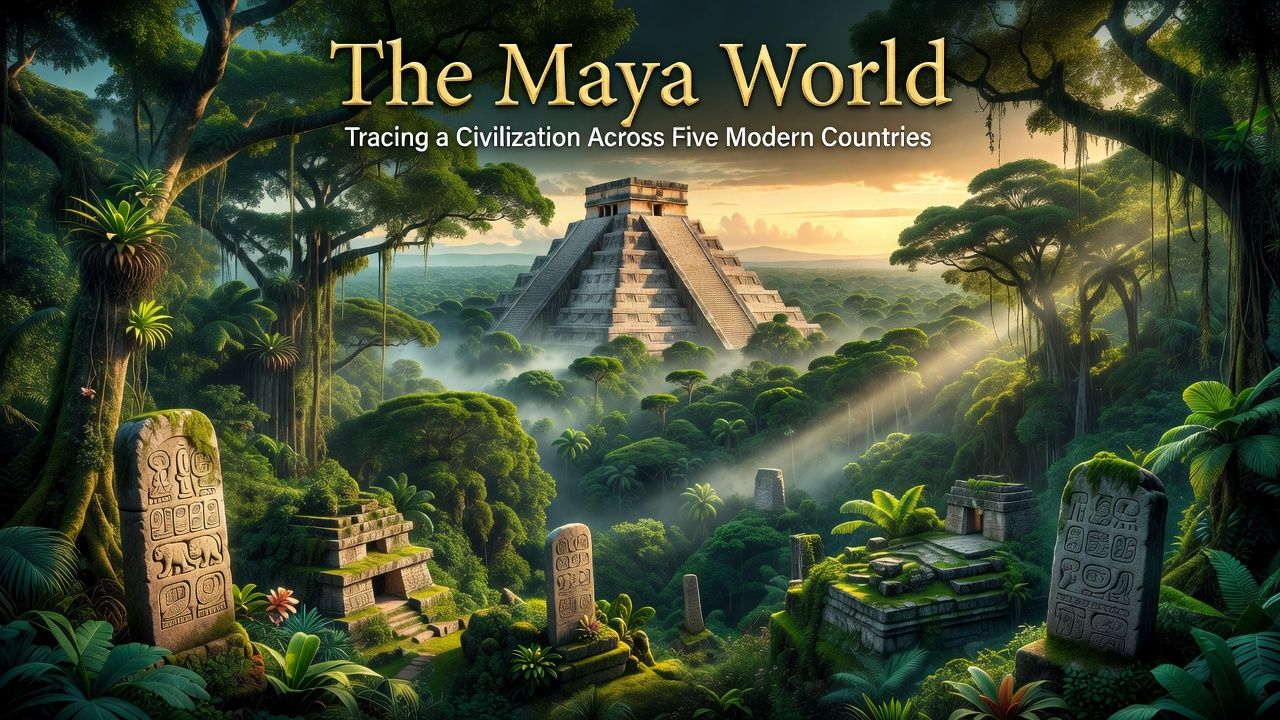
History & Indigenous Cultures · The Maya World
The Maya never had an empire, never vanished, and never stayed inside the borders drawn over their homeland. Following their cities through Mexico, Guatemala, Belize, Honduras and El Salvador is the finest historical journey in the Americas — and far easier than it looks.
Begin with two corrections, because everything worthwhile about the Maya follows from them. First: the Maya did not disappear. The “mysterious collapse” beloved of documentaries was the abandonment of certain southern lowland cities around 900 CE — while millions of Maya people, speaking thirty-odd living Mayan languages, continued being Maya then and continue now; something like seven million descendants live in the region today. Second: the Maya were never an empire. They were a civilisation of city-states — rivals, allies, trading partners, occasional conquerors of one another — which is exactly why their world rewards a multi-country journey. There is no single capital to tick off. There’s a constellation, and it spans five modern nations.
Tracing that constellation — from the tourist colossus of Chichén Itzá to jungle cities where howler monkeys outnumber visitors — is one of the great trips on Earth. Here’s how the pieces fit, in what order to see them, and what changes when you cross each border.
A Civilisation in One Paragraph The frame for everything you’ll see
Maya civilisation matured during the Classic period, roughly 250–900 CE, when city-states across the lowlands raised temple pyramids, carved dynastic histories into stone stelae, played a ballgame with cosmological stakes, and tracked Venus with observatory precision. They developed the Americas’ only true pre-Columbian writing system — now substantially deciphered, which transformed these sites from mute masonry into readable history. After the southern cities were abandoned (drought, warfare and political strain, in proportions still argued over), northern Yucatán cities rose; Chichén Itzá and later Mayapán dominated until the Spanish arrived in the sixteenth century. The last independent Maya city, Nojpetén in Guatemala, fell only in 1697 — 175 years after the Aztec capital. That’s the arc; every site below is a chapter of it.
Mexico: The Famous North Yucatán, Chiapas, and the art of dodging crowds
Chichén Itzá — a UNESCO site and one of the most visited ruins on Earth — earns its fame honestly: the Castillo pyramid is a calendar in stone, and the great ball court is the largest in Mesoamerica. It also absorbs several thousand visitors a day in season. The strategy is simple and absolute: stay in Valladolid or Pisté the night before, enter at the 8 a.m. opening, and be at the Castillo before the tour buses arrive from the coast around ten. Two hours of relative quiet, then leave as the masses arrive.
Palenque, in Chiapas, is the aesthete’s choice — a smaller, exquisite city half-wrapped in jungle, where Pakal the Great’s tomb (discovered inside the Temple of the Inscriptions in 1952) delivered the single richest royal burial in the Americas. The UNESCO-listed site is compact, the howler monkeys provide the soundtrack, and the on-site museum holds Pakal’s magnificent jade-adjacent funerary regalia. Pair it with the waterfall circuit at Agua Azul and Misol-Ha on the way through.
Calakmul is the adventurer’s flagship: a superpower city-state (Tikal’s great rival) buried in a biosphere reserve near the Guatemala border, sixty kilometres down a jungle road from the highway. From the top of Structure II — one of the largest Maya pyramids ever built — you look across unbroken forest into Guatemala, with other ruins visible as green swells. The site and its forest hold joint World Heritage status. Jaguars live here; you’re more likely to meet spider monkeys, ocellated turkeys, and almost no tourists. Base in Xpujil and go at dawn.
And don’t sleep on the second rank: Uxmal and the Puuc route (an hour from Mérida) offer the most refined facades in Maya architecture; Ek Balam has climbable pyramids and astonishing stucco; Cobá spreads through jungle between lakes. The Mexican Maya world alone justifies two weeks.
Guatemala: The Heartland Tikal, and everything beyond it
Tikal is the one that makes people gasp out loud. Five temple pyramids rise above the jungle canopy — Temple IV’s rooftop at dawn, mist moving through the treetops and the sun catching the crests, is one of travel’s canonical experiences, and it became a global image when it stood in for a rebel base in the first Star Wars film. The UNESCO-listed city was home to perhaps 60,000 people at its peak; the plazas, palaces and carved stelae spread over sixteen square kilometres of protected forest loud with toucans and monkeys. Base in Flores, the island town on Lake Petén Itzá, and take the earliest shuttle. Stay for the full day; most tours leave by two and the late afternoon belongs to you and the wildlife.
Beyond Tikal, Guatemala holds the connoisseur’s sites: Yaxhá, an hour away and a tenth as visited, with sunset views over its lake; El Mirador, the colossal pre-Classic city (its La Danta complex among the largest pyramids by volume ever built) reachable only by a two-day jungle trek or helicopter; and Quiriguá, whose stelae include the tallest carved monoliths in the Maya world. In the highlands, the living Maya culture — markets at Chichicastenango, the cofradías of the lake villages around Atitlán — is as essential as any ruin. This is the country where the past tense dissolves.
Belize, Honduras, El Salvador The underrated three
Belize packs remarkable sites into a small, English-speaking country. Caracol, deep in the Chiquibul forest, was a city-state that defeated Tikal in war; its Caana pyramid remains among the tallest structures in Belize. Xunantunich, reached by hand-cranked ferry, rewards a half-day with a climbable pyramid and border-country views. Lamanai, approached by riverboat through jungle, is the most atmospheric arrival in the Maya world. And Actun Tunichil Muknal — the ATM cave — is something else entirely: a swim-and-scramble into a ceremonial cave holding calcified sacrificial remains and intact ceramics, guided and regulated, and routinely called the most affecting archaeological experience in Central America. Book ahead; daily numbers are capped.
Honduras holds Copán, and Copán holds the crown for art. Where Tikal impresses with scale, Copán stuns with detail: the Hieroglyphic Stairway — the longest inscribed text in the pre-Columbian Americas — and stelae carved in the round with a sophistication specialists compare to classical sculpture. The UNESCO-listed site sits beside Copán Ruinas town, one of the most pleasant small towns in Central America, and scarlet macaws — sacred to the Maya, reintroduced here — fly the valley. Two days, minimum.
El Salvador’s gift is different: Joya de Cerén, the “Pompeii of the Americas,” where a volcanic eruption around 600 CE buried an ordinary farming village in ash, preserving homes, storehouses, a sauna and even food crops. No pyramids — just daily Maya life, frozen mid-meal. It’s the necessary counterweight to all that royal stone, and it’s an easy day trip from San Salvador or Santa Ana alongside the modest but pleasant Tazumal.
Reading the Stones How to actually see a Maya site
A short field method that will double what you get from every site. Start with the stelae: these carved standing stones are dated dynastic records — a king, his regalia, the events he wanted remembered. Find the ball court and imagine the game as theology: the ball as the sun, the court as the cosmos, the stakes occasionally mortal. Look for the corbel arch — the Maya never developed the true arch, and the stepped vault gives their rooms that characteristic narrow, tall solemnity. Note the orientation: many buildings align to solstices, equinoxes and Venus cycles; at Chichén Itzá’s equinoxes, light and shadow run a serpent down the Castillo’s stairway. And hire the site guides where they exist (Copán and Palenque especially): the decipherment of Maya glyphs means these sites now speak, and a good guide makes them speak to you.
“The Maya never vanished. Seven million of them are still here. The ruins aren’t a civilisation’s remains — they’re its archive.”
Stringing It Together Routes and realities
The classic grand loop (three to four weeks): fly into Cancún or Mérida; Chichén Itzá and the Puuc route; south through Campeche to Calakmul; into Guatemala via the Bethel or El Ceibo crossings for Tikal; down to Copán; and out via San Salvador (Joya de Cerén) or back through Belize (Caracol, Lamanai, ATM) to Chetumal. The region’s first-class buses (ADO in Mexico) and tourist shuttles (ubiquitous in Guatemala and Belize) connect every leg; borders on these routes are well-worn and straightforward.
Practical notes that matter: season — November to April is the dry season and the comfortable window; May is brutally hot in the lowlands; June–October brings rain, mud and thinner crowds. Cash — Guatemala, Honduras and El Salvador run cash economies at site level; ATMs cluster in the hub towns. Heat strategy — dawn entries aren’t just about crowds; by noon the lowland sites are furnaces, and the wildlife goes quiet. Safety — the tourist corridors described here are well travelled and generally calm, but conditions vary by country and region; check current advisories (for US travellers, travel.state.gov) before each border, and take local advice on the ground about specific routes.
| Site | Country | Why it matters | Crowd level |
|---|---|---|---|
| Chichén Itzá | Mexico | The famous calendar-pyramid; Postclassic power | Heavy — go at 8 a.m. |
| Palenque | Mexico | Pakal’s tomb; jungle elegance | Moderate |
| Calakmul | Mexico | Superpower ruins in a living rainforest | Light |
| Tikal | Guatemala | The great Classic capital; dawn over the canopy | Moderate-heavy |
| Caracol & Lamanai | Belize | Tikal’s conqueror; the riverboat arrival | Light |
| Copán | Honduras | The finest Maya art and the longest text | Light-moderate |
| Joya de Cerén | El Salvador | Everyday Maya life, preserved by ash | Light |
The Museums That Complete the Picture Where the best pieces actually live
A hard truth of Maya travel: the finest objects were often moved to museums decades ago, and an hour in the right gallery transforms what you see at the sites. In Mexico City, the National Museum of Anthropology is non-negotiable — the Maya halls alone justify the flight connection, with Pakal’s jade mask and the great stelae presented as art rather than inventory. Palenque’s site museum holds the red-queen finds and the carved sarcophagus lid replica in the context of its jungle city. Copán’s Museum of Maya Sculpture, at the site entrance, displays the original facades and the full-size reconstructed Rosalila temple — the jaw-dropping proof that these pyramids were once painted in screaming reds and greens, not the weathered grey we romanticise. Guatemala City’s archaeology museum and the excellent private collections fill in Tikal’s story. And Mérida’s Gran Museo del Mundo Maya does the best job anywhere of connecting the ancient cities to the living culture — the right final stop before flying home, because it sends you out understanding that the story has no ending, just a change of medium.
Deep Cuts for the Second Trip When the circuit hooks you
Almost everyone who does the grand loop starts planning the follow-up before it’s over. The second-trip list: El Mirador by mule and foot (two days each way through the Mirador basin — the great pre-Classic cities, seen the hard way and therefore properly); Bonampak, whose painted murals are the finest surviving Maya narrative art, deep in the Lacandón jungle and traditionally paired with riverside Yaxchilán, reached by boat; Río Bec’s fantastical false-temple towers near Calakmul; Toniná’s towering acropolis outside Ocosingo; and the highland ceremonial towns where Maximón is still fed cigarettes and rum by candlelight. The Maya world is deep enough to absorb a lifetime of trips — the five-country circuit is just the orientation course.
The Living Maya The most important section of this article
You will, at some point, buy textiles from a Maya weaver, eat in a Maya family’s comedor, or be guided through a cave by a Maya guide whose grandparents farmed beside it. Treat those encounters as the point, not the garnish. Learn that the highland markets (Chichicastenango on Thursday and Sunday; Sololá on quieter days) are working institutions, not performances. Ask before photographing people, always, and pay fairly when you buy. If your itinerary allows, a community-run experience — a homestay on Lake Atitlán, a weaving cooperative in the Chiapas highlands, a cacao workshop in Belize’s Toledo district — will teach you more about the Maya world than any single ruin. The stones are magnificent. But the civilisation that built them is a living culture, and visiting it like one is both the respectful and the far more interesting choice.
When to Go, and What to Carry The unglamorous logistics
The Maya world’s season is the dry season — roughly November to April — but the fine print matters. Petén’s jungle (Tikal, El Mirador country) is at its most walkable from February to April, before the May heat peaks and the June rains turn trails to soup. The Yucatán works year-round, with March–May the hottest and the cenotes earning their keep; the Caribbean side keeps a hurricane watch from August into October. Highland Guatemala and Chiapas flip the logic: cool, clear and busy around Christmas and Easter, mild and quiet in the green months, when the rain is mostly an afternoon appointment you can schedule around. Copán and the lowland sites reward the shoulder months — February especially, when the heat hasn’t yet turned the plazas into ovens.
The field kit is short and non-negotiable: more water than seems reasonable (sites rarely sell it inside; a litre per person per half-day is the floor), a real hat and long sleeves in quick-dry fabric, insect repellent you’ll actually reapply, small bills for site fees and the local guides at the gate (worth hiring at the major sites; the difference between seeing carvings and reading them), and shoes with actual grip — those temple stairways are steep, worn and occasionally polished to a shine by a thousand years of feet. One behavioural note that improves every site: go at opening. The first two hours of the day hold the cool air, the wildlife, the best light and the smallest crowds, and at places like Tikal the dawn chorus of howler monkeys is not a detail, it’s the point. The traveller who arrives at 8 a.m. and the one who arrives at noon are visiting different ruins.
Site hours, cave-tour caps and border formalities change; confirm current arrangements in each hub town. Security conditions vary across the five countries — consult current official advisories before travel. This article contains no affiliate links. All outbound links checked live in August 2026.
Leave a Reply