The Ancient Cliff Dwellings of the American Southwest: A Practical Guide to Mesa Verde and Beyond
Tucked into sandstone alcoves across Colorado, Arizona, New Mexico, and Utah, the Ancestral Puebloan cliff dwellings are among the most arresting ruins in the Americas. Here is how to visit them without treating the living landscape like a theme park.
Just after sunrise, the light inside Mesa Verde’s canyons turns the stone the color of burnt honey. The air is still cool, the junipers smell of resin, and the silence is broken only by a raven’s call from across the mesa. Then you round a corner and see Cliff Palace suspended beneath an overhang, its walls stacked in neat tiers, and the whole place stops feeling like a national park. It feels like a neighborhood someone left behind.
That neighborhood was built, occupied, and eventually abandoned by the Ancestral Puebloans, a people whose descendants today include the 24 tribes with ties to the Four Corners region. The Mesa Verde National Park preserves the densest concentration of their cliff dwellings in the United States, with roughly 600 known sites tucked into its canyons. Some are small granaries no bigger than a closet. Others, like Cliff Palace, once held more than 100 people in 150 rooms and 23 kivas.
Most visitors make a beeline for Mesa Verde, and they are right to do so. But the Southwest is scattered with lesser-known cliff dwellings that are just as evocative and far less crowded. Canyon de Chelly, Walnut Canyon, Gila Cliff Dwellings, and Hovenweep each tell a different piece of the same story. String a few of them together and you get a road trip that moves beyond sightseeing into something closer to listening.
Who Built These Places, and Why They Left
The term “Ancestral Puebloan” replaced the older label “Anasazi” decades ago, after archaeologists and Pueblo communities agreed the old Navajo word carried disrespectful overtones. The people themselves are not lost; their descendants live in modern Pueblo villages along the Rio Grande and on Hopi mesas in Arizona. The stone villages in the canyons are ancestral homes, not relics of a vanished civilization.
The building tradition began on the mesa tops around 550 CE, when families farmed beans, corn, and squash in the thin soil above the canyons. By the 1100s, some groups had moved down into the alcoves, building the elaborate masonry apartments we now call cliff dwellings. The reasons are still debated. The alcoves offered shade in summer, passive solar warmth in winter, and natural defense. They also put people closer to seeps and springs at the canyon base.
Construction peaked between 1200 and 1260, then slowed. By the end of the 1200s, the region was in the middle of a prolonged drought, soil was exhausted in some areas, and forests had been stripped for timber. Families began leaving for the south and east, joining established communities near the Rio Grande, in the Hopi mesas, and in what is now Arizona’s White Mountains. Mesa Verde was essentially empty by 1300.
This was not a sudden collapse. It was a migration made in stages, over generations, by people who knew exactly where they were going. Archaeologists at Chaco Culture National Historical Park have traced some of those movement patterns through ceramics, road networks, and architectural styles. The Southwest, in other words, was a connected world long before European ships appeared.
Mesa Verde: Start Here, But Don’t Stop Here
If you have never visited a cliff dwelling, Mesa Verde is the ideal introduction. The park sits on a high mesa in southwestern Colorado, roughly 35 miles west of Durango, and it is open year-round. The entrance road climbs from 7,000 to more than 8,500 feet, so give yourself time to adjust if you are coming from sea level.
The star attractions are Cliff Palace, Balcony House, and Long House. All three require advance tour tickets in the warmer months, and the ladders at Balcony House are genuinely steep. If you are not steady on your feet, skip Balcony House and take the Cliff Palace tour instead; it is still dramatic, but the access is easier. Tickets, released months ahead on Recreation.gov, sell out fast, so check the park’s current hours and tour schedule before you drive up.
Beyond the ticketed ruins, Mesa Verde rewards slow exploration. The Mesa Top Loop road passes pit houses and pueblos that show how architecture evolved over centuries. The Petroglyph Point Trail gives you a close look at rock art without a guide. Spruce Tree House, one of the best-preserved cliff dwellings, has been closed to entry since 2015 because of rockfall risk, but you can still view it from an overlook near the museum. Do not skip the Chapin Mesa Archaeological Museum; the pottery and tools on display make the place feel inhabited in a way the outdoor ruins alone cannot.
Where to stay? Morefield Campground, inside the park, fills up fast. Cortez, Colorado, 10 miles east, has motels, groceries, and gas. Durango, 35 miles east, is livelier but adds an hour each way. If you are visiting in winter, only the museum and a few overlooks stay open, and the cliff-dwelling tours shut down. The snow-dusted ruins are beautiful, but you will see less.
Beyond Mesa Verde: Four Dwellings Worth the Detour
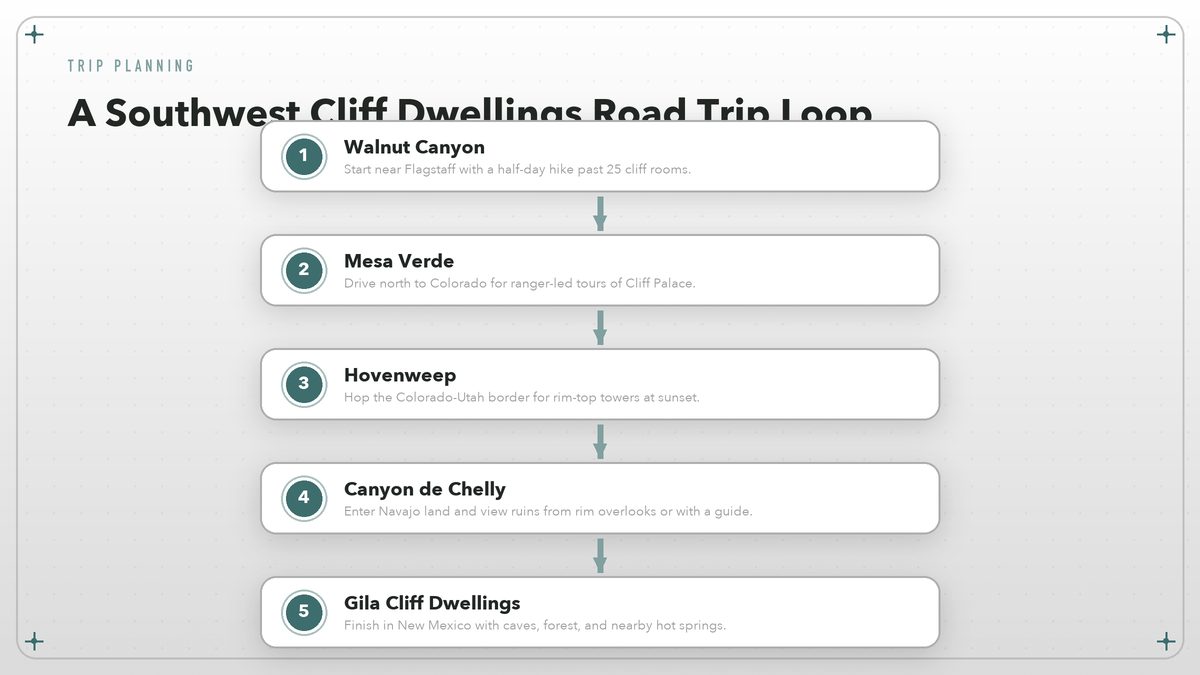
Once you have seen Mesa Verde, the rest of the region opens up. Each of these sites is managed differently, and that difference matters. Some are national parks, some are national monuments, and one is on Navajo Nation land. The rules, fees, and access change accordingly.
Canyon de Chelly, Arizona
Canyon de Chelly National Monument is a partnership between the National Park Service and the Navajo Nation. The monument includes several Ancestral Puebloan ruins, but it is also a living community; Navajo families still farm, graze livestock, and hold ceremonies in the canyon. You can drive the North and South Rim drives yourself and stop at overlooks like Spider Rock, which rises 750 feet from the canyon floor. To hike into the canyon, you need a Navajo guide. There is no self-guided hiking below the rim.
The most famous ruin is White House, which sits partway up a cliff and is reached by a single public trail. Even that trail enters the canyon under tribal regulations, so stay on the path, do not touch the walls, and do not photograph Navajo residents without permission. The canyon is sacred. Treat it that way.
Walnut Canyon, Arizona
Just east of Flagstaff, Walnut Canyon National Monument is the opposite of Mesa Verde in scale. The canyon is narrow, the dwellings are small, and the Island Trail loops past 25 cliff rooms in about a mile. The hike down is 185 feet via switchbacks; the climb back up is what reminds you that people once carried water, corn, and firewood up these same slopes every day.
Walnut Canyon is a half-day stop at most, which is part of its charm. It makes a perfect break on the drive between Phoenix and the Grand Canyon, and because it is smaller, you can study the masonry up close. The mortar is still visible between the stones. In places, you can see fingerprints pressed into it centuries ago.
Gila Cliff Dwellings, New Mexico
In the mountains of southwestern New Mexico, Gila Cliff Dwellings National Monument protects a cluster of caves that were converted into rooms around 1300 CE. The setting is spectacular: ponderosa pine and Douglas fir forest at 5,700 feet, with hot springs nearby and the Gila Wilderness stretching in every direction.
The main trail is a one-mile loop that climbs to the caves and lets you walk through several rooms. The dwellings are smaller than Mesa Verde’s, but you can stand inside them, look out through the original doorways, and imagine the afternoon light moving across the canyon. The monument is remote; the nearest real town is Silver City, 44 miles southwest. Combine it with a soak at nearby Gila Hot Springs and you have one of the most peaceful ruin days in the Southwest.
Hovenweep, Colorado and Utah
Hovenweep National Monument is less about cliff alcoves and more about towers. The people here built stone towers on canyon rims and boulders, some of them balanced in places that seem impossible. The most accessible site is Square Tower Group, near the visitor center, where a two-mile loop trail passes ruins named for their shapes: Square Tower, Hovenweep Castle, Twin Towers.
Hovenweep straddles the Colorado-Utah border and gets a fraction of Mesa Verde’s visitors. The light at sunrise and sunset turns the stone pink, and the silence is total. It is a place for photographers, slow walkers, and anyone who has ever wanted to stand in a landscape that feels older than the roads that lead to it.
How to Plan a Respectful, Low-Impact Trip
These sites are not museums with ruins in them. They are ancestral homelands where modern Indigenous communities still have legal, spiritual, and cultural ties. The difference between a thoughtful visit and a careless one is mostly a matter of paying attention.
Follow the posted rules. Do not climb on walls, do not enter closed areas, and do not take pottery sherds, flakes, or corn cobs as souvenirs. The phrase “take only pictures, leave only footprints” is a cliché because it is true. Even moving a small stone can disturb an archaeological context that researchers have preserved for centuries.
Consider hiring Indigenous guides where they are available. At Canyon de Chelly, Navajo-led jeep and hiking tours add layers of context that a sign cannot. At Mesa Verde, the park offers ranger-led tours, but tribal perspectives often come through special programs and partner events. Check each park’s calendar before your trip.
Photography has limits. Tripods and drones are usually banned in archaeological areas, and some sites prohibit photography of human remains or sacred objects. If you see a sign asking you not to photograph something, put the camera away. The point of the visit is not your feed.
A Six-Day Southwest Cliff Dwellings Road Trip
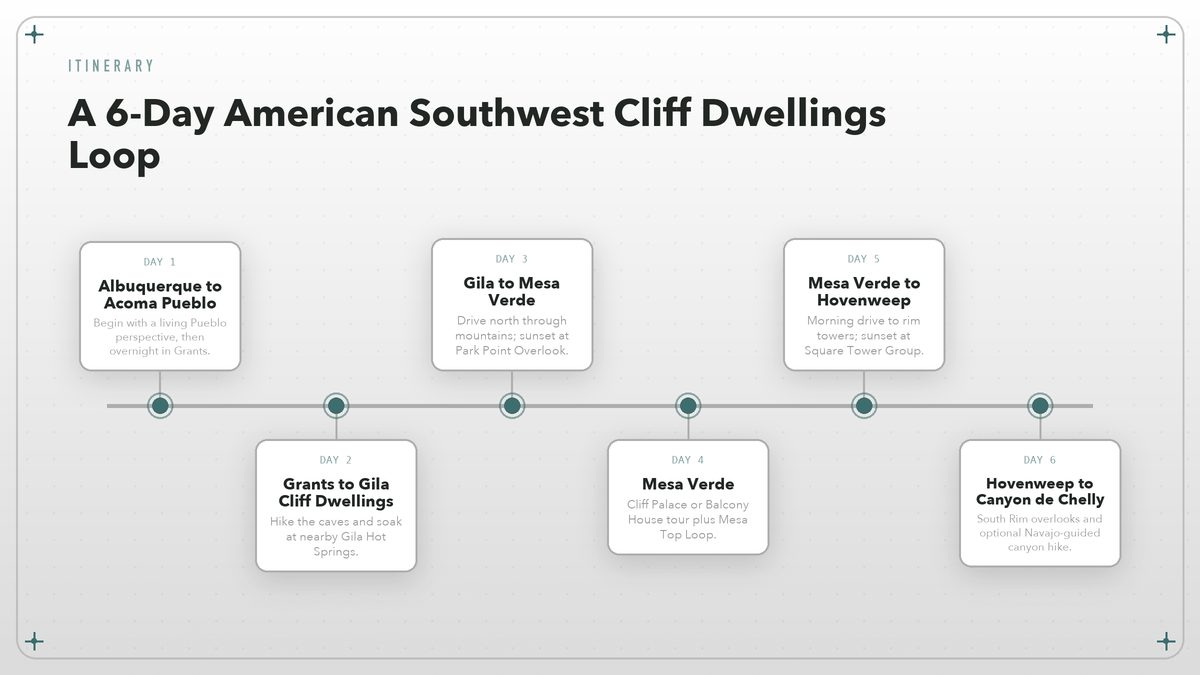
This loop assumes you are flying into Albuquerque, New Mexico, and renting a car. It covers roughly 750 miles and keeps daily drives under three hours when possible. Adjust for season; mountain passes in northern New Mexico and southwestern Colorado can see snow into late spring.
| Day | Route | Focus | Overnight |
|---|---|---|---|
| Day 1 | Albuquerque to Acoma Pueblo | Stop at Acoma Sky City for a living Pueblo perspective before pushing west. | Grants, NM |
| Day 2 | Grants to Gila Cliff Dwellings | Hike the cliff dwellings, soak at Gila Hot Springs. | Silver City, NM |
| Day 3 | Silver City to Mesa Verde | Drive north through the Gila Wilderness; catch sunset at Park Point Overlook. | Morefield Campground or Cortez, CO |
| Day 4 | Mesa Verde | Cliff Palace or Balcony House tour; Mesa Top Loop. | Cortez, CO |
| Day 5 | Mesa Verde to Hovenweep | Morning drive to Hovenweep; sunset at Square Tower Group. | Cortez or Bluff, UT |
| Day 6 | Hovenweep to Canyon de Chelly | South Rim overlooks; optional Navajo-guided canyon hike. | Chinle, AZ |
If you have another day, add Walnut Canyon on the drive back to Albuquerque. It is a gentle re-entry into the modern world, and the Flagstaff area has good food, coffee, and a decent airport if you want to drop the car there instead.
What to Pack, and When to Go
The high desert is not forgiving. Summer temperatures can top 100 degrees Fahrenheit at Canyon de Chelly and Walnut Canyon, while winter nights at Mesa Verde drop below freezing. Spring and fall are the sweet spots, especially April through May and September through October. Monsoon season, roughly July through early September, can bring dramatic afternoon thunderstorms and flash-flood risk in canyons.
Good boots are non-negotiable. The trails are rocky, uneven, and often steep, and the stone can be slick after rain. Bring more water than you think you need; the dry air hides how much you are sweating. A wide-brimmed hat, sunscreen, and lip balm are basics. If you are doing the Balcony House tour, pack light; you will be climbing a 32-foot ladder and crawling through a short tunnel.
Cell service is spotty to nonexistent at most of these sites. Download offline maps before you leave. Gas stations are scarce on the stretches between Silver City, Durango, Cortez, and Chinle, so fill up whenever you can. A paper map is a nice backup, and it never runs out of battery.
The cliff dwellings were not built for tourists. They were built for families who wanted dry storage, warm winters, and a view of the canyon mouth. That practicality is what makes them feel so human.
Finding the Right Entry Point for You
Not everyone has two weeks for a ruin road trip. If you are short on time, pick the site that best matches your travel style rather than trying to see everything.
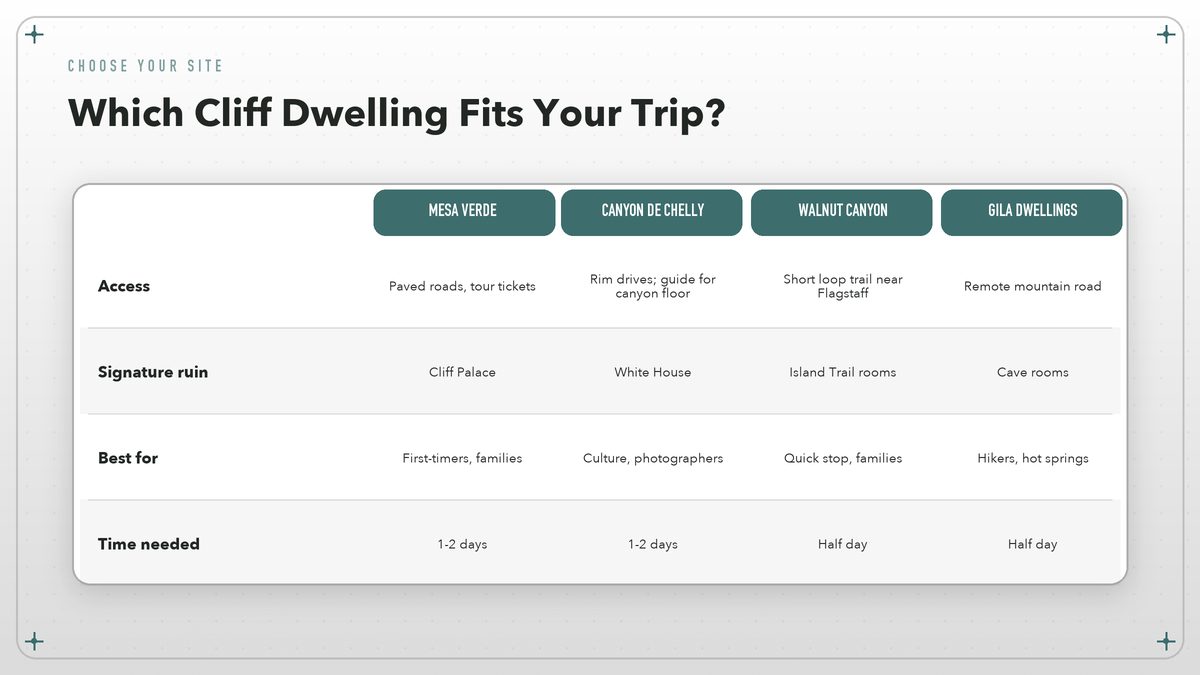
Mesa Verde is the obvious starting point if you want ranger-led tours and the most impressive architecture. Canyon de Chelly suits travelers who are drawn to a landscape that is still lived in. Walnut Canyon is ideal for a quick, half-day stop near Flagstaff, while Gila Cliff Dwellings pairs ruins with wilderness and hot springs. Hovenweep takes the most effort to reach, which is exactly why it feels so quiet once you arrive.
Families tend to do best at Mesa Verde and Walnut Canyon, where the trails are short and the overlooks are easy. Photographers should plan for sunrise or sunset at Hovenweep and Canyon de Chelly, when the stone catches fire and the crowds thin out. Hikers who also want a hot spring soak should head straight for Gila. The real trick is not finding the “best” ruin; it is matching the site to the trip you are already planning.
Try to visit at least one ruin early in the morning or late in the afternoon. The low sun stretches shadows across the masonry, and the temperature drops enough that you can sit on a bench and simply look. Those are the hours when the place feels least like an attraction and most like a home.
Leave room in your itinerary for something unplanned. A ranger might mention an overlook you had not heard of, or a storm might clear just as you reach the rim. The best moments on a Southwest ruin trip rarely come from ticking boxes. They come from standing still long enough to notice what is already there.
Wherever you go, slow down. Walk through the rooms quietly, look at the smoke stains on the ceilings, and try to imagine the sound of children running along the terraces. That is the visit. Everything else is just directions.
All links were checked before publication. Park hours, tour availability, and road conditions change with the season, so confirm current details on the official National Park Service websites before you leave.