History & Indigenous Cultures · Peru
The Inca built the largest empire in the pre-Columbian Americas, laced with 40,000 kilometres of stone road. One citadel gets the crowds. The rest of the system is sitting there, half-empty, wondering where everyone went.
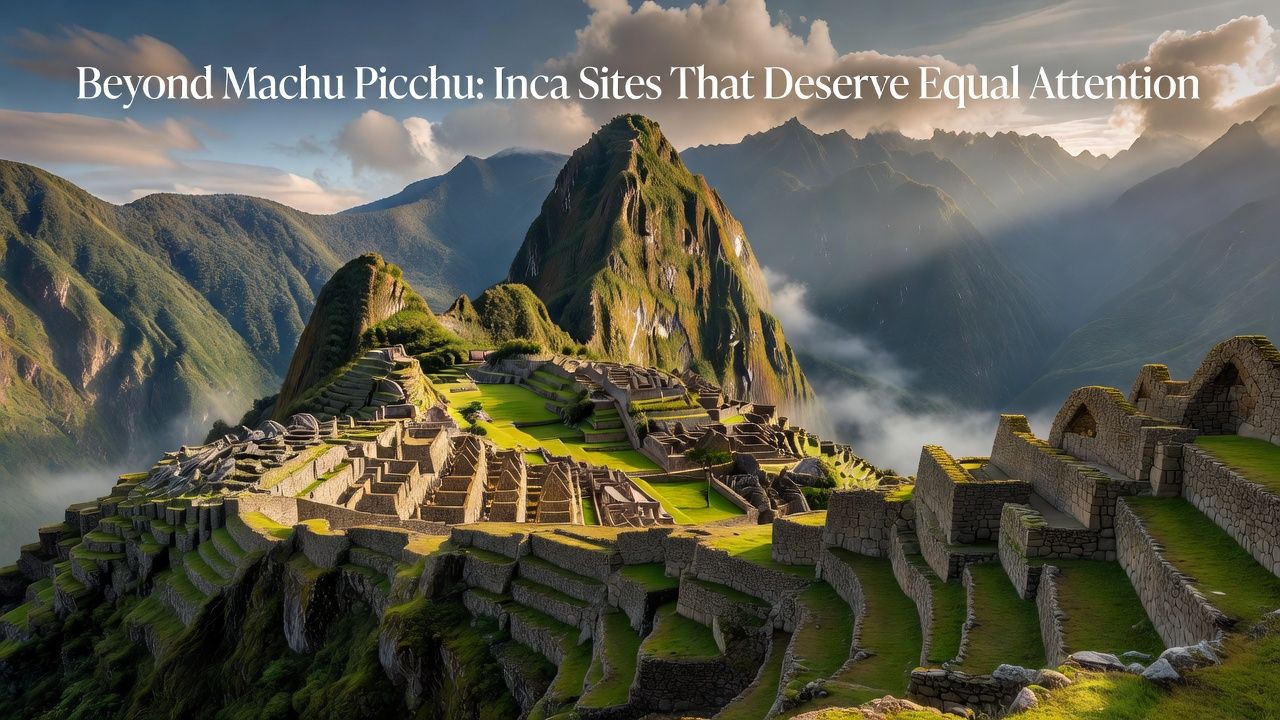
Here is the open secret of Peruvian archaeology: Machu Picchu is not the best Inca ruin. It is the most photogenic, the most dramatically situated, and the one with a railway built to its doorstep — and it is genuinely extraordinary. But travellers who treat it as the beginning and end of the Inca world miss the larger truth. The Inca ran an empire of ten million people without writing, money or the wheel, and they stamped that achievement into stone across an entire mountain range. Much of it sits an hour or two from Cusco, visited by a trickle of the crowds that queue at 4 a.m. for the famous citadel. Some of it, arguably, is more impressive.
This is a tour of the other Inca Peru — the sites that historians and repeat visitors quietly rate alongside (or above) the famous one — with the practical notes for seeing them well. Book Machu Picchu too, by all means. Just don’t let it be the whole sentence.
Understanding the Empire First Ninety years, one continent
A fact that recalibrates everything you’ll see: the Inca Empire — Tawantinsuyu, the Land of Four Quarters — lasted barely ninety years at full scale, from Pachacuti’s expansion around 1438 to the Spanish catastrophe of the 1530s. In three generations, the Inca absorbed or out-built civilisations that had dominated the Andes for millennia, running a state from southern Colombia to central Chile via the Qhapaq Ñan — a road network of some 40,000 kilometres, itself now a six-country UNESCO World Heritage site. The sites below aren’t scattered ruins; they’re organs of that single, startlingly brief machine. Seeing them together is how the empire stops being a backdrop and becomes a story.
The Sacred Valley Sites An hour from Cusco, a world away from the queues
Ollantaytambo
The only town in Peru still living on its original Inca street plan — you sleep in a grid laid out in the fifteenth century — and the site of the Inca’s rare military victory over the Spanish, when Manco Inca flooded the plain and routed Hernando Pizarro’s cavalry in 1536. The fortress-terrace above town is monumental in the literal sense: six rose-granite wall sections, hauled from a quarry across the valley, fitted without mortar into joints you can’t slide a card into. Crowds pass through on the way to the Machu Picchu train and give it forty minutes. Give it a morning, and stay the night — the town after the day-trippers leave is one of the Sacred Valley’s great pleasures.
Pisac
Ask archaeologists which Sacred Valley site rivals Machu Picchu for scale and setting, and Pisac is the answer. The ruins sprawl across a mountain spur above the famous market town: sweeping agricultural terraces, a ceremonial centre with masonry as fine as anything in the empire, and a mountainside honeycombed with thousands of looted tomb cavities — a stark visual footnote on what happened next. The full site hike (up from town or down from the upper road) takes half a day and you’ll share it with dozens, not thousands.
Moray and the Salt Terraces
Moray looks like a hallucination: concentric circular terraces sinking into the earth in vast green bowls. The leading interpretation is an agricultural research station — the terrace levels create microclimates differing by several degrees, letting Inca agronomists trial crops at simulated altitudes. Whether or not the theory holds, the engineering is real and the site is unforgettable. Pair it with the Maras salt pans nearby — thousands of evaporating pools terraced into a hillside, worked since before the Inca and still producing — for the most photogenic half-day in the valley.
Tipón
The one almost nobody visits, and the one engineers love most. Tipón is a water temple: a terraced complex where spring-fed channels still run, five centuries on, through fountains, drops and ceremonial baths with acoustic precision that appears deliberate. On a weekday morning you may have it nearly to yourself. If the Inca genius could be summarised in one site, the argument for Tipón — hydrology as worship — is strong.
Cusco Itself The navel of the world, still working
Cusco, the UNESCO-listed imperial capital, is routinely treated as an acclimatisation stop. It’s a headline site in its own right. The city is a palimpsest: Inca walls of impossible precision forming the ground floors of colonial churches. The Coricancha — the Temple of the Sun, once sheeted in gold, its perfect curved wall now embedded in the Santo Domingo convent — is the single most important Inca building to survive, and the starkest illustration anywhere of what conquest did to this civilisation. Above town, Sacsayhuamán’s zigzag walls use boulders weighing over a hundred tonnes, fitted so tightly that five centuries of earthquakes have failed to move them. Stand underneath one and the word “fortress” feels inadequate; the annual Inti Raymi festival still stages the Inca sun ceremony here every June 24.
“The Inca built an empire of ten million people without writing, money or the wheel — and stamped it into stone across an entire mountain range. Most of it is still there.”
The Deep Sites For those willing to walk
Choquequirao
The great one. Choquequirao — “cradle of gold” — is a citadel comparable in scale to Machu Picchu, last refuge of the Inca resistance, perched above the Apurímac canyon, and reachable only on foot: a two-day descent-and-climb trek each way (roughly 60 kilometres round trip with brutal elevation change) or nothing. Visitor numbers are a rounding error compared to its famous sibling. The reward is the rarest thing left in Peruvian archaeology: a major Inca city experienced in silence, with the condors and the orchids and the terraced llamas-of-stone mosaics, on your own schedule. A long-planned cable car has been debated for years; go before it changes the place, and go fit, acclimatised, and ideally with a mule-supported trek arranged in Cusco.
Huchuy Qosqo and the Quarry Trail
For those who want a trek without the Inca Trail’s permit scramble: Huchuy Qosqo (“Little Cusco”) is a fine mountaintop complex reachable on a gorgeous two-to-three-day walk from the Sacred Valley, over a 4,300-metre pass with almost no other walkers. It proves the point of this whole article — in the Inca heartland, solitude is a route choice, not a lottery.
Vilcabamba and the Road System
The truly committed can go deeper: Espíritu Pampa, the overgrown final capital of the neo-Inca state where Manco’s line ended in 1572, is a multi-day expedition into the ceja de selva. Closer to hand, surviving stretches of the Qhapaq Ñan itself — original Inca road, stone-paved, stair-stepped over passes — can be walked in several regions. Walking a morning on the actual imperial highway, alone, is worth more than a week of museum labels.
Practical Architecture Tickets, altitude, order of operations
The Boleto Turístico. Cusco’s tourist ticket bundles most of the sites above (Ollantaytambo, Pisac, Moray, Tipón, Sacsayhuamán and more) into one pass, full or partial circuits, valid over set days. It’s the economic backbone of visiting the region and excellent value if you’re seeing three or more sites. Buy it at the first site or the Cusco office; carry your passport.
Altitude is the itinerary. Cusco sits at 3,400 metres — high enough to flatten unacclimatised visitors for a day or two. The smart order: land, descend immediately to the Sacred Valley (Ollantaytambo at 2,800 m, Urubamba lower still), see Pisac, Moray and the valley sites while your body adjusts, then return to Cusco’s higher elevations, and only then tackle Choquequirao or high passes. The CDC’s high-altitude guidance (see our health article) puts the rule simply: don’t jump to high sleeping altitudes on day one.
Timing. Dry season (May–October) is trekking season; June adds Inti Raymi and peak crowds. Shoulder months — late April, October — split the difference nicely. Rainy season (November–March) makes Choquequirao genuinely hard and some trails inadvisable.
Guides. The sites are well signed but thinly explained; a good local guide at Ollantaytambo or Sacsayhuamán (hired at the gate, negotiable, usually US$15–30) doubles the value of the visit. At Choquequirao, an arriero-supported trek is the standard and supports the villages on the route.
The Pre-Inca Bonus Round Because the Inca were the last chapter, not the first
Travellers who fall for the archaeology usually end up asking the right follow-up question: what came before? The answer fills northern Peru and deserves its own days. Chan Chan, outside Trujillo, is the largest adobe city ever built — the capital of the Chimú Empire, which the Inca absorbed only in 1470 — its walled royal compounds and friezes of fish and seabirds spreading across the desert in a scale that resets your sense of pre-Columbian urbanism; it’s a UNESCO site and receives a sliver of Cusco’s traffic. Nearby, the Moche pyramids of the Sun and Moon carry painted reliefs of a civilisation a millennium older than the Inca, and the museum at Lambayeque holds the gold of the Lord of Sipán — a royal tomb discovery comparable in New World terms to Tutankhamun’s. In the northern highlands, Kuélap — the mountain-top fortress of the Chachapoya, the “Cloud People” — rises behind twenty-metre walls above the cloud forest, reachable now by cable car from Nuevo Tingo, and its circular stone houses among bromeliads feel like a lost world that happens to have a visitors’ centre. And on the coast south of Lima, the Nazca Lines — geoglyphs of hummingbirds, spiders and whales visible properly only from a small plane — remain archaeology’s most elegant unsolved argument. A Peru trip that pairs the Inca heartland with even one of these turns a visit into an education: the Inca built the empire, but they were standing, like every civilisation in the Andes, on the shoulders of giants.
A Word on Respect These are not props
The sites in this article are ancestral places for the Quechua communities who live around them — people who speak the empire’s language, farm its terraces, and in many cases maintain ceremonial relationships with these places that long predate the tourism economy. That has practical expression: some communities manage access to trails and sites on their land (a small fee, fairly charged, increasingly the norm and rightly so), and sacred spaces — active offerings, shrines, church-festivals — deserve the same behaviour you’d want in yours. The fuller etiquette of visiting Indigenous communities is its own subject; the short version is that your presence is a relationship, not a purchase. Peru’s official portal peru.travel is a useful starting point for current site and community-tourism information.
The Case, Restated
Machu Picchu earns its fame. But the traveller who also stands alone at Tipón listening to five-hundred-year-old water, watches the light move across Pisac’s terraces, sleeps on an Inca street grid in Ollantaytambo, and earns Choquequirao with their legs comes home with something the famous postcard can’t contain: an understanding of the civilisation, not just the photograph of its prettiest estate. The empire is still out there, holding its stones together without mortar, waiting in the thin air. The queues are optional.
Ten Days Through the Empire An order of operations that works
The mistake nearly everyone makes is landing in Cusco and immediately climbing things. The better design uses the region’s own geography as a staircase. Days 1–3: the Sacred Valley, first. The valley floor sits several hundred metres below Cusco, which makes it the correct place to sleep while your body adjusts — and it contains the sites anyway. Pisac on the first morning (the terraces, then the market town below), Ollantaytambo on day two, timed for late afternoon when the day-trippers have gone and the light turns the fortress gold. Sleep in Ollanta itself; the town is a living Inca grid, and its evenings are the calmest in the region.
Days 4–5: Machu Picchu, mid-trip, from the valley. This is the insider ordering: you visit the famous one once you’re acclimatised and before Cusco fatigue sets in, then come back down to sleep low. Days 6–8: Cusco, now that you’re ready for it — Sacsayhuamán at opening time, Qorikancha and the museums by day, and the full day-trip east along the South Valley or west to Moray and Maras, depending on whether the stonework or the landscapes have hooked you deeper. Days 9–10: choose your deep cut. Strong legs and a love of emptiness: the first two days of the Choquequirao trail get you the ruin and back with time to spare if you hire the mule support. Short on legs: the overnight to Lake Titicaca for Uros and Taquile, which adds the living-culture chapter the ruins can’t. Two honest warnings on the logistics: buy the Boleto Turístico before anything else (it covers most valley and Cusco sites and is sold nowhere convenient), and book Machu Picchu entry and the train the moment your dates exist — in high season, both genuinely sell out weeks ahead, and no amount of money fixes that at the gate.
A practical note on the famous one, since the system changed: Machu Picchu entry is by timed ticket on fixed circuits — designated walking routes through the site, introduced to manage flow — and the circuit determines what you see. The classic postcard route and the main temples sit on the middle circuit; others trade the famous view for the upper terraces or the hike up to the Sun Gate alternatives. Research the circuits before buying, because you cannot improvise on the day, and buy only through the official government platform or your tour operator — the resale market is a genre of heartbreak. Entry slots at the civilised hours (early morning, late afternoon) sell first; midday in high season is what’s left, and it’s still Machu Picchu, just warmer and busier. The ruins beyond it, mercifully, remain the opposite: most days at Ollantaytambo’s upper terraces or Pisac’s far citadel, you can hear the wind.
Site access rules, ticket bundles and trek logistics change seasonally; confirm current arrangements in Cusco before setting out, especially for Choquequirao (the long-proposed cable car would change access substantially). Altitude guidance is general — travellers with health conditions should consult a physician. This article contains no affiliate links. All outbound links checked live in August 2026.
Leave a Reply