Travel Planning & Logistics · Borders
The good news: a US passport opens almost the entire western hemisphere without a visa. The useful news: the exceptions changed recently, the fees hide in odd places, and the rules everyone remembers are a few years out of date.
Visa information ages faster than almost anything else in travel. The article you read before your last trip is quietly wrong by your next one: Brazil reinstated its visa requirement in 2025, Bolivia abolished its notorious $160 reciprocity fee the same year, and several countries have moved their paperwork online or invented new entry fees since your favourite blog post was written. This overview reflects the state of play in mid-2026, written primarily for US passport holders (with notes where Canadians and Europeans differ) — and it comes with the standing order that applies to every visa guide ever published: verify your specific situation with official sources before you book. For US travellers, the country-by-country pages at travel.state.gov are the authoritative baseline.
The Big Picture Mostly open, with famous exceptions
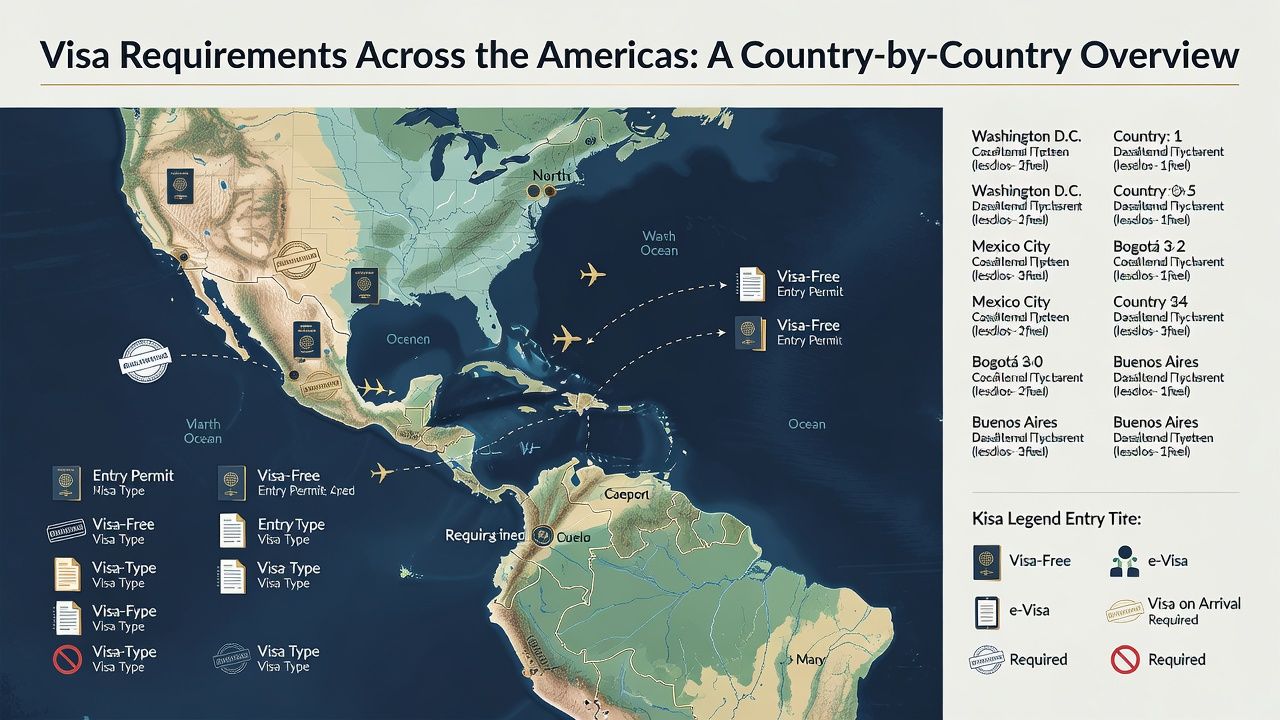
For a US passport, the Americas are one of the easiest regions on Earth: the overwhelming majority of countries admit tourists visa-free for 30 to 180 days, stamps at the border, no advance paperwork. The exceptions cluster into three buckets: countries requiring an electronic visa or online authorisation in advance (Brazil being the headline), countries requiring a purchased tourist card or entry fee (Cuba, Suriname, and the occasional airport tax), and the one country where US tourism sits in its own legal category (Cuba again — more below). Canada and Mexico — the two most-visited destinations — need no visa at all for US citizens, though Mexico issues its FMM tourist permit on arrival or online, which you must keep and surrender on exit.
The Headline Changes What shifted in 2025 and still applies
Brazil: the eVisa is back
After six visa-free years, Brazil reinstated visa requirements for citizens of the US, Canada and Australia on April 10, 2025. The process is entirely online — an eVisa via the government-authorised portal at brazil.vfsevisa.com, costing around US$80.90, with processing averaging about five business days. The eVisa is typically issued with multi-year validity allowing stays of up to 90 days per entry (extendable in-country to 180 days per year). Two operational details matter: apply at least two weeks before departure to leave margin for document requests, and print the PDF — airlines check it at boarding and have denied boarding over its absence. EU, UK, Japanese and most Latin American passport holders remain visa-exempt.
Bolivia: the $160 fee is gone
For decades, Bolivia charged US citizens a $160 reciprocity fee for a visa on arrival — the most expensive welcome mat in the Americas. In December 2025, Bolivia moved the US, UK and EU countries onto its visa-free list for tourism (up to 90 days), ending that era. The new friction point is administrative rather than financial: Bolivia now requires all foreign visitors to complete the SIGEMIG online pre-registration (free, via the official migration portal) before arrival — skipping it is currently the leading cause of airport delays at El Alto. Given how recently this changed, confirm the current rules before travel; land-border implementation of new policies in the region sometimes lags the announcement.
Cuba: the special case for Americans
Cuba requires every visitor to hold a tourist card (often bundled by airlines or bought at the departure gate, roughly US$50–100 depending on route) — that’s the Cuban requirement and it’s simple. The complication for US passport holders is American law, not Cuban: US regulations prohibit tourism as such, requiring travel under one of twelve authorised categories (the commonly used one being “support for the Cuban people,” which shapes where you sleep and spend). This guide can’t adjudicate US law, but can say plainly: the Cuban paperwork is trivial and the US compliance question is the one to research seriously before booking.
Country by Country The full board, mid-2026
| Country | Requirement | Typical stay | Notes |
|---|---|---|---|
| Canada | Visa-free | Up to 6 months | Passport required; no eTA for US citizens |
| Mexico | Visa-free + FMM permit | Up to 180 days (at officer’s discretion) | Keep the FMM; surrender on exit |
| Central America (all 7) | Visa-free | 90 days (CA-4: Guatemala, Honduras, El Salvador, Nicaragua share a single 90-day zone) | Panama, Costa Rica & Belize separate; CR may require onward ticket |
| Cuba | Tourist card | 30–90 days | US-law categories apply to Americans |
| Colombia | Visa-free | 90 days, extendable to 180/yr | Check-Mig online form before flights |
| Ecuador | Visa-free | 90 days | Includes Galápagos (separate transit card & park fee) |
| Peru | Visa-free | Up to 90 days | Stamp-free e-gates at Lima for some; keep entry record |
| Bolivia | Visa-free since Dec 2025 | 90 days | SIGEMIG pre-registration mandatory |
| Chile | Visa-free | 90 days | Reciprocity fee abolished years ago |
| Argentina | Visa-free | 90 days | Reciprocity fee abolished; no advance paperwork |
| Brazil | eVisa required | 90 days per entry | Apply online ~2 weeks ahead; print the PDF |
| Uruguay / Paraguay | Visa-free | 90 days | Among the simplest entries on the continent |
| Venezuela | Visa required | Varies | Apply via consulate well ahead; check advisories |
| Suriname | eVisa / entry fee online | Up to 90 days | Pay online before travel |
| Guyana / French Guiana | Guyana visa-free; French Guiana = France (Schengen rules) | 30–90 days | FG follows EU rules for non-EU passports |
The Rules Behind the Rules What actually gets travellers refused
Passport validity. The six-months-beyond-entry rule is enforced patchily in the Americas but real — several countries (including much of South America) state it, and airlines enforce it at check-in even when border officers might not. Renew at nine months remaining and the issue disappears from your life.
Onward tickets. More enforced than visas in this region. Costa Rica, Panama and others formally require proof of onward travel, and airlines — who bear the cost of flying you back — check more often than immigration does. A flexible or refundable onward booking solves it.
The 90/180 arithmetic. Most South American countries grant 90 days, extendable to 180 per calendar year. Long-term travellers do “visa runs,” but note the CA-4 zone in Central America counts four countries as one block — hopping Guatemala to Honduras doesn’t reset anything.
Entry and exit fees. The Americas mostly buried their old airport departure taxes into ticket prices, but exceptions survive — some Caribbean states and the occasional Latin American airport charge separately, and land borders in Central America levy small entry/exit fees payable in cash. Keep small US bills for this; dollars work at borders throughout Central America and Ecuador uses the dollar outright.
Yellow fever certificates. Not a visa, but adjacent: several countries (Bolivia, Colombia for some arrivals, Brazil’s neighbours in both directions) require proof of yellow fever vaccination when arriving from risk areas, and a few jungle regions recommend or require it outright. Carry the yellow card; some posts check it more diligently than passports.
The Non-US Reader Quick notes for other passports
Canadian and EU passports track the US position closely across the region, with two standing differences: Brazil’s eVisa currently applies to Canadians and Australians alongside Americans (most EU states are exempt), and Cuba’s category restrictions are US-law only. UK, Australian, Japanese and most Latin American passports enjoy similar visa-free coverage. Whatever passport you carry, your own government’s travel-advice site plus the destination’s consulate page is the verification pair to use — third-party visa-checking websites lag policy changes by weeks to months, which in this region is sometimes the entire life of a policy.
A Pre-Flight Ritual Ten minutes, two weeks out
Two weeks before any trip in the Americas, run this loop: check each destination on your government’s official travel site (for the US, the country pages at travel.state.gov); search the destination’s own migration or consulate page for “entry requirements”; confirm passport validity past six months; complete any online pre-registration (Brazil’s eVisa, Bolivia’s SIGEMIG, Colombia’s Check-Mig); print everything — approvals, onward tickets, first-night accommodation; and photograph your passport into cloud storage. Visa drama in the Americas is almost never about visas. It’s about a form nobody mentioned, discovered at a check-in desk. The ritual above is how you never meet it.
Extensions, Renewals and Overstays When 90 days isn’t enough
Ninety days sounds generous until you fall in love with a place in week eleven. The extension landscape splits three ways. Easy to extend: Argentina grants one 90-day extension through its migrations office (online in recent years) for a modest fee; Colombia lets you add 90 days via Migración Colombia’s website without leaving your hammock; Brazil allows extension to 180 days through the Federal Police. Discretionary: Mexico technically issues up to 180 days on the FMM, but the number is written by the officer at the desk, and the era of the automatic 180 is over — many travellers now receive exactly the days their itinerary justifies, so arrive with bookings that show a plan. Effectively fixed: Peru has not routinely granted tourist extensions in recent years; what you’re stamped in with is what you have.
The classic workaround — the border run — still exists, but it’s living on borrowed time. Leaving Costa Rica or Panama for 72 hours and returning generally restarts the clock. Ducking from Guatemala into Mexico does nothing at all, because Guatemala, El Salvador, Honduras and Nicaragua share one CA-4 allowance between them; the run that works is out of the zone entirely. And everywhere, officers increasingly ask the fair question: if you’ve done this three times, are you actually a tourist? Repeated re-entries invite scrutiny, shorter stamps and eventually refusal. Treat the border run as a once-a-trip tactic, not a residency strategy.
Overstaying is the bad option dressed as the free one. Fines across the region typically run a few US dollars per day — payable at the airport, often in cash, sometimes at a special desk while your flight boards — and the record can complicate future entries, particularly in Ecuador, Colombia and the CA-4. The exception people miscalculate: Argentina’s overstay fine is famously modest and payable on exit, which has bred a generation of Buenos Aires long-stayers who treat it as a parking ticket. It works until it doesn’t; repeat overstays have produced entry bans. Where an extension exists, pay for it. The fee is always cheaper than the problem.
Land Borders: The Practical Layer Where the rules meet the road
Most border trouble in the Americas is procedural, not political, and it concentrates in three places. The exit stamp. The region runs on paired stamps: you must be stamped out of one country before the next will stamp you in. At major crossings this is automatic; at small ones — the Bolivia–Chile desert posts, the Guatemala–Belize crossing at Melchor, river borders in the Amazon — it’s on you to find the migration window, which may sit a kilometre back from the actual line. Travellers who skip it discover the omission days later, when the next country’s system shows them as never having left, and the fix involves returning. Build “get the exit stamp” into your crossing checklist like fuel.
The clock. Borders keep hours. The big ones — Tijuana–San Diego, the Paso de Los Libertadores tunnel between Argentina and Chile — run around the clock or near it, but Andean and Amazonian posts commonly close overnight, and weather closes high passes entirely: Los Libertadores and the Paso de Jama shut for snow with little notice in winter. Never plan a same-day flight after a land crossing, and never arrive at a remote border at dusk.
The vehicle. Driving your own car across the Americas means collecting a temporary import permit (TIP) per country and cancelling it on exit — every time, without exception. The traveller who flies home from Bogotá leaving an uncancelled Colombian TIP discovers the consequences at the next entry: fines and impoundment risk, because the system believes the vehicle never left. Photograph every cancellation receipt. Cash helps at borders too: small official fees (FMM payments, Belize’s exit fee, assorted border charges) are cash-only, in dollars or local currency, and the moneychangers at the line know exactly how captive you are. Change the minimum, at a rate you’ve checked on your phone in front of them.
The Documents That Actually Get Checked Beyond the passport
The passport is the least-checked document in your stack. What airlines and officers actually ask for, in rough order of frequency:
Proof of onward travel. This is the region’s real gatekeeper, enforced mostly by airlines at departure check-in, because carriers pay to fly back anyone refused entry. Costa Rica, Panama, Colombia, Peru and Brazil all carry onward-ticket rules on paper; enforcement waxes and wanes, but the big regional carriers ask often enough that a refundable or cheap throwaway ticket out is standard equipment for one-way travellers. A bus ticket to the next country satisfies it across most of Central America.
The entry forms. Colombia’s Check-Mig (free, online, within 72 hours of the flight), Bolivia’s SIGEMIG pre-registration (free, mandatory since the December 2025 visa change), Brazil’s printed eVisa approval, Cuba’s tourist card and advance traveller form, and the US ESTA for visa-waiver travellers heading north — none of these is a visa, and all of them can stop a boarding pass. They’re the paperwork equivalent of speed bumps: invisible until you hit one.
Health documents. The yellow-fever certificate is required by a rotating cast of countries when you arrive from endemic zones — travellers moving from the Colombian or Peruvian Amazon toward Central America get asked. Carry the yellow card on any itinerary touching jungle. Prescriptions travel in original packaging; a doctor’s note for anything injectable or controlled saves long conversations at land borders.
The quiet ones. An accommodation address for the first night (arrival forms demand it, and “the hostel with the green door” doesn’t parse). Proof of travel insurance for Cuba, which officially requires it and occasionally checks. An International Driving Permit if you’ll rent cars — technically required alongside your licence in Brazil and much of South America, rarely asked for until the traffic stop where it suddenly matters. And everywhere: six months of passport validity past your entry date. Some countries legally require only validity for the length of your stay, but airlines apply six months as a blanket rule — and the airline is the border you meet first.
Working Remotely: The Grey Zone The question everyone asks
Can you answer email from a Mexican beach on a tourist permit? As a practical matter, the entire remote-working world already does, and no country in the region has shown any appetite for policing laptop use by tourists. As a legal matter, tourist status everywhere forbids “work” — a term written for a pre-laptop era — and the honest summary is that enforcement risk for serving clients back home is effectively nil while the rulebook technically says otherwise. What clearly crosses the line: taking local clients, being paid locally, or working on-site for a local company. That’s work-permit territory in every country, and it’s the version that actually gets enforced.
If the trip stretches into seasons rather than weeks, the region now offers the honest route: digital-nomad visas. Costa Rica, Colombia, Brazil, Argentina, Ecuador and Uruguay all run programs as of 2026, typically asking proof of roughly US$1,500–3,000 in monthly foreign income and granting a year or more, often renewable; Mexico’s temporary-residency route serves the same crowd. Fees run a few hundred dollars and processing takes weeks to months, but they convert the grey zone to white — and in several countries, residency is also the simplest path to a bank account and a lease. If your plan is a season rather than a holiday, price the visa. It’s cheaper than three border runs and far more comfortable at immigration.
Entry policies summarised here were verified against official sources in August 2026, including the US State Department and the Brazilian government’s authorised eVisa portal; they change without notice, and this article is general information, not legal advice. Fees are approximate and vary by exchange rate and nationality. This article contains no affiliate links. All outbound links checked live in August 2026.
Leave a Reply