The Atacama Desert: A Practical Guide to Chile’s Otherworldly North
Chile’s Atacama is the driest non-polar desert on Earth, a high-altitude expanse of salt flats, geysers, and volcanic peaks that looks more like Mars than anywhere else most travelers will reach.
The first thing that strikes you about the Atacama is the silence. Not forest-hush. Not snow-quiet. An absence of sound so complete that you become aware of your own heartbeat. Stand on the edge of the Salar de Atacama at dawn and the only movement might be a flock of flamingos picking their way through pink-tinged brine, their wings catching the first light from the Andes. The desert sits in northern Chile, stretching roughly 600 miles along the Pacific coast and inland to the Bolivian and Argentine borders. Some weather stations here have never recorded rain. The ground is so dry that NASA has used the region to test instruments bound for Mars. This is not a place you visit casually. The altitude, the sun, and the distances demand planning. The payoff? One of the most visually arresting places in the Americas.
Most independent travelers use the small adobe town of San Pedro de Atacama as a base. It sits at about 7,900 feet above sea level, which is high enough to slow you down on day one but low enough to sleep reasonably well. From there you can reach the major sights in a few hours by rental car, bicycle, or organized tour. The town itself is compact, walkable, and slightly dusty, with low buildings, unpaved side streets, and a central plaza where tour operators and small restaurants compete for your attention. It feels like the last outpost before the high plateau. In many ways, it is.
Where the Atacama Actually Is
The Atacama Desert occupies the northern third of Chile, wedged between the Pacific Ocean and the Andes. Its core visitor area lies in the Antofagasta Region, roughly 1,000 miles north of Santiago. Calama, about 60 miles east of San Pedro, has the nearest airport with regular flights. From there the road climbs steadily onto the Altiplano, a high plateau shared with Bolivia, Peru, and Argentina. Chile Travel, the country’s official tourism site, has up-to-date background on the region and the main gateways.
The desert’s dryness comes from a combination of geography and ocean currents. The cold Humboldt Current chills the air offshore, which suppresses evaporation and keeps moisture from reaching the coast. To the east, the Andes block rainfall from the Amazon basin. The result is a strip of land where annual precipitation in some spots is measured in millimeters per century. That extreme aridity has preserved ancient mummies, Inca trails, and even early 20th-century mining camps with an eerie completeness. It also means there is almost no vegetation to soften the view. What you see is rock, salt, sand, and sky.
Do not expect Sahara-style dunes everywhere. The Atacama is mostly a desert of texture: crusted salt pans, volcanic cones, geothermal vents, and badlands carved by water that has not flowed in thousands of years. The dunes do exist, particularly in the Valle de la Muerte, but they are one element in a much larger geologic puzzle. The place rewards slow looking.
Getting There and Getting Around
Fly into El Loa Airport in Calama. LATAM and Sky Airline run several flights daily from Santiago, with less frequent connections from other Chilean cities. The flight from Santiago takes about two hours. From Calama you have three options for the 60-mile transfer to San Pedro: a pre-booked private transfer, a shared shuttle, or a rental car. The road is paved and straightforward, climbing from Calama’s mining sprawl up onto the plateau in roughly 90 minutes.
Once you are in San Pedro, you do not strictly need a car for the standard sights. Tour agencies sell half-day and full-day trips to every major attraction, and the prices are reasonable because the competition is fierce. A rental car, however, gives you freedom. You can leave before dawn without waiting for a van full of strangers, and you can stay at a viewpoint after the tour buses roll back to town. A standard two-wheel-drive car is fine for the paved and graded roads that lead to Valle de la Luna, the salt flat overlooks, and the village of Toconao. For more remote tracks, ask locally about current conditions; some require high clearance or a guide.
Bicycles are popular for nearby sites like Pukará de Quitor and the Catarpe Valley, but the altitude makes even gentle climbs feel harder than they look. E-bikes are increasingly available and worth the extra cost. On foot, San Pedro is small enough to walk end to end in fifteen minutes. Just watch for the occasional stray dog and the soft sand that swallows regular shoes.
San Pedro de Atacama as a Base
San Pedro is not a polished resort town. It is a functional village that happens to be surrounded by extraordinary geology. The streets are narrow, many unpaved, and the buildings mostly adobe. Hostels, boutique hotels, eco-lodges, and a handful of high-end properties line the outskirts. Prices swing widely with the season. Book early if you are coming in January or February, when Chilean summer holidays fill every bed.
The town’s main strip, Caracoles, is where restaurants, tour agencies, and souvenir shops cluster. It is also where you will find ATMs, which can run out of cash on busy weekends. Many smaller restaurants and family-run tour operators prefer cash or charge extra for card payments. Bring Chilean pesos. US dollars are not useful here.
Water is a serious concern. The town relies on a limited aquifer, and tourism has strained the supply. Short showers are standard. Some upscale lodges have their own filtration systems, but do not expect to drink from the tap everywhere. Buy large jugs of water for your room and carry a reusable bottle. The dryness sneaks up on you; by the time you feel thirsty, you are already behind on fluids.
Food in San Pedro ranges from basic set-menu lunches to ambitious takes on Altiplano ingredients. Expect quinoa, llama, fresh Andean potatoes, and lots of eggs. The altitude affects cooking, so bread and cakes can be a little denser than at sea level. That is just physics. Enjoy it anyway.
The Landscapes You Came For
The real reason to visit the Atacama is the scenery, and the scenery does not disappoint. Each major site feels like a different planet.
Valle de la Luna
Valle de la Luna, the Valley of the Moon, is the closest major attraction to San Pedro and the most visited. It is a bowl of salt-crusted hills, sand dunes, and eroded rock formations that turn gold, pink, and violet as the sun drops. The classic visit is a late-afternoon entry followed by a hike to a viewpoint for sunset. The light changes fast — one minute the peaks look beige, the next they are on fire. Bring a jacket. Once the sun disappears, the temperature drops.
The park has a defined circuit with stops for short walks through salt caves and up dunes. It is not a strenuous day, though the altitude makes the climbs slower than they appear. Go early or late to avoid the midday heat and the biggest van convoys. Tickets are sold at the entrance; the park limits visitor numbers at peak times. CONAF, Chile’s national parks service, manages access and publishes current hours and fee information.
El Tatio
El Tatio is the largest geyser field in the southern hemisphere and one of the highest in the world, sitting at roughly 14,000 feet. The geysers are most dramatic at sunrise, when the cold air turns the steam columns into towering white plumes. Tours leave San Pedro between 4:00 and 5:00 a.m. to arrive before dawn. It is an early start, and the altitude at the site is no joke, but the spectacle is worth the lost sleep.
After watching the geysers, most tours stop at a small thermal bath where you can soak in water warmed by the same volcanic system. The air temperature might be below freezing; the water is gloriously hot. Bring a swimsuit and a towel. Do not dunk your head at this altitude. The morning ends with breakfast near the geyser field before the long drive back down.
Lagunas Altiplanicas
The high-altitude lagoons Miscanti and Miñiques sit at over 13,000 feet, fed by snowmelt from volcanic peaks that rise directly from their shores. The water is an improbable blue — the kind of color that makes you check whether your camera’s saturation slider is broken. Vicuñas graze the surrounding grasslands. If you are lucky, you might spot a flamingo in the smaller pools. The road from San Pedro passes Toconao, a village known for its white volcanic-stone church and crafts made from local materials.
This excursion is best saved for after you have spent at least one full day acclimatizing in San Pedro. The air is thin. Even walking from the parking lot to the lagoon edge can leave lightheaded visitors sitting on a rock. Take it slow. The Andes are not in a hurry.
Salar de Atacama
The Salar de Atacama is Chile’s largest salt flat, a vast white expanse interrupted by briny lagoons where flamingos feed on microscopic algae. The most accessible viewpoint is the Los Flamencos National Reserve sector near Chaxa Lagoon. Boardwalks keep visitors above the fragile crust while allowing close views of flamingos, Andean avocets, and other birds that have adapted to the extreme salinity.
At sunset the salt turns warm colors and the volcanoes to the east cast long shadows across the flat. It is a quieter experience than the Bolivian Uyuni salt flat, partly because the area is smaller and partly because the infrastructure is more controlled. That is a good thing. The birds and the salt crust do not need crowds.
ALMA and the Night Sky
The Atacama Large Millimeter/submillimeter Array, better known as ALMA, sits on the Chajnantor Plateau at 16,000 feet, about 30 miles east of San Pedro. It is the most powerful radio telescope array on Earth, a collaboration between North America, Europe, and East Asia that has produced some of the most detailed images of star and planet formation ever captured. Public visits to the operations support facility are free but must be reserved in advance through the ALMA Observatory website. The high site itself is off-limits to tourists.
Even if you do not visit ALMA, the desert’s night sky is reason enough to stay up late. The combination of high altitude, extreme dryness, and minimal light pollution makes the Atacama one of the best stargazing locations on the planet. The Milky Way rises like a luminous arch, and satellites drift across the darkness every few minutes. ESO, the European partner in ALMA, publishes background on why this corner of Chile is so prized by astronomers. Amateur stargazing tours run nightly from San Pedro and usually include a telescope, hot drinks, and a patient guide who can point out the Southern Cross.
Dealing With Altitude
Altitude is the variable that separates a great Atacama trip from a miserable one. San Pedro’s 7,900 feet are enough to cause mild headaches or shortness of breath for the first day or two, especially if you flew directly from sea level. The geysers at El Tatio and the lagoons at Miscanti and Miñiques are above 13,000 feet, where altitude sickness becomes a real possibility.
The standard advice is boring because it works. Take it easy on arrival, drink more water than you think you need, and avoid heavy alcohol for the first 24 hours. Eat light meals. If a headache starts, rest before pushing higher. Most people acclimatize naturally within a day or two. Those who ascend too fast often spend a morning in bed with a pounding headache while their friends watch geysers.
Coca tea is not part of Chilean culture the way it is in Bolivia or Peru, so do not expect to find it on every menu. Some tour operators carry basic first-aid supplies and oxygen canisters for emergencies. If you have a history of altitude-related problems, talk to a clinician before the trip and consider building in extra acclimatization days. This is not the place to test your body’s limits.
When to Go
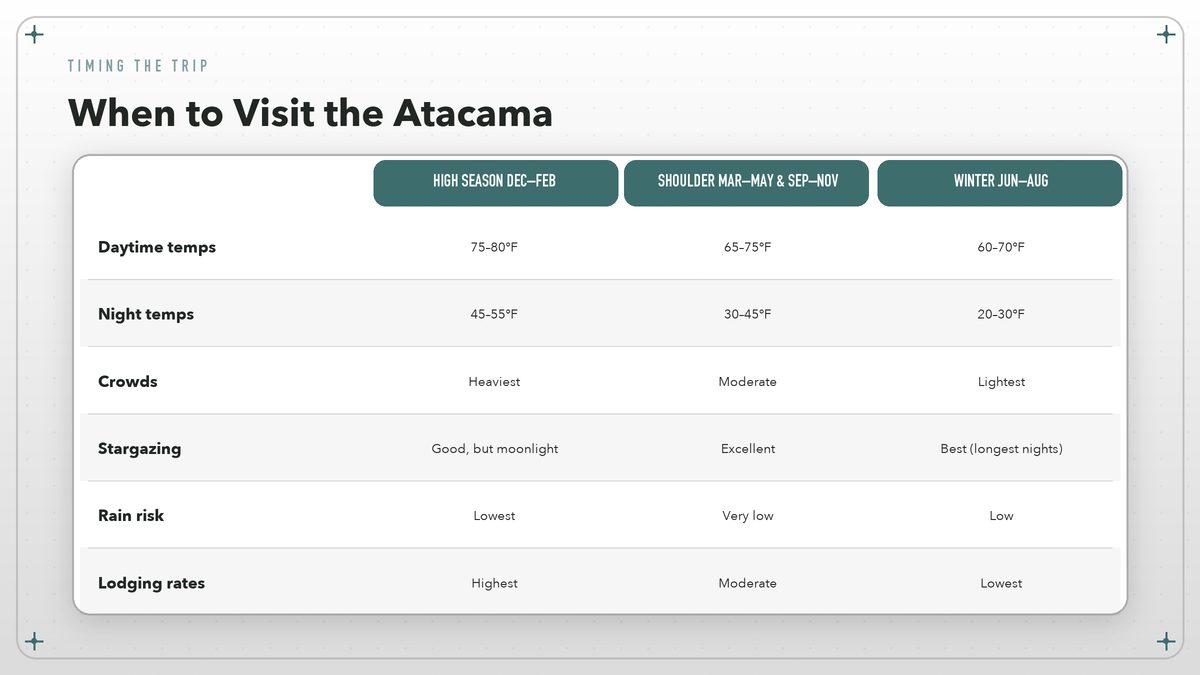
The Atacama is a year-round destination, but the seasons feel different. December through February is the warmest and busiest period. Days are sunny and mild, nights are cool but not freezing, and Chilean holiday traffic fills San Pedro. March through May and September through November are the shoulder seasons. Temperatures are still pleasant, crowds thin out, and lodge rates drop. June through August is winter in the southern hemisphere. Days are crisp, nights are cold, and some high-country roads can ice over in the early morning. The trade-off is the darkest skies of the year and the fewest tourists.
Rain is rare at any time, though January and February can bring the occasional afternoon shower or the unusual weather pattern known as the Bolivian winter, when tropical moisture pushes south and turns parts of the desert green with dormant seeds. It does not happen every year. When it does, photographers descend from around the world.
A Five-Day Itinerary
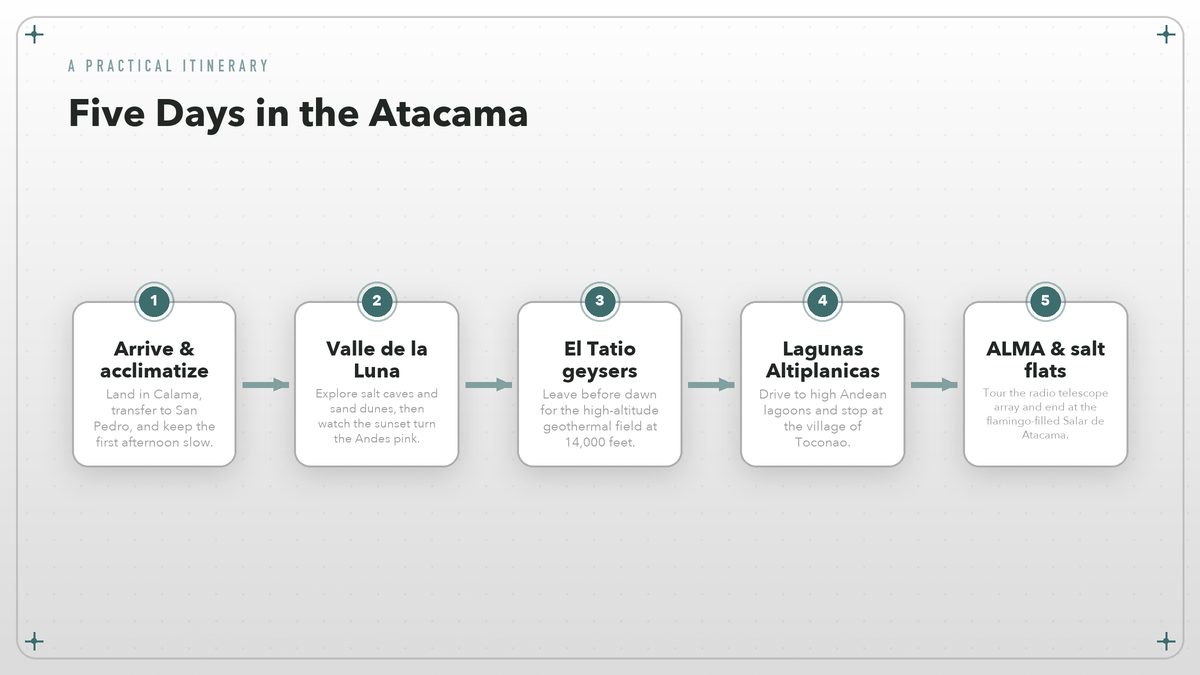
Five days is enough to see the main sights without rushing. It also gives your body time to adjust.
On day one, arrive in Calama and transfer to San Pedro. Do not plan much. Walk around the plaza, eat a light dinner, and go to bed early. Your body is adjusting to thin air even if you do not feel it yet.
Valle de la Luna works well on day two. The site is close, the walking is moderate, and the sunset is the headline. You will be back in town for dinner at a reasonable hour.
Reserve day three for El Tatio. Accept the 4:00 a.m. departure. The geysers are best at dawn, and returning by midday leaves the afternoon free for a nap or a soak in the Puritama Hot Springs.
The high-lagoon circuit fits day four: Miscanti, Miñiques, and the village of Toconao. The drive is scenic, the altitude is serious, and the photography is excellent. Pack a picnic.
For day five, combine a visit to the Salar de Atacama with an ALMA tour if you reserved one, or with an evening stargazing session. Do not try to cram both ALMA and a late-night telescope tour into the same day unless you genuinely enjoy exhaustion.
What to Pack
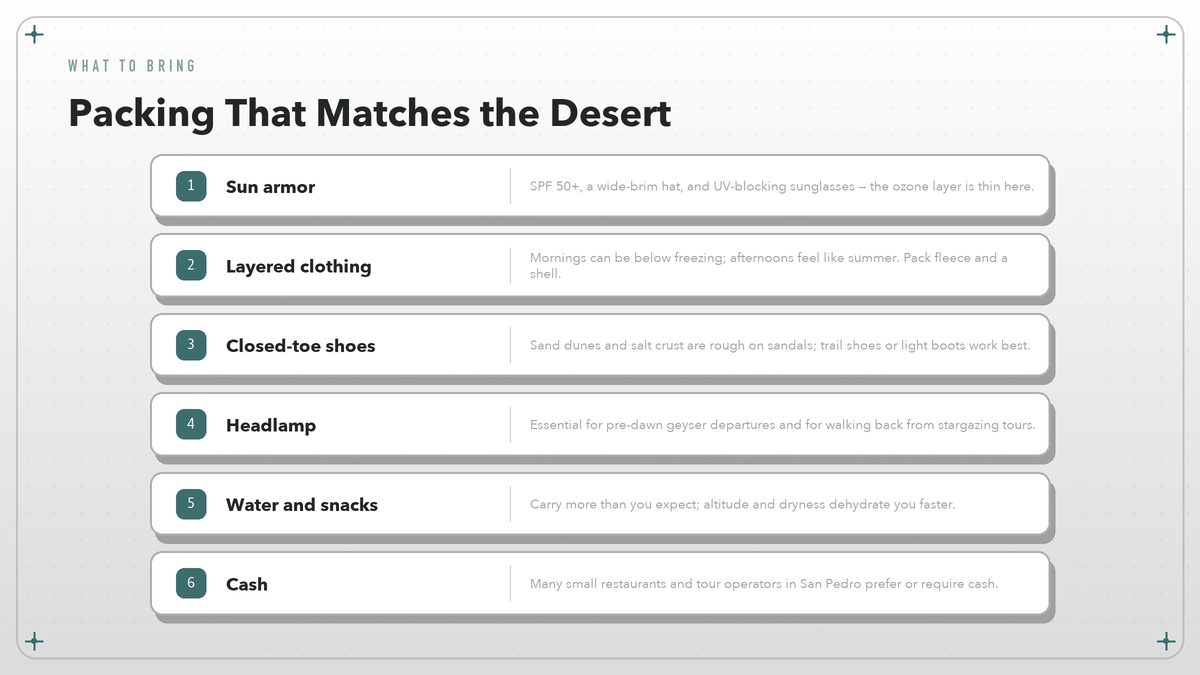
Packing for the Atacama is about managing extremes. Daytime temperatures in the sun can feel like a warm summer afternoon, while shade and nighttime temperatures drop fast. The air is so dry that lips crack and skin flakes within a day or two.
Start with sun protection. A wide-brim hat, SPF 50 sunscreen, and quality sunglasses are non-negotiable. The UV intensity at this altitude and latitude is fierce, and the lack of humidity means you do not feel yourself burning, so reapply sunscreen every few hours. Your future self will thank you.
Bring layers. A fleece or light down jacket, a windproof shell, and a warm hat are useful even in summer. For the El Tatio sunrise, you will want gloves and a heavy layer; for the afternoon, a t-shirt is enough. Mornings can start below freezing and afternoons can hit the high seventies. No single outfit handles both.
Footwear should be closed-toe and sturdy. Trail shoes are ideal for the salt caves and dunes, while sandals are fine for walking around San Pedro but a poor choice for most excursions. A headlamp is handy for the pre-dawn geyser departure and for walking back from stargazing tours. Cash, a reusable water bottle, and lip balm round out the essentials.
Practical Details
Entrance fees add up. Valle de la Luna, the high lagoons, and the flamingo sectors of the salt flat each charge separate fees, usually payable in cash. Some sites have online reservation systems during peak season. Carry small bills; change can be scarce in remote ticket booths.
Tours are easy to book on arrival, but ALMA visits and some high-end stargazing experiences require reservations days or weeks ahead. If those matter to you, plan before you leave home. Otherwise, showing up in San Pedro and comparing agencies works fine.
Connectivity is limited. San Pedro has reasonable cell service and wifi in hotels, but many excursion areas have none. Download offline maps, and tell someone your plans if you are driving alone. The desert is not actively hostile, but it is indifferent. A flat tire or a wrong turn can become serious quickly when the next car might be an hour away.
The nearest medical care beyond a small clinic is in Calama. For anything serious, evacuation to Antofagasta or Santiago may be necessary. Travel insurance that covers altitude-related evacuation is worth confirming. NASA keeps a useful public image and summary of the region’s extreme environment, which gives a sense of just how harsh the conditions can be.
Why the Atacama Is Worth the Effort
The Atacama is not a relaxing beach vacation. It is dry, high, cold at night, and intense under the sun. The rewards come in different forms. You will see terrain that looks borrowed from another planet. You will stand under a night sky so dense with stars that the constellations become hard to pick out. In a small but real way, you will understand why scientists come here to rehearse for Mars.
It also forces a slower pace. There is nowhere to rush to, and the altitude makes rushing feel foolish anyway. You drink water. You watch the light change. You wait for the stars. That slowness is the point. The desert does not perform for you. It simply is.
Check current fees, road conditions, and ALMA tour availability before traveling. Official sources include Chile Travel, CONAF, the ALMA Observatory, ESO, and NASA.