
Chile’s Atacama is the driest non-polar desert on Earth, a high-altitude expanse of salt flats, geysers, and volcanic peaks that looks more like Mars than anywhere else most travelers will reach.
The first thing that strikes you about the Atacama is the silence. Not forest-hush, not snow-quiet, but an absence of sound so complete that you become aware of your own heartbeat. Stand on the edge of the Salar de Atacama at dawn and the only movement might be a flock of flamingos picking their way through pink-tinged brine, wings catching the first light from the Andes. The desert sits in northern Chile, stretching roughly 600 miles along the Pacific coast and inland to the Bolivian and Argentine borders. Some weather stations here have never recorded rain, not a trace in the gauge across decades of watching. The ground is so dry that NASA has used the region to test instruments bound for Mars, which tells you something about what you’re stepping into. The altitude and the sun, plus the distances, mean you can’t just show up the way you would at a beach town. Plan it like a small expedition and the payoff is one of the most visually arresting places in the Americas.
Most independent travelers base themselves in San Pedro de Atacama, a low adobe town of only a few thousand residents that sits at about 7,900 feet above sea level. That elevation is high enough to slow you down on day one but low enough to sleep reasonably well, which is why nearly every itinerary starts here. From there you can reach the major sights in a few hours by rental car, bicycle, or organized tour. The town is compact and walkable, with low buildings and unpaved side streets ringing a small central plaza where tour operators and family restaurants compete for your attention. It feels like the last outpost before the high plateau, and geographically that’s about right.
In this article
Where the Atacama Actually Is
The Atacama Desert occupies the northern third of Chile, wedged between the Pacific Ocean and the Andes. Its core visitor area lies in the Antofagasta Region, roughly 1,000 miles north of Santiago. Calama, about 60 miles east of San Pedro, has the nearest airport with regular flights. From there the road climbs steadily onto the Altiplano, the high plateau shared with Bolivia, Peru, and Argentina, and you’ll feel the altitude in your breathing well before you reach town. Chile Travel, the country’s official tourism site, has up-to-date background on the region and the main gateways.
The desert’s dryness comes from geography and ocean currents working together. The cold Humboldt Current chills the air offshore, which suppresses evaporation and keeps Pacific moisture from reaching the coast. East of the crest, the Andes block what little rain pushes over from the Amazon basin. The result is a strip of land where annual precipitation in some spots is measured in millimeters per century. That extreme aridity has preserved ancient mummies and Inca trails with an eerie completeness, along with early 20th-century nitrate mining camps. It also means there’s almost no vegetation to soften the view. What you see is rock, salt, sand, and sky.
Don’t expect Sahara-style dunes everywhere. The Atacama is mostly a desert of texture, with crusted salt pans and geothermal vents scattered among badlands carved by water that hasn’t flowed in thousands of years. The dunes do exist, particularly in the Valle de la Muerte, but they’re one element in a much larger geologic puzzle. Give a site an hour instead of the tour-bus twenty minutes and the textures start to separate into things you can name.
Getting There and Getting Around
Fly into El Loa Airport in Calama, airport code CJC. LATAM and Sky Airline run several flights daily from Santiago, a hop of about two hours, with less frequent connections from other Chilean cities. From Calama you have three options for the 60-mile transfer to San Pedro: a pre-booked private transfer, a shared minibus shuttle, or a rental car. The road is paved and straightforward, climbing from Calama’s mining sprawl up onto the plateau in roughly 90 minutes. If you’re flying in from sea level, don’t schedule anything ambitious for the first evening; the altitude will make that decision for you.
Once you’re in San Pedro, you don’t strictly need a car for the standard sights. Tour agencies along the main strip sell half-day and full-day trips to every major attraction, and the prices stay reasonable because the competition is fierce. A rental car, however, buys you freedom. You can leave before dawn without waiting for a van full of strangers, and you can stay at a viewpoint after the tour buses roll back to town. A standard two-wheel-drive car handles the paved and graded roads to Valle de la Luna, the salt flat overlooks, and the village of Toconao. For more remote tracks, ask locally about current conditions, since some require high clearance or a guide depending on recent weather.
Bicycles are popular for nearby sites like Pukará de Quitor and the Catarpe Valley, though at this altitude even gentle climbs feel harder than they look, and your lungs will tell you so on the first hill. E-bikes are increasingly available around town and worth the extra cost unless you’re arriving already acclimatized from Bolivia, and on foot San Pedro is small enough to cross in fifteen minutes. Watch for the occasional stray dog and the soft sand that swallows regular shoes.
San Pedro de Atacama as a Base
San Pedro isn’t a polished resort town. It’s a functional village that happens to be surrounded by extraordinary geology, and the streets show it, narrow and mostly unpaved and lined with plain adobe walls rather than resort façades. Accommodation runs from backpacker hostels and mid-range boutique hotels to eco-lodges and a handful of high-end properties on the outskirts, and prices swing widely between the January–February peak and the quieter shoulder months. Book early if you’re coming in January or February, when Chilean summer holidays fill every bed.
The town’s main strip, Calle Caracoles, is where restaurants and tour agencies cluster, with souvenir shops filling the gaps, and it’s also where you’ll find the handful of ATMs. Those machines can run out of cash on busy weekends, so withdraw when you see one that’s working. Many smaller restaurants and family-run tour operators prefer cash or charge extra for card payments. Bring Chilean pesos, because US dollars aren’t useful here.
Water is a serious concern, more than most travelers expect. The town relies on a limited aquifer that tourism has strained for years, so short showers are the standard courtesy in most lodgings. Some upscale lodges run their own filtration systems, but you shouldn’t count on drinking from the tap everywhere. Buy a large jug of water for your room, it costs only a few thousand pesos at any corner store, and carry a reusable bottle. The dryness sneaks up on you: by the time you feel thirsty, you’re already behind on fluids.
Food in San Pedro ranges from basic set-menu lunches to ambitious takes on Altiplano ingredients, with quinoa and llama turning up alongside fresh Andean potatoes and a lot of eggs. The altitude affects cooking, since water boils at a lower temperature up here and doughs behave differently, which is why bread and cakes can come out denser than at sea level. That’s just physics, and after a day or two nobody notices.
The Landscapes You Came For
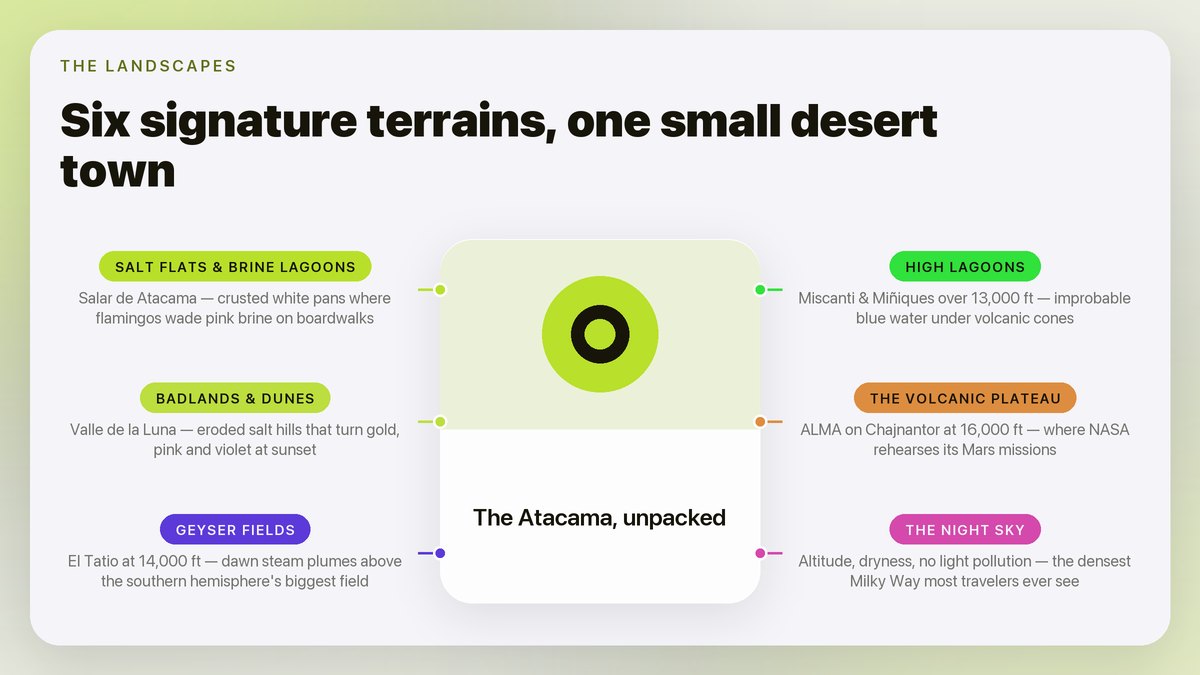
The real reason to visit the Atacama is the scenery, and the half-dozen standard excursions each reach a different kind of terrain, from brine lagoons to the ALMA plateau.
Valle de la Luna
Valle de la Luna, the Valley of the Moon, is the closest major attraction to San Pedro and the most visited, sitting in the eroded folds of the Cordillera de la Sal hills a short drive west of town. It’s a bowl of salt-crusted hills and sand dunes around eroded rock formations that turn gold, pink, and violet as the sun drops. The classic visit is a late-afternoon entry followed by a hike to a viewpoint for sunset, and the light changes fast, one minute the peaks look beige and the next they seem lit from inside. Bring a fleece even in summer, because once the sun disappears the temperature falls quickly.
The park has a defined circuit with stops for short walks through salt caves and up dunes. It isn’t a strenuous day, though the altitude makes the climbs slower than they appear. Go early or late to avoid the midday heat and the biggest van convoys, which tend to arrive between about 11 a.m. and 2 p.m. Tickets are sold at the entrance. The park also limits visitor numbers at peak times. CONAF, Chile’s national parks service, manages access and publishes current hours and fee information.
El Tatio
El Tatio is the largest geyser field in the southern hemisphere and one of the highest in the world, sitting at roughly 14,000 feet. The geysers are most dramatic at sunrise, when the sub-freezing air turns the steam columns into towering white plumes that drift sideways across the first light. Tours leave San Pedro between 4:00 and 5:00 a.m. to arrive before dawn, and it’s an early start on top of thin air that can leave you winded walking to the viewing line. The spectacle, though, is worth the lost sleep.
After watching the geysers, most tours stop at a small thermal bath where you can soak in water warmed by the same volcanic system, and soaking in hot water while the air sits below freezing is the part people remember. Bring a swimsuit and a towel, plus warm clothes for the ride back down. Don’t dunk your head at this altitude, because the temperature shock at 14,000 feet is no place to learn how your body reacts, and the morning ends with breakfast near the geyser field before the long drive back down.
Lagunas Altiplanicas
The high-altitude lagoons Miscanti and Miñiques sit at over 13,000 feet, fed by snowmelt from volcanic peaks that rise directly from their shores. The water is an improbable blue, the kind of color that makes you check whether your camera’s saturation slider is broken. Vicuñas graze the surrounding grasslands, and if you’re lucky, you might spot a flamingo working one of the smaller pools. The road from San Pedro passes Toconao, a village known for its white volcanic-stone church and crafts made from local materials.
This excursion is best saved for after you’ve spent at least one full day acclimatizing in San Pedro. The air is thin enough up here that even walking from the parking lot to the lagoon edge can leave lightheaded visitors sitting on a rock, so take it slow and carry water, and don’t let the van’s schedule talk you out of the extra ten minutes at the shore.
Salar de Atacama
The Salar de Atacama is Chile’s largest salt flat, a vast white expanse interrupted by briny lagoons where flamingos feed on microscopic algae. The most accessible viewpoint is the Los Flamencos National Reserve sector near Chaxa Lagoon, roughly an hour’s drive south of San Pedro. Boardwalks keep visitors above the fragile crust while allowing close views of flamingos and Andean avocets, and other birds adapted to salinity several times harsher than the ocean.
At sunset the salt turns warm colors and the volcanoes to the east cast long shadows across the flat. Compared with the Bolivian Uyuni salt flat a few hundred miles north, which dwarfs it, it’s a quieter experience, partly because the area is smaller and partly because the infrastructure is more controlled, which is a good thing for the site itself, since the flamingos and the fragile salt crust don’t need the volume of visitors that Uyuni draws every dry season.
ALMA and the Night Sky
The Atacama Large Millimeter/submillimeter Array, better known as ALMA, sits on the Chajnantor Plateau at 16,000 feet, about 30 miles east of San Pedro. It’s the most powerful radio telescope array on Earth, with 66 high-precision antennas working as one instrument in a partnership among North America, Europe, and East Asia, and it has produced some of the most detailed images of star and planet formation ever captured. Public visits to the operations support facility, down at 9,500 feet, are free but must be reserved in advance through the ALMA Observatory website, while the high site at 16,000 feet stays off-limits to tourists.
Even if you don’t visit ALMA, the desert’s night sky is reason enough to stay up late. High altitude and extreme dryness, plus almost no light pollution, make this one of the best stargazing locations on the planet: the Milky Way rises in a broad arch, and satellites drift across the darkness every few minutes. ESO, the European partner in ALMA, publishes background on why this corner of Chile is so prized by astronomers. Amateur stargazing tours run nightly from San Pedro and usually include a telescope and hot drinks, plus a patient guide who can point out the Southern Cross.
Dealing With Altitude
Altitude is the variable that separates a great Atacama trip from a miserable one. San Pedro’s 7,900 feet are enough to cause mild headaches or shortness of breath for the first day or two, especially if you flew directly from sea level, which is exactly how most North American travelers arrive. The geysers at El Tatio and the lagoons at Miscanti and Miñiques are above 13,000 feet, where altitude sickness becomes a real possibility rather than a background risk.
The standard advice is boring because it works. Take it easy on arrival, drink more water than you think you need, and skip heavy alcohol for the first 24 hours; it hits noticeably harder up here. Eat light meals. If a headache starts, rest before pushing higher. Most people acclimatize naturally within a day or two, while those who ascend too fast often spend a morning in bed with a pounding headache while their friends watch geysers.
Coca tea isn’t part of Chilean culture the way it is in Bolivia or Peru, so don’t expect to find it on every menu. Some tour operators carry basic first-aid supplies and oxygen canisters for emergencies on the high excursions. If you have a history of altitude-related problems, talk to a clinician before the trip and consider building in an extra acclimatization day. This isn’t the place to test your body’s limits.
When to Go
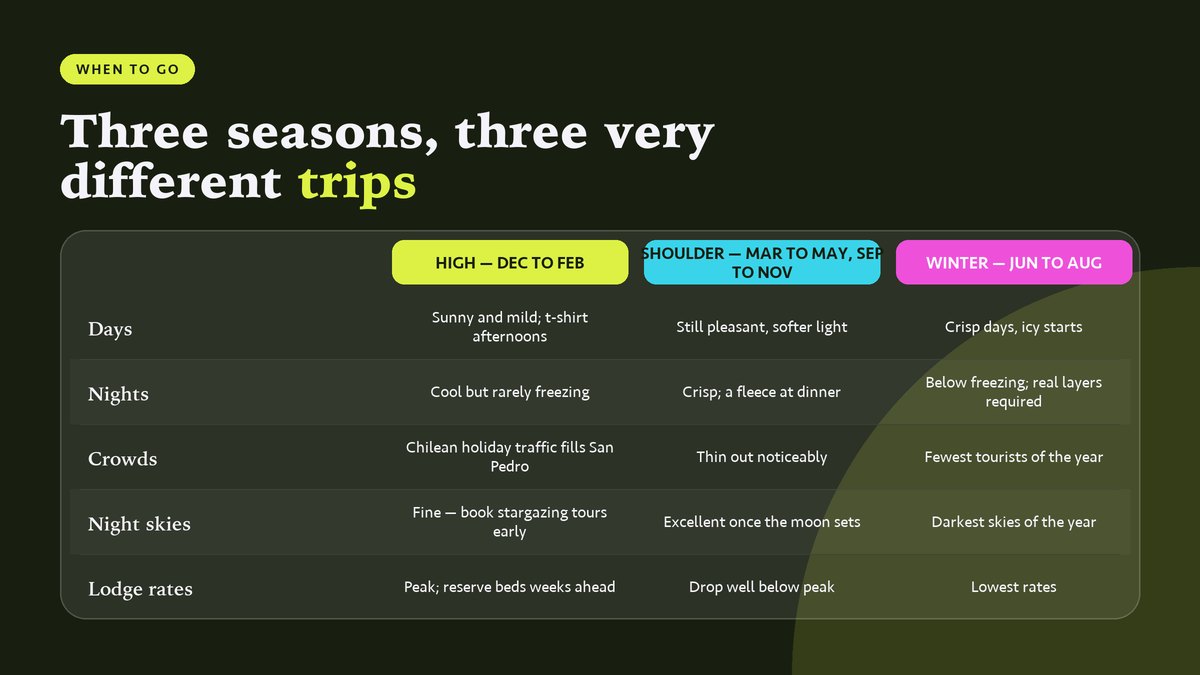
The Atacama is a year-round destination, but the seasons feel different enough to shape the trip. December through February is the warmest and busiest period, with sunny days and nights that are cool but not freezing, plus holiday traffic from Santiago and the rest of Chile. March through May and September through November are the shoulder seasons, when temperatures stay pleasant while crowds thin and lodge rates drop. June through August is winter in the southern hemisphere, with crisp days and cold nights plus the chance of ice on high-country roads in the early morning. The trade-off is the darkest skies of the year and the fewest tourists.
Rain is rare at any time, though January and February can bring the occasional afternoon shower or the unusual weather pattern known as the Bolivian winter, or invierno altiplánico, when tropical moisture pushes south and turns parts of the desert green with dormant seeds. It doesn’t happen every year. When it does, photographers descend from around the world.
A Five-Day Itinerary
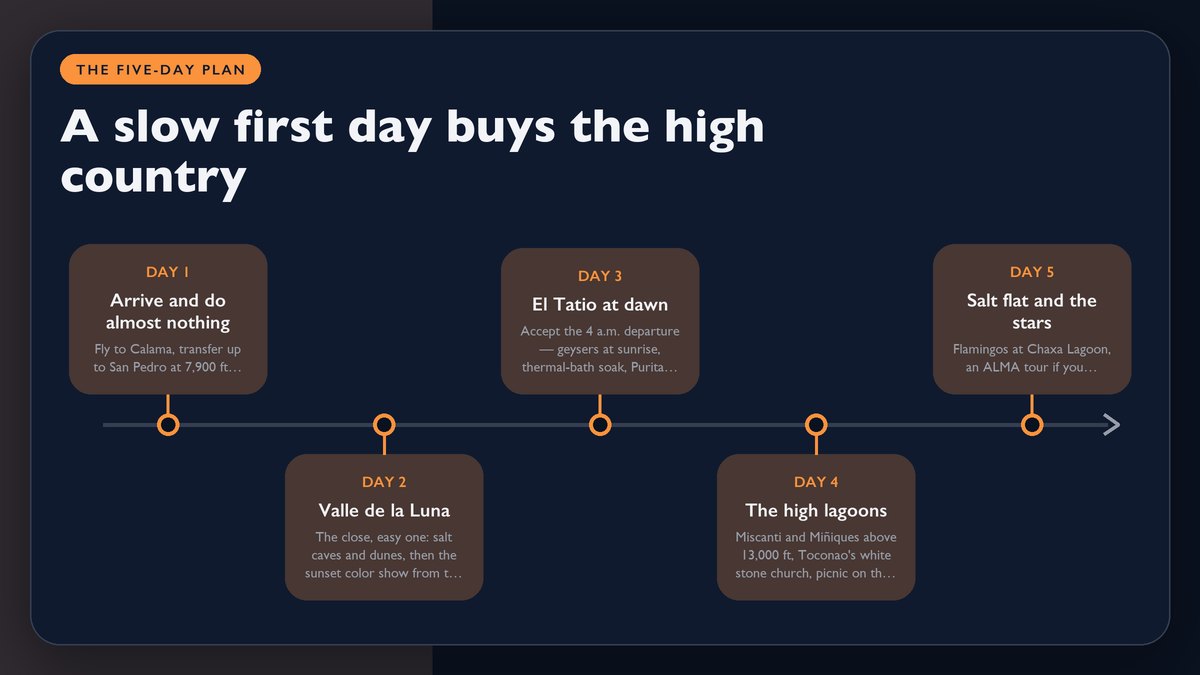
Five days is enough to see the main sights without rushing, and, more important at this altitude, it gives your body the buffer the schedule needs.
Day one is for arriving in Calama and transferring to San Pedro; don’t plan much beyond the plaza. Walk around the church square, eat a light dinner on Caracoles, and go to bed early. Your body is adjusting to thin air even if you don’t feel it yet.
Valle de la Luna works well on day two. The site is close, the walking is moderate, and the sunset is the headline, so you’ll be back in town for dinner at a reasonable hour without the van ride eating your evening.
Reserve day three for El Tatio. Accept the 4:00 a.m. departure, because the geysers are best at dawn. You’ll be back by midday, which leaves the afternoon free for a nap or a soak in the Puritama Hot Springs, a chain of thermal pools in a canyon about 20 miles north of town.
The high-lagoon circuit fits day four, looping Miscanti and Miñiques with the village of Toconao. The drive is scenic and the photography is excellent, though the altitude is serious and there’s no food for sale at the lagoons, so pack a picnic in San Pedro before you leave.
For day five, combine a visit to the Salar de Atacama with an ALMA tour if you reserved one, or with an evening stargazing session. Don’t try to cram both ALMA and a late-night telescope tour into the same day unless you really enjoy running on four hours of sleep.
What to Pack
Packing for the Atacama is about managing extremes. Daytime temperatures in the sun can feel like a warm summer afternoon, while shade and nighttime temperatures drop fast once the plateau radiates its heat away. The air is so dry that lips crack within a day or two, so keep lip balm in your pocket.
Start with sun protection, because the UV intensity at this altitude and latitude is fierce. A wide-brim hat and quality sunglasses are non-negotiable, and so is SPF 50 sunscreen, because the lack of humidity means you won’t feel yourself burning. Reapply sunscreen every couple of hours whether you think you need it or not.
Bring layers rather than one heavy coat. A fleece or light down jacket plus a windproof shell covers most situations, and a warm hat earns its space even in summer. For the El Tatio sunrise, you’ll want gloves and a proper winter layer, while the same afternoon can call for a t-shirt. Mornings at 14,000 feet can start below freezing and afternoons in San Pedro can hit the high seventies.
Footwear should be closed-toe and sturdy, with trail shoes ideal for the salt caves and dunes and sandals fine for walking around San Pedro but a poor choice on most excursions. A headlamp is handy for the pre-dawn geyser departure and for walking back from stargazing tours. Cash in small bills and a reusable water bottle round out the essentials.
Practical Details
Entrance fees add up faster than people expect. Valle de la Luna, the high lagoons, and the flamingo sectors of the salt flat each charge separate fees, usually payable in cash, and the foreigner rates at the busiest sites often run 10,000 pesos or more per entrance. Some sites have online reservation systems during peak season. Carry small bills, because change can be scarce in remote ticket booths.
Tours are easy to book on arrival, but ALMA visits and some high-end stargazing experiences require reservations days or weeks ahead, so plan before you leave home if those matter to you. Otherwise, comparing agencies on arrival works fine.
Connectivity is limited. San Pedro has reasonable cell service and wifi in hotels, but many excursion areas have none, so download offline maps before you set out. If you’re driving alone, tell someone your route and when you expect to be back in cell range. The desert isn’t actively hostile, but it is indifferent, and a flat tire or a wrong turn can become serious quickly when the next car might be an hour away.
The nearest medical care beyond a small clinic is in Calama, an hour down the road, and for anything serious, evacuation to Antofagasta or Santiago may be necessary. Travel insurance that covers altitude-related evacuation is worth confirming before you fly. NASA keeps a useful public image and summary of the region’s extreme environment, which gives a sense of just how harsh the conditions can be.
Why the Atacama Is Worth the Effort
The Atacama isn’t a relaxing beach vacation, and it doesn’t try to be. It’s dry, high, cold at night, and intense under the sun, and what you get in return is terrain that looks borrowed from another planet, salt crusts and steaming vents and dune fields within an hour of each other, plus a night sky so dense with stars that the constellations become hard to pick out. In a small way, you’ll understand why scientists come here to rehearse for Mars.
The trip also forces a slower pace. There’s nowhere to rush to, and the altitude makes rushing feel foolish anyway. You drink water, watch the light change on the Cordillera de la Sal, then wait for the stars to come out after dinner. That slowness is the point, at least for travelers who give it five days instead of two.
Check current fees, road conditions, and ALMA tour availability before traveling. Official sources include Chile Travel, CONAF, the ALMA Observatory, ESO, and NASA.
Keep reading
 Destination GuidesCalifornia’s Desert Parks by Car: A Practical Guide to Joshua Tree, Death Valley, and the Mojave Preserve
 Destination GuidesNewfoundland and Labrador by Car: A Practical Guide to the Viking Trail and Beyond
 Destination GuidesGreat Smoky Mountains National Park: A Practical Guide to America’s Most Visited Park