Destination Guides · Canada
Banff in July and Banff in October are two different destinations that happen to share a postcode. The right season depends on what you came for — and the wrong one can strand you at a closed road, a frozen lake, or a shuttle stop with no reservation.
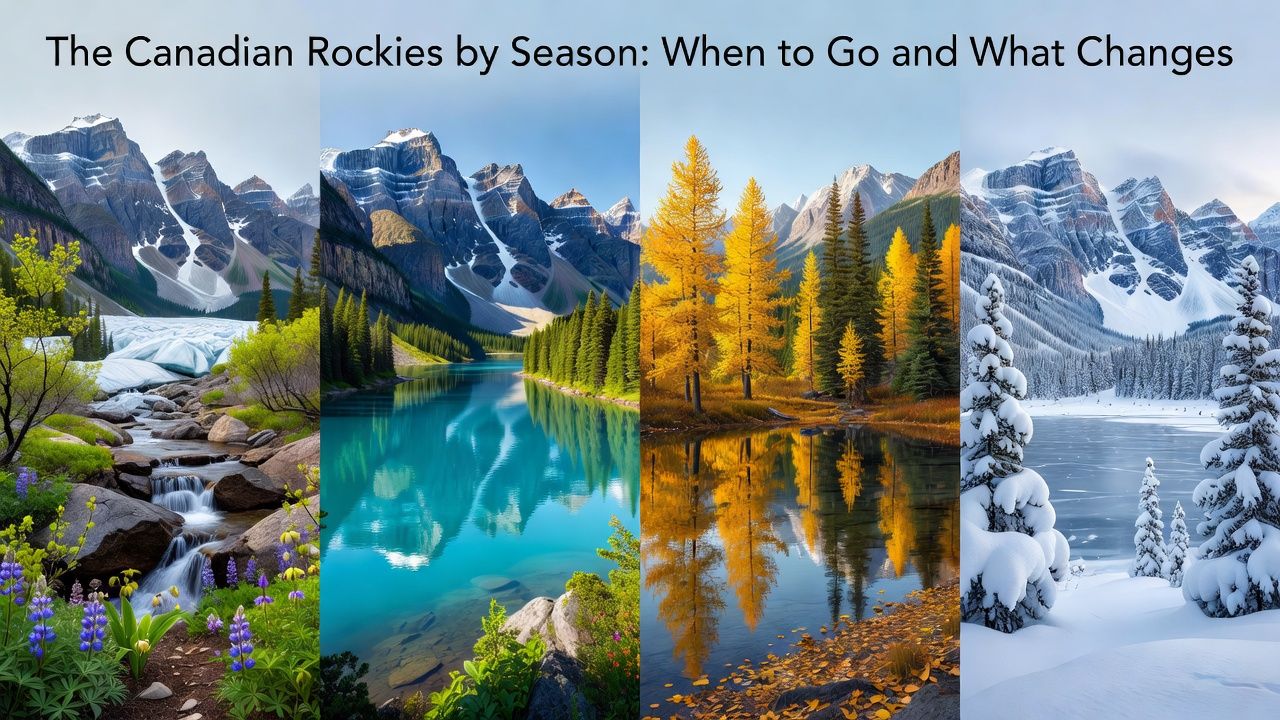
The Canadian Rockies sell a single image: a turquoise lake, a wall of peaks, maybe a canoe. What the brochures don’t mention is that the lake is turquoise for about four months, frozen for six, and reachable only by shuttle bus for all of them. These mountains run on a strict seasonal calendar, and a trip that’s magical in one window can be genuinely disappointing two months either side of it.
This guide walks through the year in Banff and Jasper — the two anchors, along with Yoho and Kootenay next door — season by season: what opens, what closes, what the crowds and prices do, and which experiences belong to which months. The goal isn’t to tell you the “best” time. It’s to match the trip you want to the season that actually delivers it.
The Lay of the Land A sixty-second orientation
Banff National Park, an hour and a half west of Calgary, holds the famous southern sights: Banff townsite, Lake Louise, Moraine Lake, and the Icefields Parkway heading north. Jasper National Park, four hours up that parkway, is bigger, wilder and noticeably quieter. Yoho and Kootenay sit just over the continental divide in British Columbia — smaller, less crowded, and home to some of the best hiking in the range. Most visitors base in Banff town, Canmore (just outside the park gates, cheaper, less charming), or Lake Louise village, and day-trip from there.
Everything runs through Parks Canada: park entry requires a pass (daily or the annual Discovery Pass, which pays for itself around day seven across parks), and current conditions, closures and reservation systems live on the official pages for Banff and Jasper. Bookmark them. In these parks, conditions change the trip more than any brochure does.
Summer: Late June to Early September Everything open, everyone here
This is the Rockies at full throttle. Every road, trail and lake is open; the wildflowers peak in the alpine meadows in July; daylight stretches past ten at night. It’s also when the parks absorb their entire annual crowd in a single surge. Lake Louise’s shoreline at midday in August is a pilgrimage site with a queue’s atmosphere, and hotel prices in Banff town reach levels that would make a Swiss resort nod respectfully — US$400 and up for ordinary rooms is common, and the good places sell out months ahead.
The single most important summer fact: you cannot drive to Moraine Lake. Personal vehicles have been banned from Moraine Lake Road since 2023; access is by Parks Canada shuttle, licensed commercial transport, bike, or on foot. Shuttle reservations open in a spring release and the prime morning slots go fast — though a portion is held for release two days ahead, which rewards the flexible. Lake Louise still allows cars, but the parking lot fills by around sunrise on summer weekends, after which it’s shuttles from the park-and-ride. Build your summer days around 6 a.m. starts or around shuttle bookings; there is no third option.
Summer is the season for the big hikes (Sentinel Pass, the Plain of Six Glaciers, the Skyline Trail in Jasper), canoe mornings on the lakes, and the full Icefields Parkway experience with stops at the Columbia Icefield. Book accommodation and shuttles the week reservations open. That sentence is the whole summer strategy.
Autumn: Mid-September to Mid-October The connoisseur’s window
Ask a local when to come and many will say: the last two weeks of September. The summer crowds evaporate after Labour Day, prices drop, the air turns crystalline — and for roughly three weeks, the subalpine larch trees turn gold. Larch season is the Rockies’ second great spectacle: conifers that behave like deciduous trees, blazing yellow against dark peaks and early snow dust, concentrated around Larch Valley (above Moraine Lake), Saddleback Pass and the Arnica Lake trail.
The catch is logistics and weather roulette. The Moraine Lake shuttle system still runs through larch season — the vehicle ban doesn’t lift — and demand for those weeks now rivals July. Meanwhile the season turns fast: the first serious snow can fall any time from late September, the high passes can close temporarily, and by mid-October most services wind down, some restaurants close, and the lakes begin their freeze. Come prepared for four seasons in one hike, and treat the golden-larches-against-fresh-snow photograph as a gift, not a guarantee.
“Larch season is the Rockies’ second great spectacle — three weeks when the conifers turn to gold and the crowds somehow haven’t noticed. They’re starting to notice.”
Winter: November to March A different park entirely
Winter is not the off-season here; it’s a second main event. Three ski areas serve Banff National Park — Sunshine Village, Lake Louise Ski Resort, and Mt. Norquay — with a season that typically runs from November into May, one of the longest in North America. Jasper has Marmot Basin, smaller and friendlier. Beyond skiing, the winter catalogue is deep: skating on Lake Louise beneath the Victoria Glacier, the Johnston Canyon ice walk past frozen waterfalls, snowshoeing into silent valleys, dog sledding, and hot springs in Banff and at Miette in Jasper.
The honest caveats. It’s cold — minus-twenty Celsius cold snaps happen, and they change what a “walk around the lake” means. Daylight is short in December. The Icefields Parkway stays open but is a serious winter drive: no services for 230 kilometres, avalanche zones, and a genuine requirement for good tires and good judgment; check road reports before committing. And the famous lakes lose the turquoise — they’re frozen and snow-covered from roughly November to May. If the blue water is your reason for coming, winter is the wrong trip. If it’s mountains, snow and half-price hotels, winter might be the best one.
Spring: April to Early June The shoulder with sharp edges
Spring is the Rockies’ cheapest and most complicated season. The valleys green up, the bears come out of hibernation (April into May, hungry and near the roads — a spectacle in itself), waterfalls run hard with meltwater, and hotel rates fall to their annual low. It’s the only season where Banff feels like a town rather than an attraction.
But the mountains are still in winter mode. High trails hold snow into June and July — avalanche risk lingers on the backcountry classics long after the valleys feel like spring — and the lakes’ thaw is a slow-motion event: Lake Louise typically stays frozen into late May or early June, and the water doesn’t develop its famous colour until the glacial rock flour starts flowing with the melt, generally by late June. Come in May for bears, waterfalls, empty trails in the valley bottoms and the best prices of the year. Don’t come in May expecting the postcard lake.
| Season | Months | Best for | Watch out for |
|---|---|---|---|
| Summer | Late Jun–early Sep | All trails, turquoise lakes, wildflowers | Peak crowds and prices; shuttle reservations essential |
| Autumn | Mid-Sep–mid-Oct | Larch gold, thin crowds, value | Early snow; services closing by mid-Oct |
| Winter | Nov–Mar | Skiing, ice walks, hot springs | Deep cold; frozen lakes; serious driving |
| Spring | Apr–early Jun | Bears, waterfalls, lowest prices | Lakes still frozen; high trails snowbound |
The Logistics That Matter More Than the Season Reservations, passes, fires
Book ahead, further than feels reasonable. Summer accommodation in Banff and Jasper, Moraine Lake shuttles, and the popular front-country campgrounds all run on reservation systems that open months out and empty fast for July and August. This is not a destination that rewards winging it in high season.
The park pass is mandatory and the annual one often wins. Entry is charged per person per day; the Discovery Pass covers all national parks for a year. Check current rates on the Parks Canada pages linked above.
Wildfire is now part of the calendar. Recent years have made smoke a real summer variable across western Canada, and Jasper’s 2024 wildfire — which damaged part of the townsite — was a reminder that fire shapes these forests, and occasionally the visit itself. Jasper has been rebuilding and welcoming visitors since; check current area status before you go. In July and August, watch the air quality and fire maps as closely as the weather forecast, and keep a flexible plan if you’re smoke-sensitive.
Wildlife is a feature with rules. Elk calve in Banff town in spring (give them a wide berth — protective mothers charge), bears are active April through October, and the parks enforce food-storage and distance rules with real fines. Carry bear spray on trails, know how to use it, and never approach for a photograph. The animal does not know it’s famous.
Getting There and Getting Around The logistics under the logistics
Calgary is the gateway — 90 minutes from Banff townsite by highway — and most visitors either rent a car there or take one of the frequent airport shuttles. The car question deserves a seasonal answer. In summer, a car is useful for the Icefields Parkway and the quieter trailheads but useless at the two famous lakes, where shuttles rule regardless; many summer visitors now skip the rental entirely and combine shuttles, the Roam transit network (which covers Banff town, Lake Louise and the park-and-ride), and commercial day tours. In winter, a car with proper winter tires is the flexible option for confident winter drivers, while the shuttle-plus-ski-bus combination serves everyone else. In shoulder seasons, the car wins outright. One more seasonal note: the Icefields Parkway to Jasper is one of the world’s great drives from June to September and a serious undertaking in winter — no fuel or services for 230 kilometres, chains or good winter tires essential, and a check of the road report before every attempt.
Sample Weeks by Season Putting it together
A summer week: Banff base; dawn at Moraine Lake (shuttle), Lake Louise lakeshore and the Plain of Six Glaciers tea house hike; a full Icefields Parkway day with the Columbia Icefield stop; two Jasper days (Maligne Lake, the Skyline or Valley of the Five Lakes); a rest day in Banff with the hot springs and the gondola. Book everything the week reservations open.
A larch-season week: Late September; Canmore base for value; Larch Valley at sunrise on a shuttle booking; the Arnica Lake or Healy Pass hikes as crowd-free alternatives; a Parkway day in golden light; flexible final days to chase the best weather window. Pack for snow at altitude and enjoy the year’s best photography.
A winter week: Three ski days split between Lake Louise and Sunshine; the Johnston Canyon ice walk in the morning quiet; a Lake Louise skate beneath the glacier; a Jasper or hot springs day; and one buffer day for the cold snap or the storm that winter will eventually send. Hotels at half their summer rates.
A spring week: May; valley trails and viewpoints, bear jams at respectful distance from the car, the waterfalls at full melt, the townsite museums and breweries, and the year’s cheapest beds — with the honest understanding that the famous lakes stay frozen and the high trails stay snowbound.
Matching the Season to the Traveller
First visit, want the postcard? Late June to mid-July, or larch season in late September if you can get the shuttle slots. Accept the crowds as the price of the full palette.
Hiker who hates queues? Mid-September. Golden larches, cold clear mornings, and room to breathe — with warm layers for the summit snow that may already be falling.
Skier or winter romantic? January to March for the most reliable snow; November and April for value. Build in one rest day at the hot springs.
Budget traveller? May or October, based in Canmore, self-catering, valley trails and viewpoints. The mountains don’t charge by the season; only the beds do.
Photographer? Two trips, honestly — one in late September for the larches, one in deep winter for the ice and the light. If forced to choose one: the last week of September, sunrise slots booked the minute they open.
Whatever the season, the same rule applies: these parks reward the early riser more than any gadget, reservation hack or expensive lens. The famous viewpoints at 7 a.m. and at 11 a.m. are, like the seasons themselves, two different destinations sharing a postcode. Be there for the first one.
Wildlife and Walking Safely The locals with teeth
The Rockies’ animals are a highlight with rules attached, and the rules change by season. Autumn is elk rutting season, and bull elk in Banff townsite in September are the most dangerous large animals most visitors ever stand near — territorial, unpredictable, and absolutely unimpressed by your camera. Give elk 30 metres at minimum, never get between a bull and his harem, and take seriously the fact that Parks Canada closes whole meadows when the rut peaks. Bears work on distance and noise: carry spray where recommended (and know how to use it before the trail, not during the encounter), hike in groups, make noise through blind corners and berry patches, and store food like a professional — a fed bear is a dead bear is not a slogan, it’s the enforcement policy. In spring the bears are out with cubs and the valley bottoms are theirs; give the wildlife closures the same respect as the weather.
The unglamorous risks hurt more people. Driving at dawn and dusk is statistically the most dangerous thing in the parks — elk and deer on the highway at 100 km/h have written off more holidays than any bear. Icy trail edges in shoulder season, hypothermia in a July storm above treeline, and cold shock from a June lake all outrank carnivores. And the famous photogenic residents — the mountain goats at the mineral licks along the Icefields Parkway, the bighorn sheep on the roadside — are habituated, not tame: the person who steps out of the car for the close-up is teaching an animal a lesson that eventually gets it destroyed. Long lens, closed door, everyone wins.
Seasonal dates, shuttle systems and park fees described here reflect Parks Canada operations as of mid-2026; road, trail and fire status change constantly — check the official Banff and Jasper pages (linked above) within days of travel. Broader regional planning resources are at travelalberta.com. This article contains no affiliate links. All outbound links checked live in August 2026.