Destination Guides · Mexico
Roughly four in five international visitors to Mexico never leave the coasts. Meanwhile, an hour or two inland from the airports they flew into sits one of the great collections of historic cities on Earth — and most of them are cheaper than the beach.
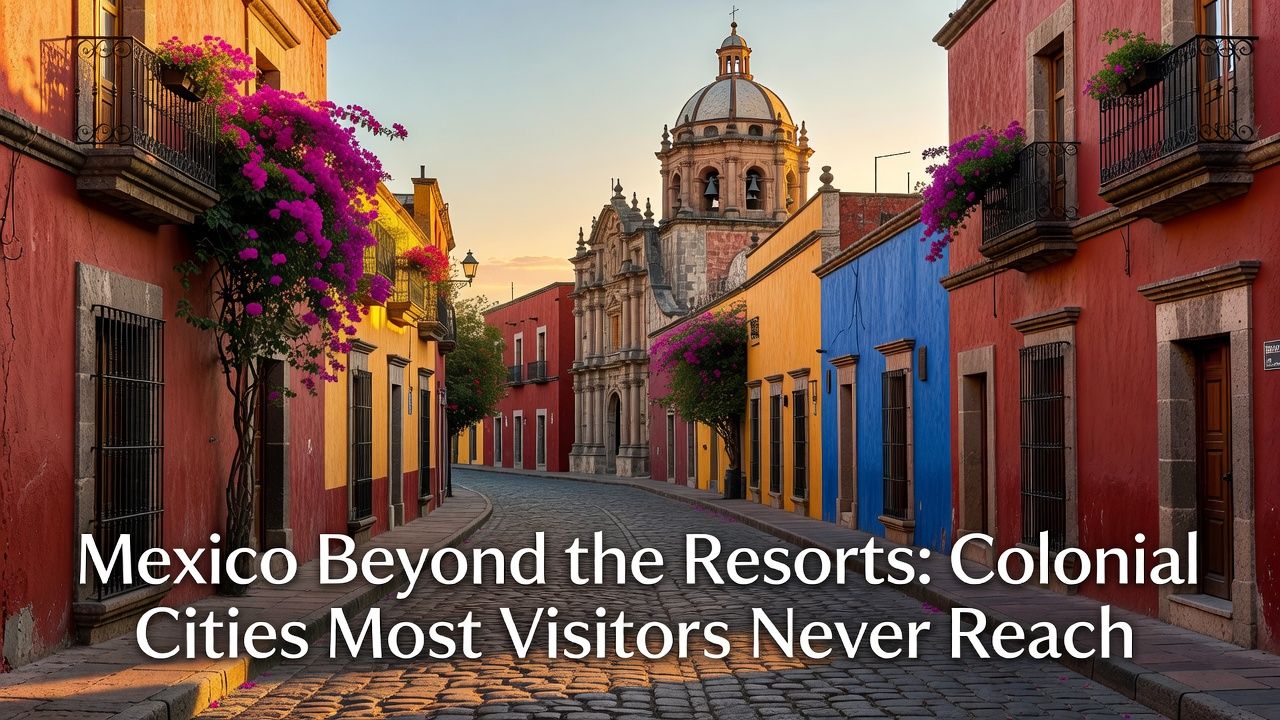
Ask a first-time visitor to picture Mexico and you’ll get a beach: Cancún’s hotel strip, Los Cabos, the Riviera Maya’s all-inclusive corridor. Ask a Mexican where they take visiting relatives, and the answer is far more likely to be a plaza — Guanajuato’s Jardín de la Unión at dusk, Oaxaca’s zócalo under the laurel trees, the pink stone cantera glow of Morelia’s cathedral. The country’s interior cities are where Mexico actually lives, and they remain strangely invisible to the resort crowd that dominates its tourism numbers.
This is a guide to that other Mexico: the colonial cities of the Bajío and the south, what each one is genuinely like, how to string them together by bus, and the practical questions — safety, altitude, cost — that stop people from going. The short version: the hesitations are mostly outdated, the buses are excellent, and a week of plazas, markets and mole will run you less than three nights at a mid-range all-inclusive.
Why the Interior Is Different A country the coast doesn’t show you
The coastal resorts were built for visitors, in many cases on empty coastline, within living memory. The colonial cities were built for Mexico — as mining capitals, religious centres and seats of power across three centuries of Spanish rule, on top of Indigenous civilisations that never went away. That layering is the whole attraction. In Oaxaca you can stand in a Zapotec ceremonial centre in the morning (Monte Albán is twenty minutes from town), eat pre-Hispanic ingredients at lunch, and walk past a baroque church built partly from the stones of older temples on the way home.
UNESCO has noticed, even if the package-tour industry hasn’t. The historic centres of Oaxaca, Puebla, Guanajuato, Morelia, Zacatecas, Querétaro, San Miguel de Allende and Campeche all sit on the World Heritage list — a density of recognised historic centres that few countries can match.
The Bajío Circuit The easy first loop
The Bajío — the high plateau northwest of Mexico City — is where independence began and where the colonial architecture reaches its most theatrical. Four cities make a natural loop, each two to four hours from the next by first-class bus.
Guanajuato
The most physically improbable city in the Americas: a silver boomtown poured into a ravine so narrow that the roads run through former river tunnels underground, leaving the surface largely to pedestrians. The funicular up to the Pípila monument, the estudiantina musicians leading singalong processions through the alleys at night, the mummies museum if your taste runs that way — Guanajuato is the one that converts people. Three nights minimum. It’s a university city, which keeps it cheap and lively, and its October Cervantino festival is the biggest arts event in Latin America (book six months ahead if that’s your target).
San Miguel de Allende
Twenty minutes’ flight of fancy from Guanajuato in atmosphere: immaculately restored, famously home to a large American and Canadian expat community, and priced to match. The neo-Gothic parish church is the postcard, but the real pleasure is the rooftop restaurants and the gallery scene. San Miguel is the most comfortable entry point for nervous first-timers — English is common, the infrastructure is polished — and the least “undiscovered” place in this article. Worth two days; calibrate your budget expectations accordingly.
Morelia
The one that should be famous and isn’t. Morelia’s centre is built from warm pink cantera stone, hundreds of blocks of it, anchored by a cathedral that took a century to finish. It’s a state capital with a serious food scene — this is Michoacán, one of Mexico’s great culinary regions — and a fraction of San Miguel’s foreign foot traffic. In November it’s also the base for the monarch butterfly reserves in the mountains to the east, one of the genuine natural wonders of the hemisphere.
Querétaro and Zacatecas
Querétaro’s clean, calm historic centre — aqueduct on one side, plazas at its heart — is an easy first or last stop given its proximity to Mexico City. Zacatecas, further north, is the dramatic option: a mining city in a mountain bowl, with a cable car swinging over the rooftops to the Cerro de la Bufa and a cathedral facade that specialists rank among the finest examples of Mexican baroque anywhere. It takes more effort to reach, which is precisely why it feels like a discovery.
The Southern Pair Oaxaca and Puebla, the food capitals
If the Bajío is architecture first, the south is food first — and the architecture is hardly a consolation prize.
Oaxaca has become internationally fashionable in the past decade, and the attention is deserved. Seven kinds of mole, the smoky mezcal palenques in the valley villages, the vast Tlacolula Sunday market, alebrije workshops in Arrazola, and Monte Albán on its mountain terrace above it all. The city has also grown expensive by Mexican interior standards in its prettiest blocks; stay a few streets back from the zócalo and the value returns. Give it four nights and consider one of them a cooking class — Oaxaca’s are the best in the country.
Puebla, two hours from Mexico City, is the undersung giant: a big, proud city of talavera-tiled facades where mole poblano and chiles en nogada were born. The historic centre is enormous, the museums (the Amparo especially) are first-rate, and the volcano views from the hills of Cholula next door — a church planted on top of the largest pyramid base on Earth — are the kind of thing you’d expect a queue for. There is no queue.
“The coast shows you a Mexico built for you. The interior shows you Mexico. You’ll eat better in the second one.”
Getting Between Them The bus is the answer
Mexico’s first-class and executive bus network is one of the underappreciated travel systems of the world — assigned reclining seats, air conditioning, onboard toilets, rest stops, and departures that run like rail services. ETN and Primera Plus cover the Bajío; ADO covers the south and southeast. Fares between Bajío cities run roughly US$15–35 depending on distance and class. You can book online or simply walk into the terminal; outside holiday weeks, same-day tickets are rarely a problem.
The main hubs: Mexico City has four bus terminals serving different directions (you’ll use Norte for the Bajío, TAPO for Puebla and Oaxaca), while Bajío International Airport between León and Guanajuato lets you skip the capital entirely if you’d rather. A car is unnecessary within this circuit — the historic centres are walkable, parking is a headache, and the buses are simply better.
| Days | Base | Bus leg to get there |
|---|---|---|
| 1–3 | Querétaro | 3h from CDMX Norte terminal |
| 3–5 | San Miguel de Allende | 1h15 from Querétaro |
| 5–8 | Guanajuato | 1h30 from San Miguel |
| 8–10 | Morelia | 3h from Guanajuato (via Irapuato) |
| 10 | Return | 4h back to CDMX, or fly out of BJX |
The Safety Question, Answered Properly What the headlines miss
Mexico’s security situation is real, regional, and badly reported. The violence that dominates coverage is concentrated in specific trafficking corridors and particular states, and it overwhelmingly does not target tourists. The colonial heartland — Guanajuato city, San Miguel, Querétaro, Morelia’s centre, Puebla, Oaxaca city — sees ordinary, manageable, big-city risk: watch your phone on crowded buses, use registered taxis or ride-hailing at night, don’t flash cash at markets.
Two qualifications, honestly stated. First, conditions vary by state and do change; check the current advisory level for your specific states — not just “Mexico” overall — on the US State Department’s travel site before booking, and note that it grades Mexican states individually. Second, road travel after dark is the standard thing to avoid in the interior, which the bus network conveniently solves: day buses get you everywhere on these routes in daylight.
Practical Realities Altitude, timing, money
Altitude. Much of this circuit sits between 1,800 and 2,400 metres. Most visitors feel nothing worse than getting winded on Guanajuato’s stairs — and Guanajuato has a lot of stairs — but arrive hydrated, keep the first day’s margaritas moderate, and take the funicular up the Pípila hill rather than proving something.
Timing. The highlands are temperate year-round: warm days, cool nights, a rainy season from June to September that delivers its rain in late-afternoon bursts rather than all-day washouts. October and November are the glory months — clear skies, marigolds, Day of the Dead (Oaxaca and the Pátzcuaro region near Morelia are the two great destinations for it, and both need bookings months ahead). Semana Santa and Christmas week fill everything with domestic tourists.
Money. Cards work in hotels and restaurants; markets, street food and small-town comedores are cash economies. The interior is dramatically cheaper than the coast: a very comfortable double room in Morelia or Zacatecas runs US$40–70, a market lunch US$4–6, and even San Miguel’s inflated prices look modest next to Tulum’s.
Language. Outside San Miguel and Oaxaca’s centre, English drops off quickly. Basic Spanish transforms the experience — not because people are unkind to non-speakers (they aren’t), but because the best of these cities happens in markets, fondas and conversations that need it. Even twenty phrases change the trip.
Where to Go Deeper When the loop isn’t enough
If the circuit whets your appetite, the interior keeps unfolding. Mérida, the Yucatán’s gracious capital, pairs with Campeche’s walled pastel centre as an alternative to the Riviera Maya entirely. Guadalajara — mariachi, tequila country next door, a magnificent historic core — is a major city that somehow stays off foreign itineraries. Real de Catorce, a half-ghost silver town at the end of a long tunnel through a mountain, is the single most cinematic arrival in the country. And Pátzcuaro, an hour from Morelia, is the soul of Michoacán: adobe, tile roofs, lake canoes, and the most moving Day of the Dead in Mexico.
For current opening hours and any access changes at the archaeological sites near these cities — Monte Albán, Cholula, the museum network — the federal anthropology institute INAH maintains the authoritative listings.
Southeast Alternative: Mérida and Campeche The colonial loop nobody flies home talking about
If your flights point at Cancún anyway, the Yucatán holds its own colonial answer to the resort strip. Mérida — the “White City” — is a proud, safe, deeply liveable state capital of mansions along the Paseo de Montejo, free nightly cultural events in its plazas, and a food scene built on cochinita pibil and sopa de lima rather than hotel buffets. It also makes the ideal base for Uxmal and the Puuc ruins, an hour south. Two hours southwest, Campeche offers the walled, pastel-painted historic centre the pirates forced Spain to build — a UNESCO-listed harbour town that receives a fraction of Mérida’s visitors and repays an overnight with its malecón sunsets and fortress museums. Travellers who split a Yucatán week between the beach and these two cities routinely report the interior days as the better half.
Where to Stay and How to Behave Small choices, better trip
Lodging in these cities clusters into three bands: hostels and simple posadas (US$15–35), the beautifully converted colonial mansions that are the region’s signature mid-range (US$50–120 for courtyards, high ceilings and rooftop terraces), and a growing boutique tier above that. Book the mansion hotels — they’re the point of the trip — and favour locations within three or four blocks of the main plaza, where evening life concentrates and walking after dark feels comfortable. A few behavioural notes carry real weight in the interior: greet shopkeepers when entering (a simple “buenos días” changes every interaction), ask before photographing market vendors and their stalls, dress a notch more formally than the coast — the interior reads shorts-and-flip-flops as beach costume — and learn the comida corrida rhythm: the main meal is lunch, roughly 2 to 4 p.m., when set menus offer the day’s best value and the cities briefly close down to enjoy them.
The Honest Objections And whether they hold up
“I don’t speak Spanish.” Workable, with effort, in San Miguel and Oaxaca; harder elsewhere. Learn the basics and go anyway.
“I only have a week.” Then do three cities — Querétaro, Guanajuato, Morelia — and don’t apologise. Three cities done slowly beats six done in buses.
“The beach is why I go to Mexico.” Fair. But consider the split trip: a week in the interior, a few coastal days at the end. Oaxaca city to the Oaxacan coast (Puerto Escondido, Huatulco) is a short flight or a spectacular mountain drive, and it’s the best of both arguments.
The resorts will survive without you for a week. The Mexico they’ll never show you is sitting on a plaza bench a few hours inland, at about 6,000 feet, with the cathedral bells going and something on the grill that you can’t get at a swim-up bar. Go find out which mole is yours.
A Two-Week Route, Day by Day The circuit, scheduled
Putting the loop on a calendar, assuming you fly into Mexico City and straight out to the interior: Days 1–3, Querétaro. Underrated, walkable, the gentlest possible landing, and the night buses and first-class coaches fan out from here in every direction. Days 4–6, San Miguel de Allende. Yes, it’s polished and half-expat; it’s also genuinely beautiful, and three days is the right dose — long enough for the parish church at dawn and the rooftop dinners, short enough to leave before the boutiques blur. Days 7–9, Guanajuato. The one people love hardest: a university city folded into a ravine, alleys instead of streets, the Callejón del Beso and the mummies if your taste runs that way. Stay up the hill for the view; take the funicular home after dinner.
Days 10–11, Morelia or Pátzcuaro. The choice is city versus lake: Morelia’s rose-stone cathedral grid and candy market, or Pátzcuaro’s plaza and the Purepecha lake towns, especially around Day of the Dead, when you must book a year ahead and accept the crowds as the price of the real thing. Days 12–14, Puebla and home via Mexico City. Puebla earns its ending: mole at the source, the talavera workshops, the Capilla del Rosario’s impossible gilding, and an easy two-hour bus back to the capital’s airport. With seventeen days instead of fourteen, bolt Oaxaca on after Puebla rather than squeezing it in — the south deserves its own four days, and the route that tries to do everything in two weeks ends up remembering mostly bus stations. Which is the one itinerary mistake worth stating plainly: in Mexico’s interior, every move is a half-day, so the winning number is five bases, not eight.
Bus companies, routes and prices referenced reflect schedules in effect in mid-2026 and shift seasonally; verify at the terminal or the operators’ sites before travel. Security conditions vary by state and over time — consult current official advisories before booking. This article contains no affiliate links. All outbound links checked live in August 2026.