Destination Guides · Colombia
Three departments, four small cities, a valley of sixty-metre wax palms, and some of the most welcoming farm stays in South America. The Eje Cafetero is Colombia’s easiest rural trip — once you understand how the pieces fit together.
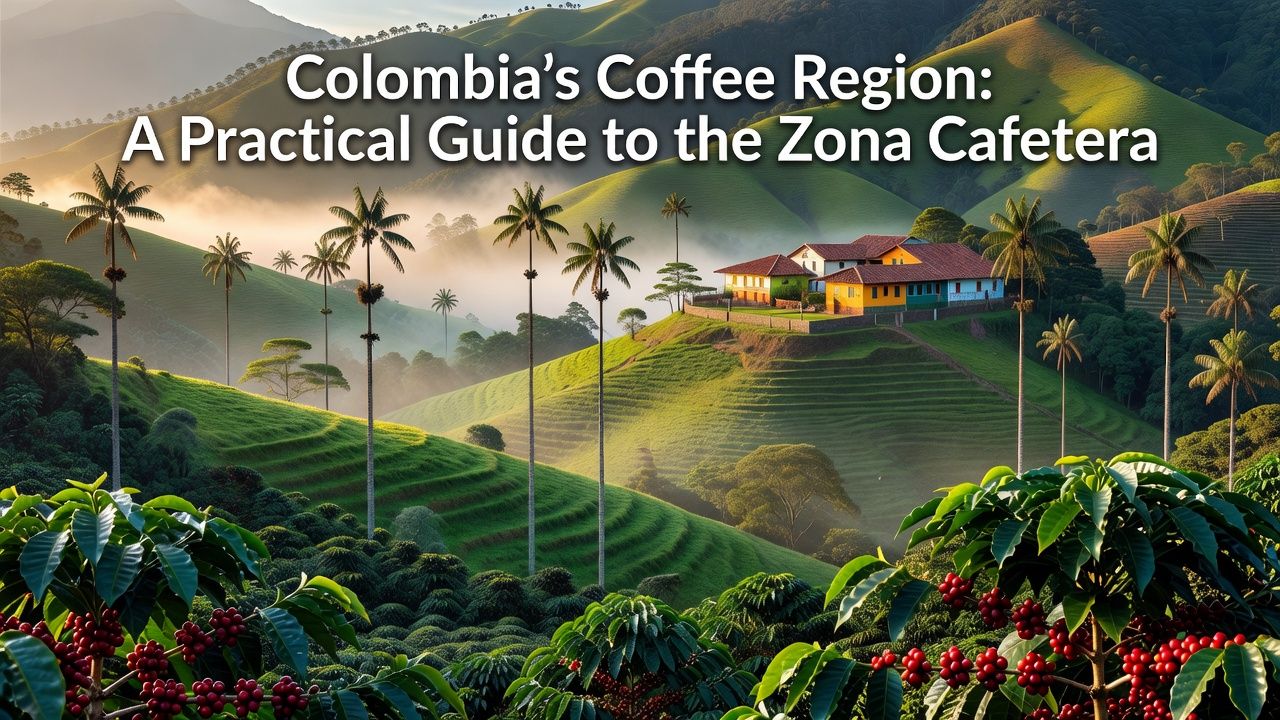
There is a moment, on the road between Pereira and Salento, when the landscape stops looking real. The hills go from green to impossible green, folded like draped cloth, every slope planted in waist-high coffee bushes under scattered shade trees, with a white-and-ochre farmhouse on a ridge and cloud moving fast through the valley below. Colombians call this region the Eje Cafetero — the coffee axis — and travellers who make it here tend to say the same thing afterward: it was the part of Colombia they hadn’t expected, and the part they recommend first.
The coffee region is also a practical rarity: a rural destination that works without a tour. The buses run, the towns are safe and walkable, the fincas pick you up from the square, and the whole zone is compact enough that nothing is more than a couple of hours from anything else. Here’s how to plan it properly.
What the Region Actually Is Geography in one paragraph
The Zona Cafetera is not a single valley but a hilly swathe across three small departments — Quindío, Risaralda and Caldas — with a fourth, northern Valle del Cauca, often folded in. The three departmental capitals — Armenia, Pereira and Manizales — form a rough triangle, each an hour or two apart. Between and below them sit the small towns that have become the traveller’s map: Salento, Filandia, Pijao, Jardín, and others. In 2011, UNESCO inscribed the Coffee Cultural Landscape of Colombia as a World Heritage site — a rare listing of a working agricultural landscape rather than a monument, recognising a century of smallholder families farming absurdly steep mountainsides.
Altitudes run roughly 1,200 to 2,200 metres: high enough for eternal spring — days in the low twenties Celsius, cool nights, rain possible any month — and low enough that altitude sickness is a non-issue. Pack a light jacket and a rain layer and you’re dressed for the region.
Where to Base Yourself Three cities, five towns, one decision
Salento is the traveller’s town: a single gorgeous main street of bahareque houses in coffee-region colours — bright doors, flower boxes, wooden balconies — climbing to a mirador, ringed by fincas and famous as the gateway to the Cocora Valley. It’s touristy in the friendly sense: craft shops, trout restaurants, a dozen hostels, and a genuine local town still running underneath. Base here for atmosphere and access.
Filandia, twenty minutes over the ridge, is what Salento was fifteen years ago — similar architecture, a fraction of the visitors, a superb mirador of its own, and a slow Sunday-square rhythm. Travellers who find Salento too polished tend to relocate here within a day.
Pijao, an hour south, is the connoisseur’s pick: officially designated a “slow city,” almost no foreign tourism, spectacular views, and a handful of small guesthouses. It’s the place to go when you want the region without any frame around it at all.
The three cities serve different purposes. Pereira is the transport hub and the least romantic — you’ll pass through rather than linger. Manizales, dramatically strung along a ridgeline with its towering cathedral, rewards a night or two; it’s a university city with serious coffee bars and easy access to high-altitude paramo at Los Nevados. Armenia is mostly a waypoint. Jardín, technically in Antioquia but part of the coffee world, is three hours from Medellín and possibly the prettiest small town in Colombia — worth the detour if your route allows.
Cocora Valley: The One Sight Everyone Shares Worth every bit of it
The Valle de Cocora is where Colombia’s national tree — the wax palm, growing to sixty metres, the tallest palm on Earth — stands in scattered herds across emerald pasture, with cloud forest closing in above. It’s the region’s postcard and it doesn’t disappoint. The classic visit: a shared Willys jeep from Salento’s square (they leave when full, all day, for a few dollars), the five-to-six-hour loop hike up through the Acaime hummingbird reserve and back down among the palms, then trout for lunch. Two notes that save people grief: the loop is muddy in places year-round, so real shoes matter; and going early — the first jeeps around 6 a.m. — gives you the valley in morning light before the clouds build and the crowds arrive. If the full loop is too much, a shorter out-and-back to the palm pastures delivers the postcard in ninety minutes.
The Finca Experience The actual reason to come
Cocora is the sight; the finca is the experience. Across the region, working coffee farms have opened their doors — some as daytime tour operations, many as full farm-stay accommodation where you sleep in the family house or a converted drying shed, eat at the family table, and walk the rows at dawn.
A good coffee tour walks you through the entire pipeline: picking ripe red cherries (harder than it looks, and the pickers you’ll see are astonishingly fast), the depulping machine, the fermentation tanks, the drying beds, and finally roasting and cupping. You’ll learn why altitude and shade matter, what “washed process” means, and why the coffee drunk in Colombia was, historically, the coffee that wasn’t good enough to export — a tradition that specialty cafés in Manizales and Salento are now cheerfully dismantling, one pour-over at a time.
Booking is informal and that’s fine: nearly every finca responds to WhatsApp, many can be arranged through your hostel, and walk-up tours at the famous show-farms near Salento run daily. Prices are gentle — farm tours typically run US$8–20 including tastings, and full-board finca stays from roughly US$40–80 per person. Stay at least one night on a farm. The tour teaches you coffee; the overnight teaches you the life around it, and the dawn view from a finca ridge is the photograph you’ll actually keep.
“The tour teaches you coffee. The overnight teaches you the life around it. Book the overnight.”
Getting There and Around Easier than the map suggests
Pereira and Armenia both have airports with frequent flights from Bogotá and Medellín (under an hour, often US$40–90 booked ahead); Manizales has one too, weather permitting — its mountain airport closes for cloud often enough that Pereira is the safer bet. Overland, the region sits on the Medellín–Bogotá corridor: comfortable buses run Medellín to Salento (via Pereira or direct) in six to seven hours, and Bogotá to Armenia in about eight.
Within the region, the transport is part of the charm. Minibuses shuttle between the cities and towns constantly. Between Salento, Filandia and the fincas, the vehicle is the Willys jeep — WWII-surplus workhorses that serve as the region’s shared taxis, loaded to the roof rack and beyond. Riding on the rear bumper, standing, is legal, traditional, and the correct way to do it at least once.
Safety and Practical Notes The region has changed — mostly
The Eje Cafetero is among the calmest, most tourist-ready rural regions in South America, and its towns feel it: families in the squares at night, solo travellers everywhere, a visible but light police presence. Ordinary precautions apply — don’t hike remote trails alone with valuables, use registered transport, keep an eye on drinks in bars — but this is emphatically not the Colombia of the old headlines. As with any country, check your government’s current advisory before travel (the US State Department maintains country and regional detail), because conditions elsewhere in Colombia vary far more than they do here.
Other practicalities: ATMs exist in Salento and Filandia but run dry on busy weekends — arrive with cash. Card acceptance is patchy outside the cities. Spanish matters here more than in Cartagena; even basic phrases unlock the region’s famous warmth. And the rain is real: this is a cloud-fed green landscape precisely because it rains, often briefly and hard, any month of the year. The driest windows are typically December to February and July to August, but no month is a washout and none is a guarantee.
How Long and What It Costs
Four to six days is the sweet spot: two nights on a finca, a Cocora day, a town day, and slack for weather or a second hike (the carbonera backcountry beyond Cocora, or Los Nevados from Manizales for the high stuff). A sample shape:
| Day | Base | Plan |
|---|---|---|
| 1 | Salento | Arrive via Pereira; main street, mirador at sunset, trout dinner |
| 2 | Salento | Cocora Valley: first jeep, full loop hike, hummingbird reserve |
| 3 | Finca stay | Morning coffee tour; overnight on the farm, family dinner |
| 4 | Filandia | Slow town day: mirador, basket-weaving workshops, square at dusk |
| 5 | Depart | Bus to Medellín or Bogotá, or add Manizales/Los Nevados if time allows |
Budget-wise, the region is one of South America’s great values. A comfortable mid-range week — private rooms, finca nights, tours, restaurants — can run US$45–70 per person per day; backpackers manage on half that. The most expensive thing in the region is the specialty coffee itself, and even that costs less than the same beans back home, where they arrived by a considerably less scenic route.
Beyond the Triangle Two extensions worth the days
Los Nevados from Manizales. The coffee region’s high-altitude ceiling is the Los Nevados National Natural Park, where the road climbs from coffee country through cloud forest into the páramo — the surreal, sponge-soft ecosystem of frailejones (giant rosette plants that look like something a set designer invented) that supplies much of Colombia’s fresh water. Day trips from Manizales reach above 4,000 metres with views of snow-capped Nevado del Ruiz; the altitude is real (acclimatise with a day or two in Manizales first), the morning departures are early, and the landscape is unlike anything else in the country.
Jardín. Three mountainous hours from Medellín, Jardín is the town travellers describe with a shake of the head: a square of technicolour chairs and tables that fills every evening, cable cars (a public one, built for locals) swinging over the green bowl of the valley, waterfall hikes, and cave-parakeet spectacles at dusk. It’s coffee country without any tourism machinery — the fincas here host visitors informally — and it combines naturally with a Medellín itinerary.
Buying Coffee and Being a Good Guest The etiquette of the finca
A few courtesies carry weight in farm country. Book finca stays ahead by WhatsApp rather than arriving unannounced — these are family homes. Take the early start seriously; the farm day begins at dawn and the best light and birdlife go with it. Ask before photographing workers, and tip guides — a few dollars is meaningful and expected on private farms. When buying beans, buy at the farm or its own roastery, whole bean, recently roasted; prices run a fraction of export retail for the same coffee, and the money lands directly with the producer. Roasted coffee in personal quantities clears US, Canadian and EU customs without issue — declare it, keep it in the sealed valve bag, and pack it in your carry-on unless you want your wardrobe to smell like a café for a month.
Don’t Miss the Small Stuff The details that make the trip
The region rewards the unplanned hour. Play tejo — the national bar sport involving gunpowder, a metal puck and beer — at a village cancha. Drink a tinto (small, sweet, black, a few cents) standing at a market stall, because that’s how the region actually takes its coffee. Try the bandeja paisa once (a plate of beans, rice, chicharrón, egg, avocado and arepa that functions as a dare), and the trout with patacones in Salento more than once. Watch for the sombrero vueltiao and the arriero muleteer culture that the UNESCO listing honours — it’s not folklore staged for visitors; it’s the operating system of the place.
And buy beans at a finca, from the family, roasted days before. Not because it’s the cheapest coffee you’ll ever buy — it won’t be — but because every cup afterward will come with a memory of sixty-metre palms in moving cloud, and that is a souvenir that outlasts the bag.
The Coffee Calendar When the region is at its best
Coffee country runs on two harvests, and timing a visit to one changes what you see. The main harvest runs roughly October to January, with a smaller fly-crop — the mitaca — around April to June, though the exact weeks slide with altitude and rainfall and every finca keeps its own rhythm. Come during harvest and the region is working: pickers in the rows at dawn, the sweet smell of fermenting coffee at the beneficio, trucks of cherry queuing at the cooperatives. Come between harvests and the fincas still run tours — flowering season (the hills go briefly white and smell of jasmine) is its own reward — but the full pick-to-cup theatre needs the harvest months.
The weather has two wet seasons, roughly April–May and October–November, which mostly means theatrical afternoon downpours rather than lost days: mornings stay clear for Cocora, and the rain is why everything is that green. June through August is the driest, easiest stretch. The calendar’s other variable is domestic tourism: Christmas to mid-January, Easter week and the long weekends Colombians call puentes fill the famous towns solid — book Salento far ahead or stay in Filandia instead. And if your dates land in January, Manizales throws its feria; in June, the coffee towns celebrate the yipao, when the region’s beloved Willys jeeps parade loaded with impossible amounts of furniture, plantains and humanity. It is exactly as absurd and wonderful as it sounds, and it’s the single best day to understand what these jeeps mean here.
One last calendar note, because it shapes a good week: Sunday is the region’s beating heart. Filandia’s market fills the square, Salento’s Calle Real turns into a promenade of families and telescoped wax palms on postcards come to life, and the Willys jeeps run their fullest schedules — which means Sunday is simultaneously the most atmospheric and most crowded day for everything. The seasoned move is to play it against itself: markets and town squares on Sunday morning, Cocora on a weekday at dawn, the finca tour on a Saturday when the week-trippers haven’t yet arrived. And keep one unplanned afternoon. The coffee axis’s best hours are the ones spent in a town-square café, watching a region that runs on coffee drink it slowly.
Finca tours and jeep schedules operate informally and change with the season; your accommodation can confirm current arrangements. Regional conditions elsewhere in Colombia differ from the Eje Cafetero — consult current official travel advisories before your trip. This article contains no affiliate links. All outbound links checked live in August 2026.