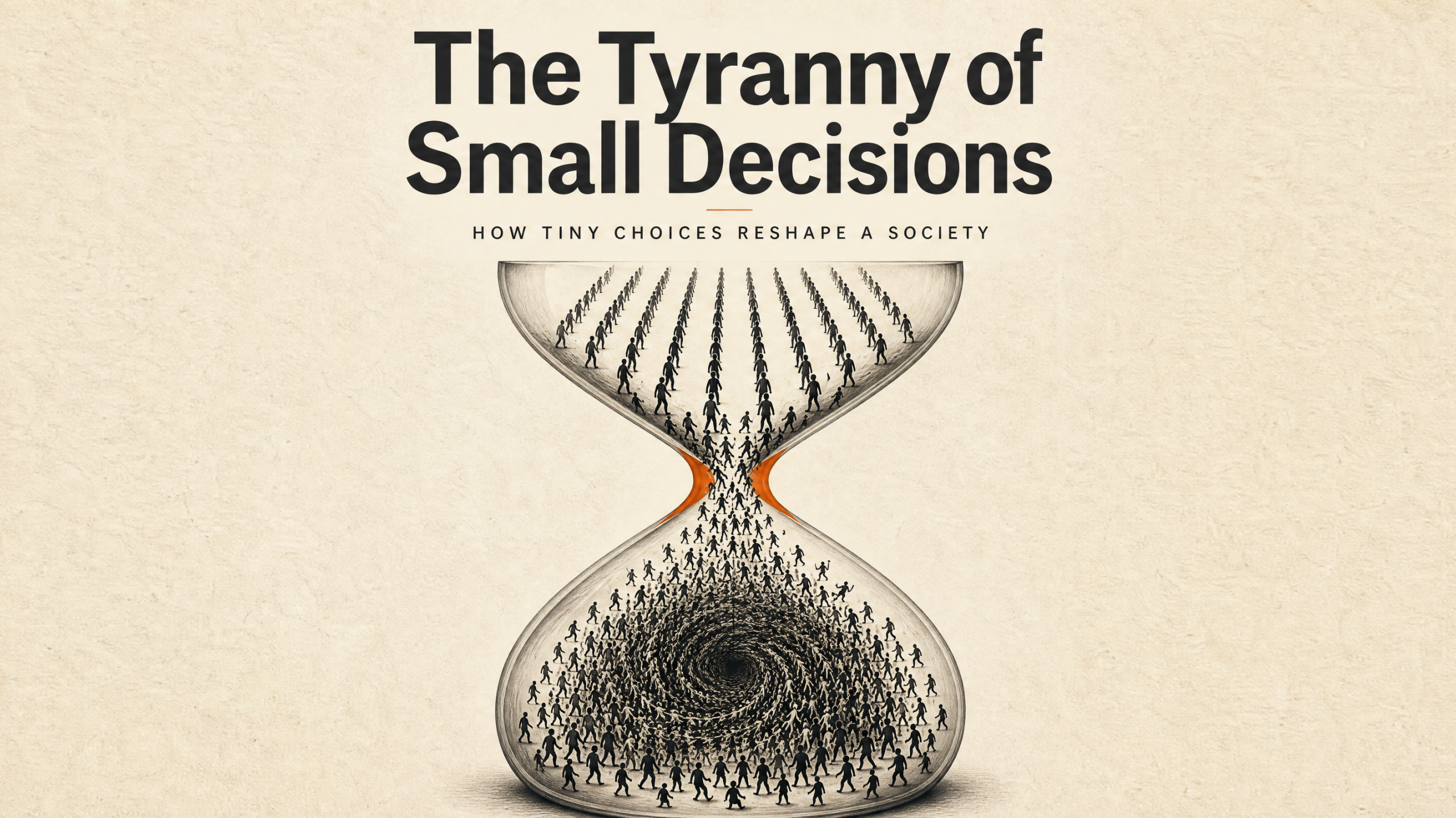
No one chose the outcome — yet everyone’s small, sensible choices added up to it.
Some of the largest changes in how we live were never decided by anyone. No vote was held, no policy declared; instead, millions of people made small, individually reasonable choices that quietly aggregated into an outcome almost no one would have chosen on purpose. Economists call this the tyranny of small decisions, and once you see it, you notice it everywhere: in vanished local shops, emptied downtowns, degraded shared resources, and habits that reshaped a culture before anyone debated them. Each individual choice was rational and minor. Their sum was a transformation no one authorized — a useful lens for understanding collective-action problems of the kind long examined in fields from economics to the philosophy catalogued by the Stanford Encyclopedia of Philosophy.
[ 01 ]When Sensible Choices Add Up to a Result No One Wanted
The core idea is deceptively simple. Imagine a town with a beloved local bookstore and a new online retailer that is slightly cheaper and more convenient. No resident wants the bookstore to close; everyone values having it. But on any given purchase, the rational individual choice is the cheaper, easier option, and the loss of the bookstore from one person’s one purchase is negligible. So thousands of people, each making a small sensible choice and each assuming their single decision doesn’t matter, collectively withdraw the support the bookstore needs to survive. One day it closes, and the same townspeople who genuinely wanted it to exist are surprised and saddened that it’s gone.
The crucial feature is the gap between the individual decision and the collective outcome. At the level of any single choice, the consequence is too small to register, so it feels free — as if it has no cost at all. But the outcome we actually care about is determined not by any one choice but by the accumulation of all of them, and that accumulation was never put to anyone as a real decision. No one was ever asked, ‘Do you want to trade the bookstore for slightly cheaper books?’ If they had been, many would have said no. They were only ever asked the small question, one purchase at a time, and the small question has a different answer than the large one it secretly composes.
This is what makes the phenomenon a genuine tyranny rather than just an unfortunate trend. The outcome is not what people wanted, yet it emerged from what people chose, with no villain and no mistake at any individual step. Everyone behaved sensibly; the system still produced a result most of them regret. It is a failure not of character but of structure — of a situation in which the sum of rational small decisions is an irrational large one, and in which the thing people actually value was never on any ballot they were handed.
The tyranny of small decisions: a process in which many individually rational, small-scale choices accumulate into a large-scale outcome that few people actually wanted — because the important question (the aggregate result) is never decided directly, only the trivial question (each tiny choice) is.
[ 02 ]The Hidden Mechanism: Costs That Hide and Choices That Don’t Feel Like Choices
Two features make this trap so powerful and so hard to escape. The first is that the costs are externalized and delayed. When you make the small convenient choice, you personally capture the small benefit immediately — the lower price, the saved time — while the cost is spread across everyone and arrives later, in the form of the diminished thing that eventually disappears. Because you feel the benefit now and yourself and feel the cost later and collectively, the math always seems to favor the small choice, even though the aggregate math points the other way.
The second feature is that these decisions rarely feel like decisions at all. No one experiences buying a book online as voting against local commerce, or driving alone as a stance on traffic, or scrolling a feed as a choice about the information ecosystem. Each act is too small and too routine to register as a meaningful choice with consequences. So we make thousands of them on autopilot, never connecting any single one to the large outcomes they jointly produce. The tyranny operates precisely in the blind spot created by the smallness of its component parts.
This connects the phenomenon to the broader family of collective-action problems, in which what is rational for each individual is destructive for the group. The classic illustration is a shared pasture where each herder, acting sensibly, adds one more animal — capturing the full benefit while sharing the cost of overgrazing — until the common resource is destroyed by the sum of reasonable individual choices. The tyranny of small decisions is the same logic applied to the everyday choices that shape commerce, community, environment, and culture: a thousand defensible acts producing a collective result that defeats the very people who made them.
[ 03 ]The Same Force Can Build as Well as Destroy
It would be a mistake to treat the tyranny of small decisions as purely a story of loss, because the same mechanism that quietly dismantles things can also quietly build them. Just as countless small withdrawals can erode a valued institution, countless small acts of support can sustain or create one. The farmers’ market that thrives, the local paper that survives, the walkable district that flourishes, the norm of decency that holds in a community — these too are the aggregate of many small individual choices, each one too minor to matter on its own, adding up to something none of the participants single-handedly produced.
This symmetry is genuinely hopeful, because it means the accumulation works in both directions and is not fixed in advance. A culture is not handed down from above; it is continuously re-created by the small choices of the people living in it, which means those people are never merely victims of the aggregate — they are also its authors. The same logic that explains how a thousand reasonable defections can kill a thing explains how a thousand small commitments can keep it alive. Nothing about the mechanism dictates which direction it runs; that depends on what the small choices are.
It also reframes the meaning of an individual choice. The standard objection — ‘my one decision doesn’t matter’ — is true in isolation and misleading in aggregate, and the same is true of every other person making it. Your single choice to support the local shop will not save it; but the belief that single choices don’t matter is precisely the belief that, held by everyone, guarantees the outcome no one wanted. To act as though your small choices count — not out of guilt, but out of clear sight about how aggregates form — is to take your actual place as one of the many authors of the collective result, rather than merely one of its casualties.
[ 04 ]What This Lens Reveals — and What to Do With It
Seeing the tyranny of small decisions changes how you interpret a great deal of social change. It dissolves the urge to find a villain behind every unwelcome outcome, because often there is none — only the aggregate of ordinary choices. It also explains why exhortations to ‘just choose differently’ so often fail: as long as the individual incentive points one way and the small choice feels costless, telling people to behave against their immediate interest, one decision at a time, rarely works at scale. The structure, not the morality, is doing the work.
For an individual, the practical response is to occasionally lift your eyes from the single choice to the pattern it belongs to. Before defaulting to the cheapest, easiest option out of habit, you can sometimes ask the larger question the situation is hiding: if everyone chose this, what would we get, and do I want that? Sometimes the answer will lead you to pay a little more for the local shop, or accept a little friction to support something you value, precisely because you have recognized that your ‘trivial’ choice is one vote in an election whose outcome you care about. This is not about guilt over every purchase; it is about consciousness of the few that genuinely matter.
At the collective level, the real solutions usually have to be structural, because the trap is structural. When the aggregate outcome matters, societies often have to make the big decision directly rather than leaving it to accumulate from small ones — through shared agreements, rules, or institutions that align individual incentives with collective interests. Understanding the tyranny of small decisions is what reveals why such coordination is sometimes necessary: not because people are bad or foolish, but because some outcomes can only be protected by deciding them on purpose, rather than letting them be decided by default, one small choice at a time. The wisdom is in knowing which outcomes are too important to leave to the silent arithmetic of a million separate choices — and in being willing, as a community, to put the big question on the table while there is still something left to protect.
> Local commerce. Everyone values the small shop; everyone shops where it’s cheaper; the shop closes.
> Shared resources. Each user takes a little more of a common resource until it’s degraded for all.
> Attention and media. Each click on the more sensational option quietly shapes what gets produced for everyone.
> Community institutions. Each family’s reasonable opt-out erodes the local club, paper, or group everyone assumed would last.
[ 05 ]Frequently Asked Questions
Q:What does ‘the tyranny of small decisions’ actually mean?
A:It describes how many small, individually sensible choices can add up to a large outcome that almost no one wanted — because people only ever decide the tiny question (this one purchase, this one choice), never the big question (the cumulative result) directly.
Q:Isn’t this just blaming individuals for big problems?
A:No — the point is the opposite. Usually no individual is at fault; each choice is reasonable. The problem is structural: the situation is set up so the sum of rational small choices is an outcome that defeats the very people who made them.
Q:So what can actually be done about it?
A:Individuals can occasionally lift their eyes to the larger pattern and choose accordingly on the choices that genuinely matter. But because the trap is structural, lasting solutions usually require shared agreements, rules, or institutions that make the big decision directly rather than letting it accumulate by default.
Mind the Sum of Small Things
Some of the biggest changes in how we live were never decided by anyone — they emerged from millions of small, sensible choices that added up to an outcome few would have chosen. No villain, no mistake at any step; just the gap between the tiny question we’re asked and the large one it secretly composes.
The remedy isn’t guilt over every choice. It’s the occasional habit of asking what we’d get if everyone chose this — and the recognition that some outcomes can only be protected by deciding them on purpose, not by default.
Ask the big question the small choice is hiding.
This article is for general educational purposes. On collective-action problems and coordination, see the Stanford Encyclopedia of Philosophy and research summarized by the Pew Research Center.