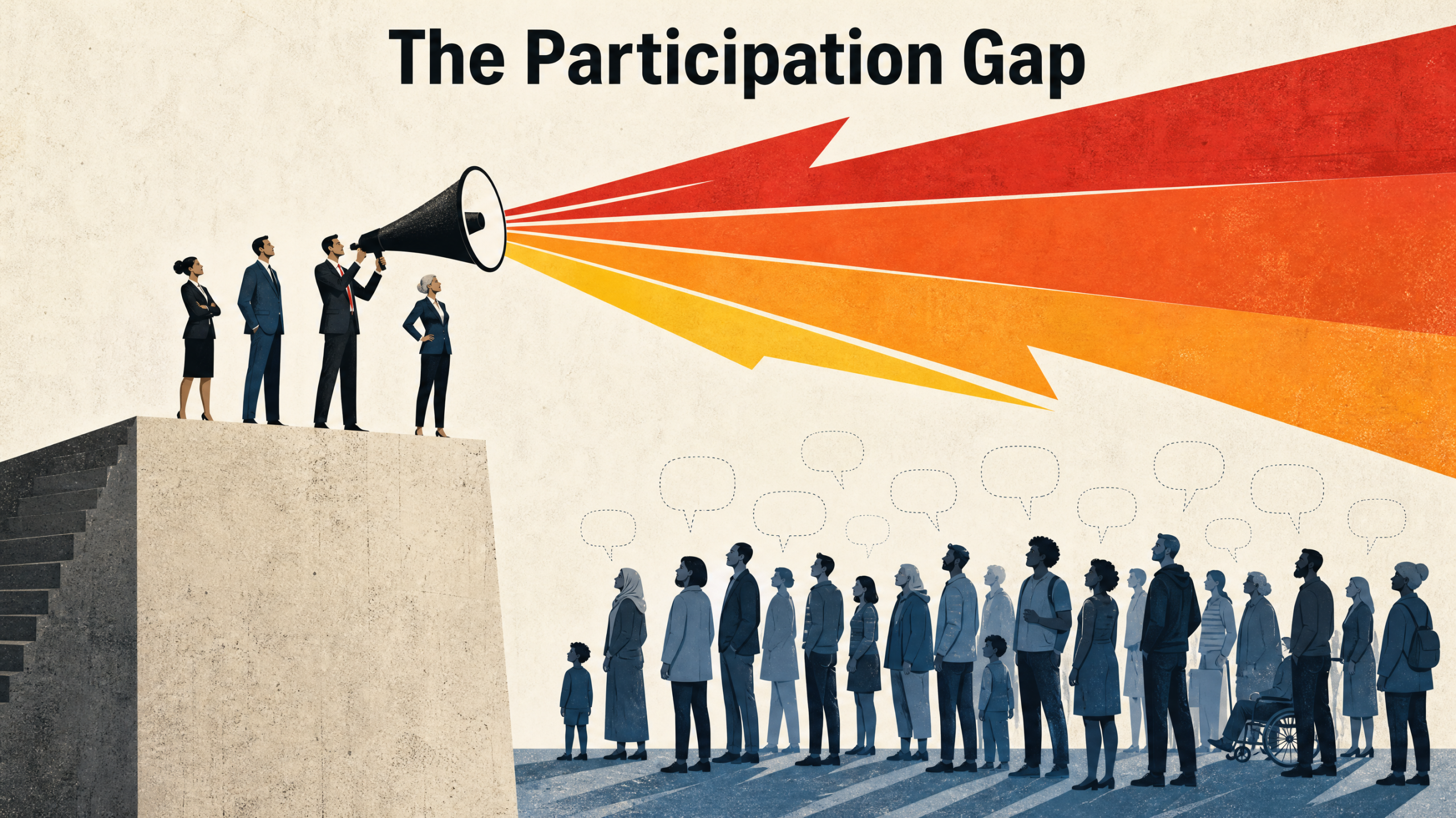
The Participation Gap: Why Some Voices Always Get Heard
In civic life, the people who show up are not a random sample — and that quietly shapes everything.
Decisions in a democracy are made by the people who participate, not by the people who merely could. And it turns out that the people who actually show up — who vote, attend the meetings, contact officials, and join the organizations — are far from a random cross-section of the community. They skew in consistent and predictable ways, which means that the chorus of voices our institutions hear is systematically different from the population they serve. This is the participation gap, and its consequences are profound but rarely discussed. Data from the U.S. Census Bureau and the Pew Research Center consistently show who participates and who does not, and the pattern helps explain why public policy so often seems responsive to some groups and deaf to others. Understanding the gap is the first step toward closing it.
I.The People Who Show Up Are Not Everyone
The foundational fact of civic participation is that it is deeply unequal, and unequal in a particular direction. Across nearly every form of engagement — voting, attending public meetings, contacting representatives, donating, volunteering for campaigns, joining civic organizations — participation rises steadily with age, income, education, and homeownership. Older, wealthier, more-educated, and longer-settled residents participate at dramatically higher rates than younger, poorer, less-educated, and more transient ones. The civic arena is not a level playing field where all voices arrive in proportion to their numbers; it is tilted from the start.
This matters because institutions, quite naturally, respond to the voices they actually hear. An official facing reelection pays attention to the people who reliably vote. A council weighing a decision responds to the residents who show up to the meeting. An organization listens to its active members. None of this requires any corruption or ill intent; it is simply the rational behavior of people responding to their actual inputs. But when those inputs come disproportionately from one slice of the community, the outputs — the policies, the priorities, the decisions — bend toward that slice, and away from everyone who stayed home.
The result is a kind of quiet, structural bias in public life that is all the more powerful for being invisible. It is not that anyone decided to ignore the young, the poor, or the transient; it is that those groups, participating less, are simply less present in the feedback that shapes decisions. Their interests are underweighted not because they were rejected but because they were never fully entered into the calculation. The participation gap thus translates, silently and reliably, into a representation gap, in which some communities are governed largely in their absence.
II.Why the Gap Exists
The participation gap is not caused by some groups caring less about their communities or being less capable. It is produced largely by differences in resources, stability, and access — the practical conditions that make participation easy for some and hard for others. Participation has real costs: time, information, transportation, flexibility, and the confidence that one’s involvement will matter. People with secure schedules, financial stability, and long roots in a place can absorb those costs easily. People juggling multiple jobs, unstable housing, caregiving burdens, and the constant friction of getting by often cannot, however much they might wish to.
Consider the simple act of attending an evening public meeting. For a homeowner with a stable job and a flexible schedule, it costs an hour. For a single parent working an evening shift with no childcare and no reliable transportation, it may be effectively impossible. Neither cares more about the community; one simply faces far higher barriers to the same act of participation. Multiply this across every form of civic engagement and you can see how the gap emerges not from differences in civic virtue but from differences in the practical capacity to act on it.
Information and confidence compound the resource gap. Effective participation requires knowing when and where decisions are made, how the process works, and that one’s voice can actually have an effect — knowledge that is unevenly distributed and often concentrated among those already advantaged. People who have participated before, or grown up around others who did, find the door easy to open; people for whom civic processes are unfamiliar and intimidating face an additional barrier of uncertainty. And a learned sense that the system does not respond to people like oneself becomes self-fulfilling, suppressing the very participation that might prove it wrong.
◆ The settled. Homeowners and long-term residents participate far more than transient renters.
◆ The secure. Stable schedules and finances make absorbing the cost of participation easy.
◆ The experienced. Those who’ve participated before know the process and expect to be heard.
◆ The informed. Knowing when and where decisions happen is itself unevenly distributed.
III.The Self-Reinforcing Cycle of Voice
The participation gap does not stay constant; left alone, it tends to widen, because it is self-reinforcing in both directions. When a group participates and sees results — when officials respond to their concerns and policies reflect their interests — the experience teaches that participation works, encouraging more of it. Success breeds engagement, engagement breeds influence, and influence breeds the further success that keeps the cycle turning. Groups that are already heard become better at being heard, accumulating civic skill, confidence, and access over time.
The opposite cycle traps the unheard. When a group participates little and consequently sees its concerns ignored, the lesson learned is that participation is pointless — that the system does not respond to people like them, so why bother. This rational-seeming conclusion suppresses participation further, which ensures their concerns continue to be ignored, which confirms the original lesson. Disengagement breeds powerlessness, and powerlessness breeds further disengagement, in a spiral that can entrench the voicelessness of entire communities across generations.
These twin cycles mean the participation gap is not a static fact but an active process that, without deliberate counterforce, concentrates civic voice ever more tightly among those who already hold it. The advantaged groups grow more practiced and more heeded; the disadvantaged grow more discouraged and more overlooked. Public life slowly organizes itself around the preferences of the consistent participants, and the gap between who is governed and who is heard widens into something that can look, from a distance, like a settled feature of the landscape rather than the fixable imbalance it actually is.
“Decisions are made by those who show up. The danger is not that anyone is silenced, but that the silence of some is mistaken for consent.”
IV.The Quiet Beneficiaries of an Empty Room
It is worth asking who actually benefits when participation is low and uneven, because the answer reveals why the gap persists. An empty meeting or a low-turnout election does not produce a neutral outcome; it produces an outcome shaped by whoever did show up. And the groups most able to reliably show up — the organized, the resourced, the professionally interested — are precisely the ones with the most concentrated stake in particular decisions. The developer with millions riding on a zoning vote will always attend; the residents who would be diffusely affected often will not. Low participation thus quietly tilts outcomes toward concentrated interests and away from the dispersed public.
This is a general pattern in civic life: organized minorities with intense, focused interests routinely prevail over disorganized majorities with diffuse ones, not because they are more numerous but because they participate more reliably. When the broad public stays home, the field is left to those for whom the decision is concentrated and personal enough to justify the effort of showing up. The participation gap, in this light, is not merely an abstract inequality of voice; it is a mechanism by which the preferences of the few who care intensely come to outweigh the preferences of the many who care diffusely but participate little.
Understanding this clarifies what is at stake in closing the gap. It is not only a matter of fairness to underrepresented groups, important as that is. It is a matter of whether decisions reflect the broad interest of the community or the narrow interest of whoever was organized enough to be in the room. A public that participates broadly is far harder for concentrated interests to capture, because the room is no longer empty enough to dominate. Broad participation is, in this sense, a structural defense against the quiet capture of public decisions by the few — which is exactly why it is worth the considerable effort of building.
V.Closing the Gap
Because the participation gap is driven largely by barriers rather than apathy, much of the remedy lies in lowering those barriers. Making participation easier — through more accessible meeting times and formats, simpler processes, better information, childcare, transportation, and the removal of needless friction from voting and civic engagement — reliably draws in voices that were previously priced out by the sheer cost of showing up. Much of the gap is not a gap in desire but a gap in access, and access is something institutions can deliberately widen if they choose to.
There is also a powerful role for organization and mobilization. People participate far more when someone they trust personally asks them to, helps them navigate the process, and assures them their voice will matter. The single strongest predictor of whether a person engages is often whether they were directly invited and supported, which is why the groups that organize the underrepresented — that knock on doors, explain the process, and bring people along — can dramatically narrow the gap. Civic voice, like trust, is built largely from the bottom up, one personal invitation at a time.
Finally, those who already participate can use their voice to widen the circle rather than to guard it. The advantaged participant who insists that decision-makers consider the absent, who advocates for more accessible processes, and who helps bring others into civic life is doing something genuinely valuable for the health of the whole community. A democracy is healthiest when the people who are heard roughly resemble the people who are governed, and closing the participation gap — through easier access, active organization, and the generosity of those already inside — is among the most important and least glamorous work of keeping self-government honest.
VI.Frequently Asked Questions
Q.Who participates most in civic life, and who least?
Participation rises consistently with age, income, education, homeownership, and length of residence. Older, wealthier, more-educated, and longer-settled residents engage far more than younger, poorer, less-educated, and more transient ones — so the voices institutions hear aren’t a representative sample.
Q.Does the gap mean some groups just care less?
No. The gap is driven mostly by barriers — time, money, information, stability, and access — not by differences in how much people care. The same act of participation costs an hour for some and is nearly impossible for others facing harder circumstances.
Q.How can the participation gap be narrowed?
Mainly by lowering barriers — accessible meeting times, simpler processes, better information, and easier voting — and by organizing and personally inviting underrepresented people, since a direct, supported ask is the strongest driver of engagement. Those already heard can also advocate for the absent.
Make the Heard Resemble the Governed
Civic decisions are made by those who participate, and participants aren’t a random sample — they skew older, wealthier, more settled, and more practiced. Institutions respond to the voices they hear, so the participation gap quietly becomes a representation gap, and self-reinforcing cycles widen it over time.
But the gap is driven by barriers, not apathy, which means it’s fixable: easier access, active organizing, personal invitations, and the willingness of those already heard to widen the circle. A democracy is healthiest when the heard resemble the governed.
Lower the barriers, issue the invitation, widen the circle.
This article is for general educational purposes. For data on civic and electoral participation, see the U.S. Census Bureau and the Pew Research Center.