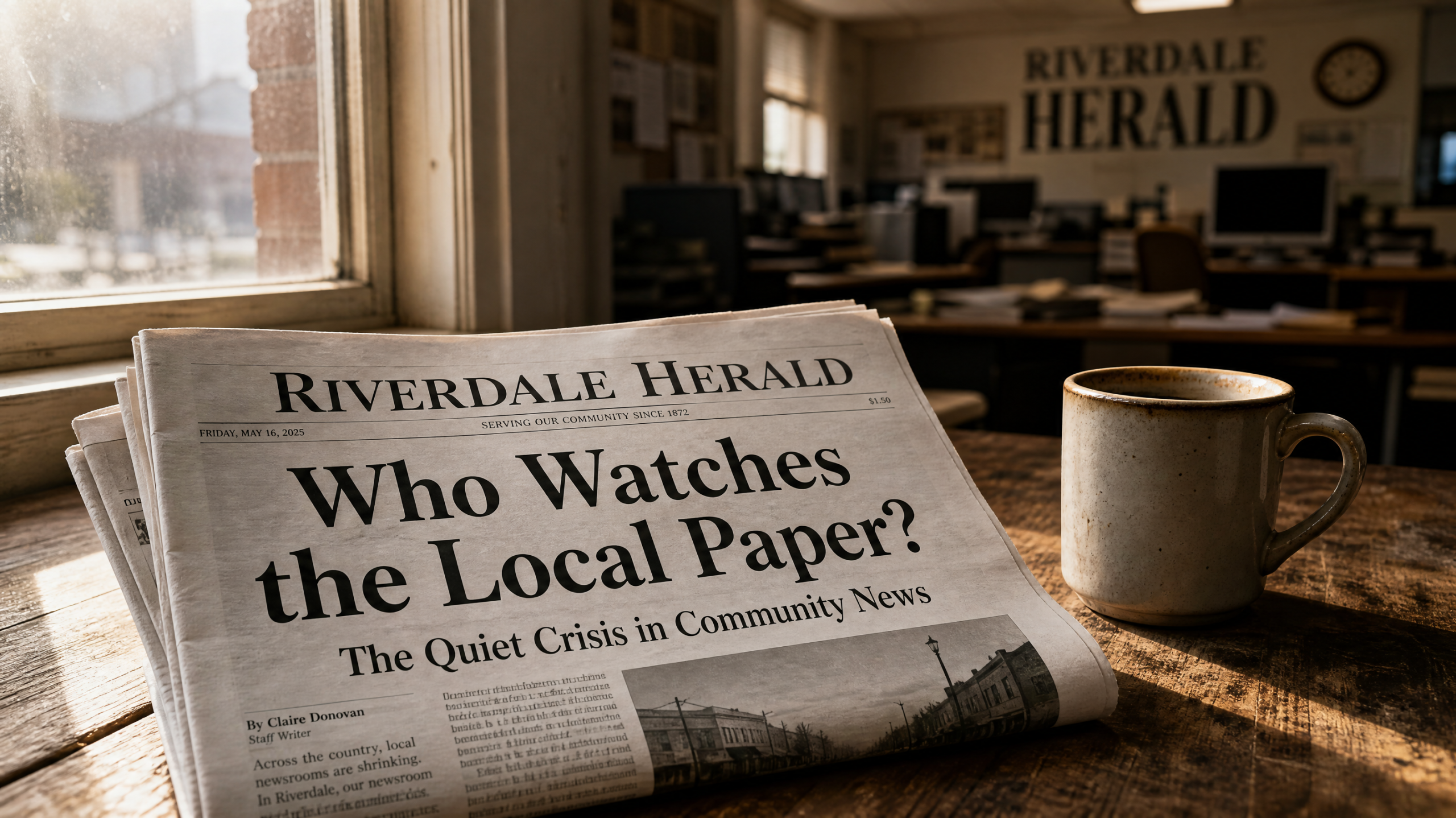
As local newsrooms vanish, no one is left to watch the meetings, the budgets, or the powerful.
Across the country, a quiet catastrophe has unfolded with almost none of the attention it deserves: the steady collapse of local journalism. Community newspapers have closed by the thousands, newsrooms have shrunk to skeleton crews, and vast areas have become what researchers call news deserts — places with little or no original local reporting at all. The Pew Research Center and the Poynter Institute have documented the scale of the decline, and its consequences reach far beyond the journalists who lost their jobs. When the local paper dies, something essential to a functioning community dies with it: the watchful eye on local power, the shared record of community life, and the common set of facts a place needs in order to govern itself. This is the story of what disappears when no one is left to watch.
I.The Watchdog No One Replaces
The most important function of local journalism is also the least visible: it watches power. A local reporter who attends the council meeting, reads the budget, files the records request, and asks the uncomfortable question is performing a civic service that almost nothing else provides. Officials behave differently when they know someone is watching and will report what they find. The mere presence of a reporter in the room imposes a discipline on local government, and the steady scrutiny of local journalism is one of the few forces that reliably checks the abuse and incompetence that flourish in the dark.
When that watchdog disappears, the consequences are measurable and grim. Studies have found that when local newspapers close, government tends to become less efficient and more expensive, because the scrutiny that kept it honest is gone. Corruption has more room to operate, waste goes uncaught, and the cost of local borrowing can even rise as the lack of oversight makes a community a riskier bet. The death of the local paper is not just a cultural loss; it has a price tag, paid by every resident in the form of worse and costlier government.
Crucially, nothing has stepped in to replace this watchdog function at the local level. National media has neither the capacity nor the interest to cover thousands of individual town councils and school boards. Social media spreads opinion and outrage but rarely produces original reporting; you cannot share a story that no one bothered to report. The watchful presence at the local meeting, the patient reading of the budget, the dogged pursuit of the records — these require a paid professional doing unglamorous work, and when the business model that funded that work collapsed, the function simply vanished, unreplaced.
II.Why the Business Model Broke
The collapse of local news was not caused by a decline in its value, which remains enormous, but by the collapse of how it was paid for. For generations, local newspapers were funded largely by advertising — especially the classified ads and local business advertising that had nowhere else to go. That revenue subsidized the expensive, unglamorous work of reporting, including the watchdog journalism that no one would have paid for directly. The reporting was, in effect, financed by the ads for used cars and apartment rentals in the back pages.
The internet severed that connection with brutal efficiency. The classified ads migrated to free online platforms; local business advertising flowed to a handful of global tech companies that could target audiences far more precisely. The revenue that had funded local newsrooms for a century drained away in a matter of years, and it did not follow the journalism to its new digital home, because the new platforms captured the advertising without bearing any of the cost of reporting. The journalism and the money that paid for it were ripped apart.
What makes this a genuine crisis rather than a mere business failure is that local news is what economists call a public good. Its benefits — an informed, well-governed community — flow to everyone, including those who never read it, which is precisely why the market struggles to fund it. The honest official, the uncaught waste avoided, the informed neighbor all benefit the whole community, but no individual has a strong incentive to personally pay for the reporting that produces them. The thing of greatest collective value turned out to be the hardest thing to sell, and so it withered.
“You cannot share a story that no one reported. When the local newsroom closes, the question is not who tells the story differently — it is whether anyone tells it at all.”
III.The Shared Reality That Goes With It
Beyond the watchdog role, local journalism performs a quieter and equally vital function: it creates a shared reality for a community. The local paper was where residents learned the same facts about their own place — what the council decided, how the team did, who had died, what was opening and closing and changing. This common informational ground is the substrate of community itself. A place where everyone draws their understanding of local affairs from the same reported facts is a place that can deliberate, disagree, and decide together, because it shares a starting point.
When that shared source disappears, a community’s sense of itself fragments. People fall back on rumor, on partisan national narratives that have nothing to do with local reality, and on the unverified churn of social media, where claims spread without anyone establishing whether they are true. The result is a town that no longer knows itself — where residents may be intensely engaged with distant national dramas while remaining ignorant of the local decisions that actually shape their lives, and where no common set of facts exists to ground a shared conversation about the place they all share.
This connects the local news crisis to the broader decline in civic participation. People engage with local government when they know what it is doing, and they know what it is doing when someone reports on it. Research has found that communities that lose their local news tend to see reduced voter turnout and civic involvement, precisely because the information that makes participation possible has dried up. The vanishing of local journalism does not just remove a watchdog; it removes the shared knowledge that a self-governing community runs on, leaving residents less able to participate even when they want to.
IV.Ghost Papers and the Illusion of Coverage
The collapse of local news is often less visible than an outright closure, because many papers do not die so much as hollow out. A community may still have a newspaper’s masthead on the newsstand, giving the comforting impression that local coverage continues, while behind it the actual newsroom has been gutted to a fraction of its former staff. Researchers call these ghost papers: outlets that survive in name but no longer have the reporters to attend the meetings, work the beats, or hold local power to account. The shell persists; the function is gone.
This hollowing is in some ways more insidious than a clean death, because it conceals the loss. Residents see a paper still arriving and assume someone is still watching, when in fact the watching has quietly stopped. Coverage shrinks to wire stories, press releases reprinted with little scrutiny, and the occasional thin local item, while the demanding, expensive work of original accountability reporting simply disappears. The community retains the comforting appearance of being informed without the underlying reality, which can be more dangerous than visible absence, because no one sounds the alarm over a watchdog that is technically still present but no longer awake.
Ghost papers also illustrate why simply keeping outlets formally alive is not enough. The thing worth preserving is not the masthead but the reporting capacity beneath it — the journalists doing the unglamorous work of showing up, asking questions, and writing down what they find. A community serious about preserving its local news has to look past the surface and ask whether real reporting is actually happening, not merely whether a paper still technically exists. The relevant question is never just whether the town has a newspaper, but whether anyone in it is still being paid to watch.
V.What Can Be Done
The old advertising-funded model is not coming back, so the rebuilding of local news is taking different and still-emerging forms. Nonprofit local newsrooms, funded by donations, grants, and community support rather than advertising, have sprung up to fill some of the gap, treating journalism as the public good it is rather than as a product that must turn a profit. Public and philanthropic funding, reader memberships, and cooperative ownership models are all being tried, and while none has yet matched the scale of what was lost, together they point toward a future in which communities deliberately pay for the journalism the market will no longer supply.
Individuals have more power here than they might think. The single most direct thing a person can do is to financially support local journalism where it still exists — to subscribe, donate, or become a member of the local outlet, treating it as the civic infrastructure it is rather than expecting it for free. Reporting costs money; if the people who benefit from it are unwilling to pay for it, it cannot survive. A modest, deliberate commitment to fund local news is, in a real sense, an investment in the quality and honesty of one’s own local government.
Beyond money, communities can value and use what local journalism remains, because attention sustains it nearly as much as funding does. Reading local reporting, sharing it, engaging with it, and treating it as more important than the national outrage of the day all help keep it alive. And recognizing local news as essential civic infrastructure — as fundamental to a functioning community as roads or schools — is the mental shift that makes people willing to support it before it is gone, rather than mourning it afterward. The communities that keep their watchdogs will be the ones that decided, in time, that the watching was worth paying for.
◆ Pay for it. Subscribe to or donate to the local outlet; reporting costs money and can’t run on goodwill.
◆ Use it. Read, share, and engage with local reporting — attention sustains it almost as much as funding.
◆ Reframe it. Treat local news as civic infrastructure, as essential as roads or schools, not as optional content.
◆ Support new models. Nonprofit, member-funded, and cooperative newsrooms are filling the gap the old model left.
VI.Frequently Asked Questions
Q.Why does it matter if local newspapers close?
Because they perform civic functions nothing has replaced: watching local government, exposing waste and corruption, and giving a community a shared set of facts. When they close, studies find government often becomes less efficient and costlier, and civic participation tends to fall.
Q.Can’t social media or national news fill the gap?
Not really. National media can’t cover thousands of local councils and boards, and social media spreads opinion and rumor but rarely produces original local reporting. You can’t share a story no one took the time to report.
Q.What can an individual actually do about it?
Financially support local journalism where it survives — subscribe, donate, or become a member — and treat it as essential civic infrastructure rather than free content. Reading, sharing, and supporting new nonprofit newsroom models also helps keep local reporting alive.
Pay the Watchers, or Lose the Watching
The collapse of local news is a quiet crisis with loud consequences. When the community paper dies, the watchdog on local power vanishes, government grows costlier and less honest, and a town loses the shared facts it needs to govern itself — with nothing stepping in to replace any of it.
The old advertising model won’t return, but the function is too important to abandon. Supporting local journalism — paying for it, using it, and treating it as civic infrastructure — is one of the most direct investments a person can make in honest local government.
Subscribe before there’s nothing left to subscribe to.
This article is for general educational purposes. For research on local news and news deserts, see the Pew Research Center and the Poynter Institute.