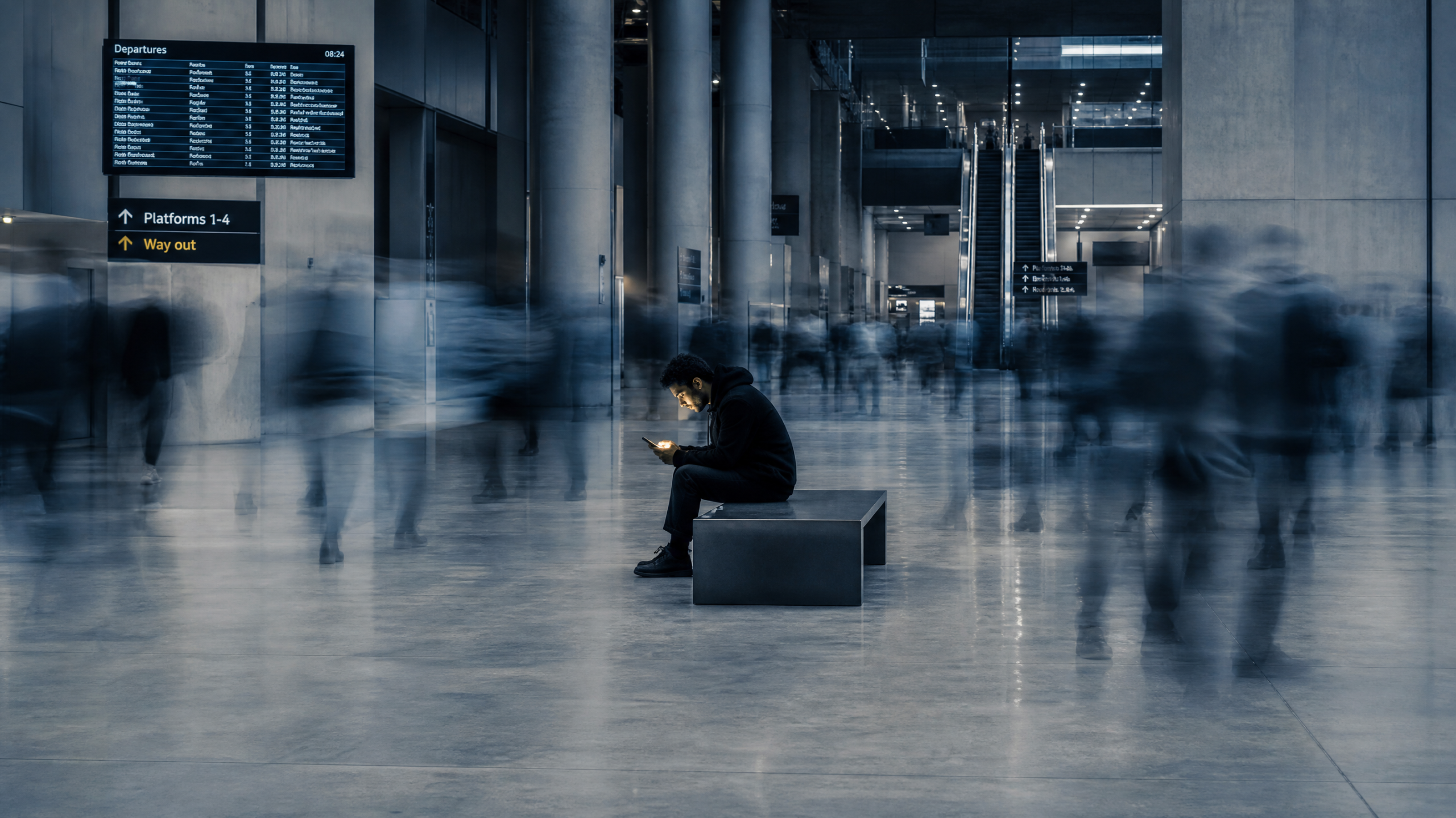
We are more reachable than any humans in history — and, by many measures, lonelier than most.
We carry in our pockets a device that can reach almost anyone on earth in seconds, and yet a great many of us go to bed feeling that no one would really notice if we disappeared. That contradiction is the strange heart of the loneliness epidemic. It is not that we lack contact; we are drowning in it. It is that contact and connection have quietly come apart, and the thing we actually need — the felt sense of being known, of mattering to specific people — has grown scarce even as the noise of communication has never been louder. Public health officials no longer treat this as a private sadness. The U.S. Surgeon General’s advisory on social connection frames loneliness as a genuine health crisis with measurable consequences for the body, not only the mood.
Connected Devices, Disconnected Lives
The first thing to understand about modern loneliness is that it is not caused by isolation in the old sense. Few of us live as hermits. We are surrounded by coworkers, followers, group chats, and a steady drip of notifications. The problem is that almost none of this delivers what human beings evolved to require, which is not stimulation but attachment — a small number of people who know us, rely on us, and would show up for us. We have traded a few deep ties for a vast number of shallow ones, and the trade has left us starving in the middle of a feast.
Digital communication is brilliant at breadth and terrible at depth. It lets us maintain a sprawling web of contacts at almost no cost, which sounds like a gift until you notice that it quietly substitutes for the harder, slower forms of connection it was supposed to supplement. A like is easier than a visit; a comment is easier than a call; following someone’s life online is easier than actually being in it. Each easy option crowds out a harder one, and the easy options, however numerous, do not add up to the thing we are missing.
There is also a cruel feedback loop built into loneliness itself. When we feel disconnected, we tend to withdraw, interpret others’ behavior more negatively, and brace for rejection — all of which make connection harder and confirm the very isolation we fear. Researchers have documented this spiral repeatedly: loneliness is not just an absence of company but an active, self-reinforcing state that makes reaching out feel riskier than it is. Understanding the loop is the first step to interrupting it, because it explains why the lonely person so often does the opposite of what would help.
“We have traded a few deep ties for a vast number of shallow ones, and the trade has left us starving in the middle of a feast.”
Why It Is a Health Problem, Not a Mood
It is tempting to file loneliness under feelings — unpleasant, but ultimately a matter of attitude. The evidence says otherwise. Chronic loneliness behaves in the body like a chronic stressor, keeping systems on a low simmer of alarm that, over years, wears down cardiovascular and immune health. Public health bodies including the CDC now treat social disconnection as a risk factor in the same broad category as smoking, poor diet, and inactivity, because the long-run effects on illness and mortality are real and measurable rather than metaphorical.
The mental-health toll is at least as serious and far more visible. Loneliness raises the risk of depression and anxiety, erodes sleep, and corrodes the sense of meaning that makes hard days bearable. It does this regardless of how successful or busy a life looks from the outside, which is part of why the epidemic is so easy to miss. The lonely person is frequently employed, scheduled, and outwardly fine. The deficit is not in activity but in being genuinely known by someone, and that deficit does not show up on a calendar.
Globally, the picture is similar enough that the World Health Organization has taken up social connection as a priority, recognizing that the same forces — mobility, screens, shrinking households, weaker community institutions — are pulling people apart across very different cultures. This matters because it tells us loneliness is not a personal failing of the weak-willed. It is a structural condition of modern life that almost everyone is exposed to, which means almost everyone can also do something about it.
Why Connection Got Harder
▪ We move more. Frequent relocation severs ties before they deepen, so we keep restarting from zero.
▪ Households shrank. More people live alone than ever, removing the default daily company of a full home.
▪ Screens substitute. Low-effort digital contact quietly displaces the higher-effort connection it can’t replace.
▪ Third places faded. The casual hangouts where ties used to form have closed, gone paid, or gone unused.
The Comparison Machine
Modern loneliness has a uniquely modern aggravator: we are lonely while watching highlight reels of everyone else apparently not being lonely. Social media presents a relentless, curated stream of other people’s gatherings, celebrations, and friendships, and the natural conclusion — that everyone else has the connection we lack — is both false and deeply painful. We are comparing our unedited inner experience to everyone else’s edited outer performance, and losing the comparison every time.
This is corrosive in a specific way. Ordinary loneliness says, ‘I wish I had more connection.’ Comparison-fueled loneliness adds, ‘and there must be something wrong with me, because everyone else has it.’ The second message is the one that keeps people from reaching out, because it reframes a common, addressable problem as a private, shameful defect. Naming this distortion robs it of much of its power: the feeds are not evidence of your isolation, only of other people’s editing.
Who Carries the Heaviest Load
Loneliness is widespread, but it is not evenly distributed, and seeing where it concentrates helps dispel the myth that it strikes only the socially awkward. Young adults, counterintuitively, report some of the highest levels of all — the generation most fluent in digital connection is in many surveys the loneliest, a fact that should permanently retire the idea that more screens mean more connection. The years of leaving home, entering unstable work, and trying to build an adult social world from scratch turn out to be a uniquely isolating passage, made worse by the comparison feeds that show everyone else apparently thriving.
At the other end of life, older adults face a different but equally serious exposure. Retirement removes the built-in social structure of work; mobility and health decline; friends and partners are lost; and the third places that once supplied daily contact have often vanished from their neighborhoods. The result can be a creeping isolation that hides behind the assumption that the elderly are simply content to be alone. They are usually not, and the consequences for their health are among the best-documented in the entire field.
New parents, recent movers, caregivers, and people in any major life transition are also quietly vulnerable, because each of these situations disrupts existing ties faster than new ones can form. The common thread is change: loneliness tends to spike whenever the scaffolding of a person’s social life is dismantled, whether by a move, a loss, a new role, or a new stage. Recognizing these as predictable high-risk moments — rather than personal failures — lets us watch for them in ourselves and reach toward the people around us when they are passing through one.
Rebuilding Connection on Purpose
Pick depth over breadth. Invest in a handful of relationships rather than chasing more contacts. Connection comes from a few people who know you, not from a larger audience. Choose two or three ties and water them.
Schedule it like anything else. Connection now competes with everything that has a calendar slot, so give it one. A standing weekly call, a recurring walk, a monthly dinner — the regularity matters more than the event.
Move from broadcasting to addressing. Replace a public post with a private message to one specific person. ‘Thinking of you’ sent to a name does what a status update to everyone never will.
Do something alongside someone. Shared activity builds bonds more reliably than face-to-face intensity. A class, a team, a volunteer shift, a regular errand together — connection is a byproduct of doing things side by side.
Interrupt the withdrawal loop. When loneliness tells you to pull back, treat that as the cue to do the opposite. Reach out before you feel ready; the feeling of readiness usually arrives only after the act, not before it.
The Reversibility of the Thing
For all its scale, the loneliness epidemic has one redeeming feature: it is remarkably responsive to small, deliberate action. Unlike many public health crises, this one does not require a new drug or a policy overhaul to begin reversing in your own life. It requires the unglamorous, slightly awkward work of reaching toward specific people and letting them reach back. The first text is the hard part; the relationship that follows tends to take care of itself.
It also helps to remember that you are almost certainly not the only lonely person in any room. Because loneliness hides behind busy, capable exteriors, the people around you are far more likely to welcome a genuine overture than you fear. The coworker, the neighbor, the old friend you assume is too connected to need you is, statistically, just as likely to be quietly hoping someone reaches out first. Being the one who reaches is not weakness. In an epidemic of waiting, it is a small act of leadership, and it is contagious in the best way. Each person who breaks the silence gives quiet permission to the next, and a single overture can begin to unwind the collective hesitation that keeps a whole circle of people lonely while each waits for someone else to move first.
Frequently Asked Questions
Is loneliness really a health risk or just an unpleasant feeling?
Both. Chronic loneliness functions in the body like a persistent stressor and is associated with higher risks of heart disease, depression, and premature death. Public health authorities now treat social disconnection as a serious health factor, not merely a mood.
Why do I feel lonely even though I’m constantly in contact with people?
Because contact and connection are different. Modern life supplies enormous breadth of shallow contact while starving the few deep, reliable ties humans actually need. The remedy is depth with a small number of people, not more contacts.
What is the single most effective first step?
Reach out directly to one specific person, by message or call, before you feel ready. Loneliness pushes us to withdraw; deliberately doing the opposite, even awkwardly, is what interrupts the cycle.
Connection Is Built, Not Found
▪ Loneliness today is rarely about isolation; it’s about depth lost beneath a flood of shallow contact.
▪ It carries real physical and mental health costs, which is why it’s treated as a public health issue.
▪ Comparison feeds make it feel like a private defect — it isn’t, and naming that distortion helps.
▪ The cure is small, deliberate, and within reach: depth over breadth, regularity, and reaching out first.
Pick one person. Send the message you’ve been postponing.
This article is for general educational purposes and is not medical advice. If loneliness is affecting your health or mood, consider speaking with a qualified professional. For research and resources, see the U.S. Surgeon General’s social connection advisory, the CDC, and the World Health Organization.