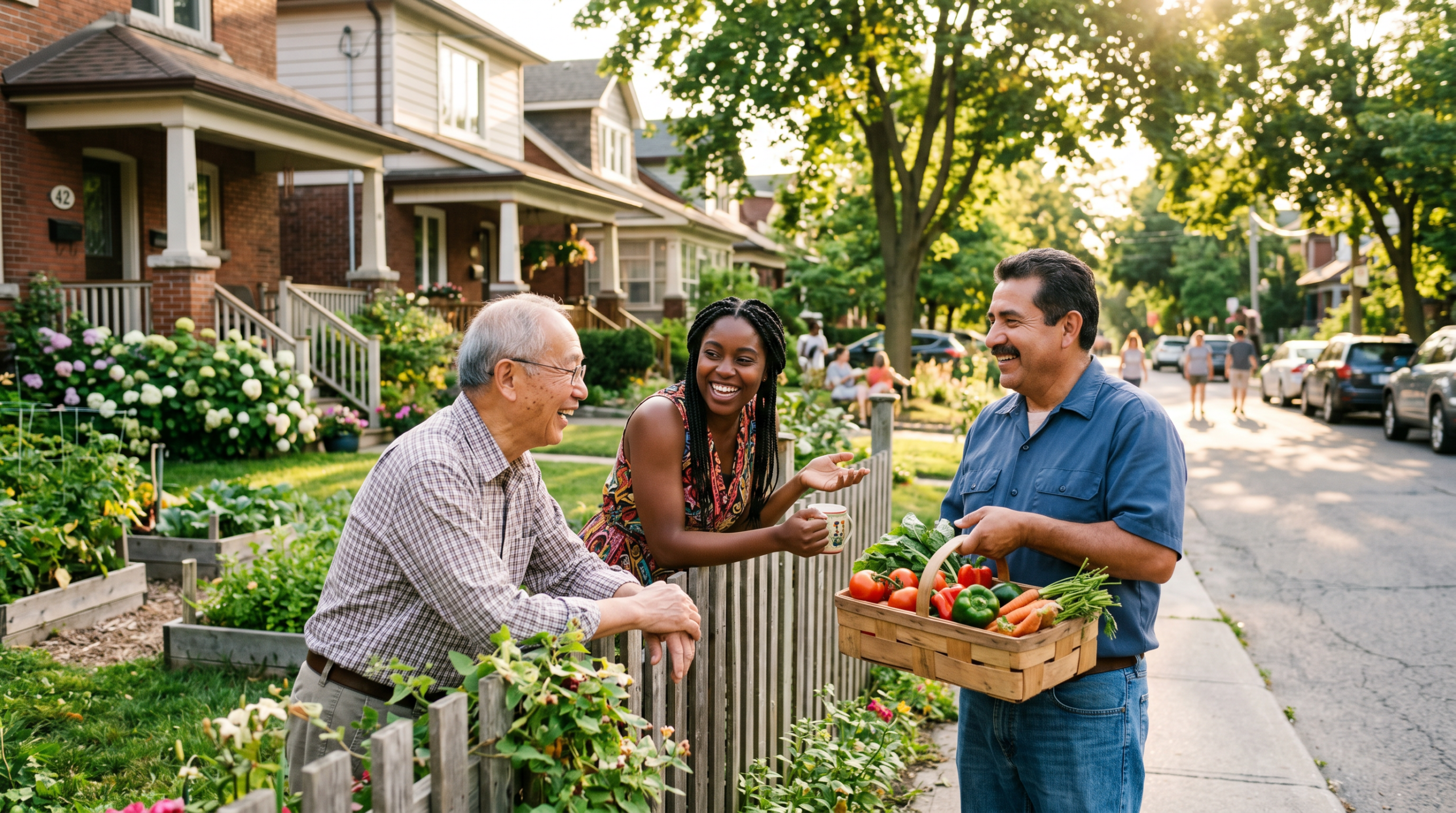
The strongest safety net is the one that lives on your own street
How We Became Strangers Next Door
The disappearance of neighborly familiarity was not a decision anyone made. It was the cumulative result of a hundred small changes, each reasonable on its own. We move more often, so we never stay long enough to put down roots. We commute farther, so we leave before the street wakes and return after it sleeps. The front porch, which once faced outward toward passing neighbors, was replaced by the back deck, which faces inward toward privacy. The garage door swallows the car and the person in one motion, so we go from sealed house to sealed vehicle without ever standing on the sidewalk.
Entertainment moved indoors and then into our pockets. The reasons to be out front — to cool off, to catch news, to simply not be bored — evaporated when the house became an air-conditioned, on-demand cocoon. Children, who used to be the great connectors of adults because they roamed the block and forced parents into contact, are now scheduled, supervised, and driven. The ambient, low-effort encounters that once built familiarity simply stopped happening, and familiarity is not built by intention so much as by repetition.
Crucially, none of this reflects a decline in human warmth. Surveys consistently find that people want stronger neighborhood ties and feel something is missing. The barrier is not desire; it is the disappearance of the small structures that used to make connection automatic. When the architecture of daily life stops producing casual contact, connection becomes a thing you must consciously manufacture — and most of us never get around to it.
Geography quietly turned against us, too. Decades of development spread homes farther apart, divided them with wide roads built for cars rather than feet, and pushed the shops, schools, and gathering spots out of walking distance. When the nearest place you might run into a neighbor requires a ten-minute drive, the running-into stops happening. A neighborhood designed so that no one ever has a reason to be on foot is a neighborhood that will, without anyone intending it, fill up with strangers. The physical layout of where we live shapes who we know far more than most of us realize, and much of what we built over the last half century was, in effect, optimized for privacy at the direct expense of familiarity. We got the quiet cul-de-sac we asked for, and lost the front-stoop acquaintance we never knew we were trading away.
What a Known Street Actually Does For You
The benefits of knowing your neighbors are easy to dismiss as sentimental until you need them. Start with plain safety. A street where people recognize one another is a street where an unfamiliar van or an open door gets noticed. Neighbors who know your routine notice when it breaks — the uncollected mail, the lights that never came on — and that noticing has saved lives during heat waves, falls, and medical emergencies. No app and no alarm system replaces a neighbor who knows you well enough to wonder where you are.
Then there is the everyday economy of small favors that money cannot efficiently buy: the package taken in, the kid watched for twenty minutes, the ladder borrowed, the ride to the airport, the cup of something you ran out of mid-recipe. Each favor is trivial. The web of them is not. It is a low-grade, always-on form of resilience that makes a hundred small problems disappear before they become real problems. People with strong local ties simply live with less friction.
And in genuine crisis, block-level ties are the first and fastest response that exists. When the storm hits, the power fails, or the emergency strikes, official help is minutes or hours away; your neighbor is seconds away. Disaster researchers have found again and again that neighborhoods where people know each other recover faster and suffer fewer casualties than equally resourced neighborhoods full of strangers. The relationships you build on an ordinary Tuesday are the infrastructure you rely on during the worst day of your life.
What Block-Level Ties Quietly Provide
Safety. Familiar faces notice the unfamiliar, and notice when your routine breaks.
Everyday help. Packages, pets, kids, tools, and rides — favors money can’t easily buy.
Crisis response. In a storm or emergency, your neighbor arrives long before any agency.
Belonging. A place where you are known, not just an address where you sleep.
The Trust That Grows From Familiarity
There is a less obvious payoff that may matter most of all. Knowing the actual humans nearby is a powerful antidote to the abstraction that poisons so much of modern life. It is easy to fear or resent a category of people you have never met. It is much harder to fear the specific neighbor who returned your trash cans and asked about your mother. Familiarity does not erase disagreement, but it puts a human face on it, and a human face is remarkably hard to hate.
This is how generalized social trust gets built — not through grand appeals but through accumulated small proofs that the people around you are basically decent and basically reliable. Each kept promise, each returned favor, each friendly nod is a tiny deposit in a shared account. Over time a street full of such deposits becomes a place where people assume good faith, and that assumption makes everything from borrowing a tool to organizing a cleanup vastly easier. Trust is not a feeling you decide to have; it is a residue that familiarity leaves behind.
The reverse is also true and worth naming. A street of strangers is a street where every small ambiguity defaults to suspicion. Whose dog is that? Why is that car parked there? Who left the gate open? In a known neighborhood these are questions you can answer with a text. Among strangers they curdle into low-grade unease that makes the whole place feel less safe than it actually is.
The stakes rise sharply at the two ends of life. Children who grow up on a known street inherit a wider circle of trusted adults, more freedom to roam safely, and an early, lived lesson that the world beyond their door is mostly friendly. Older residents, meanwhile, often depend on neighborly familiarity to age in place at all: the casual check-in, the noticed silence, the hand with a heavy door are the difference between staying in a beloved home and being forced out of it. A street that knows its own people quietly looks after both its youngest and its oldest in ways no service can fully replicate, and at no cost beyond a little attention.
| A Small Habit | What It Builds Over Time |
|---|---|
| Learning names on your block | Recognition, the foundation of every other tie |
| A wave or two-minute chat outside | Familiarity through low-stakes repetition |
| Offering one small favor first | A reciprocity loop that keeps renewing itself |
| A shared text thread or group | A standing channel for help and information |
| One annual gathering | A reset that turns acquaintances into a real network |
Rebuilding It Without Being Weird
The good news is that block-level connection is cheap to rebuild and does not require anyone to become an extrovert. It requires only the deliberate re-creation of the small contacts that the modern house and schedule eliminated. The single most powerful move is also the simplest: learn names. You cannot build a relationship with someone you cannot greet by name, and a surprising number of neighbor relationships never start because neither party wants to admit, years in, that they never caught the other’s name. Introduce yourself early, before the awkwardness compounds.
Then engineer repetition. Familiarity is built by frequency, not intensity, so the aim is many tiny contacts rather than a few big ones. Be outside a little more — in the front yard, on a walk, at the mailbox — at the times others are. Linger an extra two minutes. The two-minute sidewalk conversation, repeated weekly, does more than a single grand dinner party. It is also far less intimidating to initiate, which is why it actually happens.
Lead with a small gift of help, because giving first short-circuits the awkwardness of asking. Take in a package, offer extra tomatoes from the garden, return the stray trash can, mention you’re going to the store and ask if anyone needs anything. A favor freely given creates a comfortable opening for reciprocity without obligating anyone, and it signals that you are the kind of neighbor worth knowing. Once a couple of ties exist, formalize a channel — a group text or a small message thread for the block — so that help and information can flow without anyone having to knock.
Finally, create one recurring excuse to gather. It need not be elaborate: a casual front-yard hello on a holiday, a shared cleanup, an annual cookout where people drift in and out. Organizations like Points of Light promote exactly these kinds of low-barrier local gatherings because they work. One reliable event a year turns a set of nodding acquaintances into a network that remembers it exists — and that remembering is what you draw on when something goes wrong. None of these steps requires money, charisma, or a transformation of who you are. They require only the decision to treat the people nearest you as people worth knowing, and the patience to let a hundred small contacts do the slow, quiet work that connection has always depended on.
Frequently Asked Questions
Isn’t it intrusive to introduce yourself to neighbors?
Introducing yourself and learning names is almost universally welcomed; what reads as intrusive is over-eagerness or ignoring clear signals that someone wants privacy. A brief, friendly introduction with no demands is a low-risk gesture most people quietly appreciate.
I’m an introvert — do I really have to host gatherings?
No. The most effective tie-building is low-intensity and repeated: learning names, brief sidewalk chats, and small favors. Hosting is optional. Frequency of small contact matters far more than the size of any single event.
What if my neighbors seem uninterested?
Lead with a small, no-strings favor and keep contacts brief and pleasant. Some people warm up slowly, and a few never will, which is fine. You only need a couple of reciprocating neighbors to build a functioning local network.
The Safety Net Lives on Your Street
We did not stop caring about our neighbors; we stopped bumping into them. The porches, the roaming kids, and the slow evenings outside that once built familiarity quietly disappeared, and connection went with them. But the structures can be rebuilt deliberately, cheaply, and without anyone becoming someone they’re not.
Learn the names. Be outside a little more. Give one small favor first. Start one thread, host one gathering a year. None of it is heroic, and all of it compounds into the oldest and most reliable safety net there is — the one made of people who know you and live close enough to help.
Know your block, and your block will know you back.
This article is for general informational purposes. For research on neighborhood connection and community well-being, see the Pew Research Center and Points of Light.