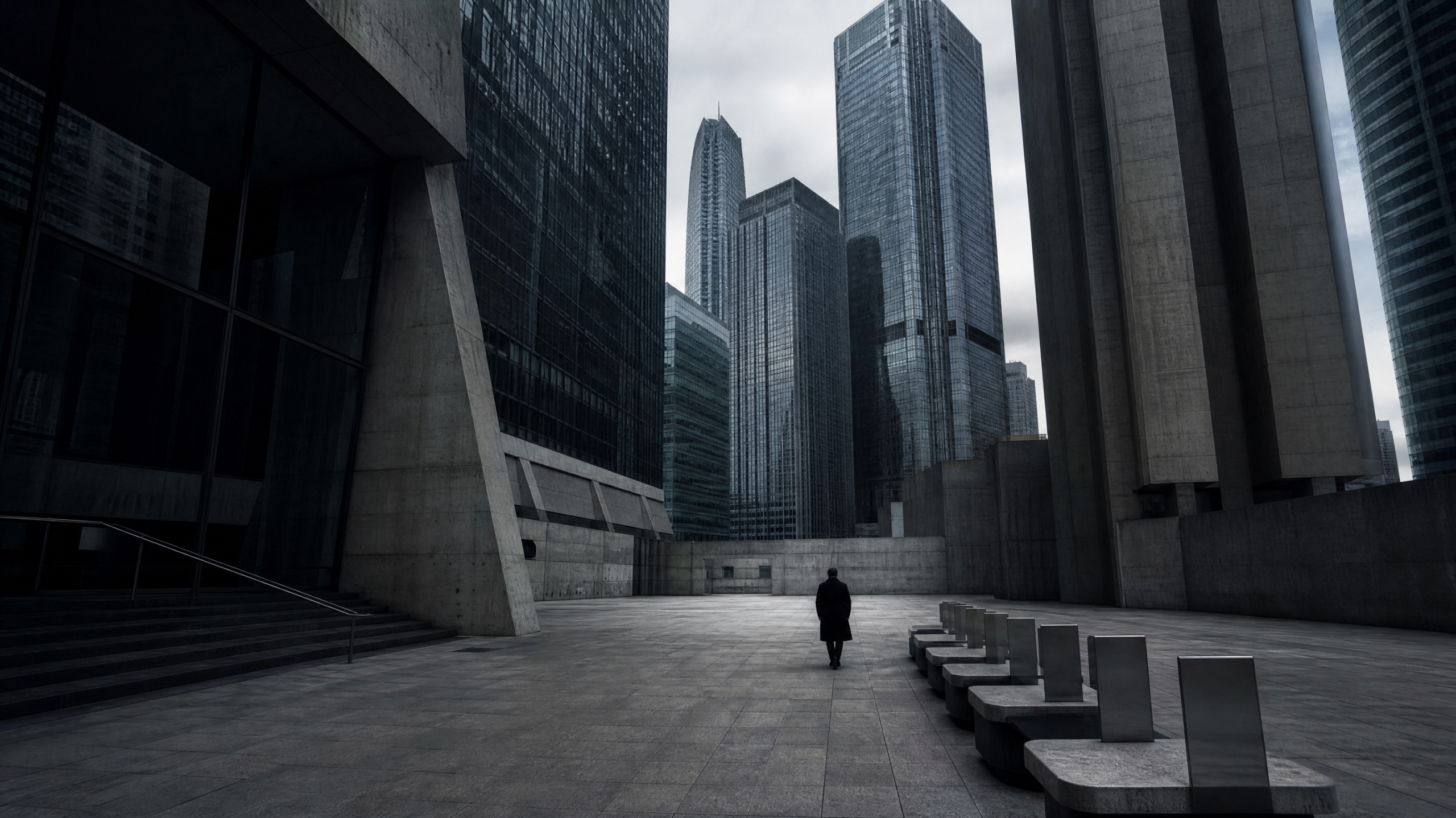
Loneliness isn’t only a feeling. Sometimes it’s poured in concrete.
We tend to think of loneliness as something that happens inside us — a matter of psychology, choice, or circumstance. But a great deal of our disconnection is built into the physical world we move through every day, designed in by decisions about roads, zoning, and housing made long before we arrived. The shape of a place quietly determines who we see, how often, and whether we ever have a reason to stop and talk. A neighborhood can be engineered for encounter or for avoidance, for lingering or for hurrying through, and most of the places built in the last several decades were, without anyone quite intending it, optimized for isolation. As the EPA’s Smart Growth program and urban planners increasingly recognize, the way we build shapes the way we connect — or fail to.
The Built Environment Has a Social Effect
Every place makes some kinds of human contact easy and others hard, and it does so long before any individual chooses how social to be. A front porch on a sidewalk street produces casual neighborly contact almost automatically; a house set behind a garage on a road with no sidewalk produces almost none. Neither outcome is about the character of the residents. It is about what the design permits and invites. This is the uncomfortable premise of connective urbanism: a meaningful share of our social lives is determined by infrastructure, not personality.
The mechanism is simple repetition. Connection, as we have seen, is built mostly through frequent, low-stakes contact — bumping into the same faces enough times that recognition turns into familiarity. A place generates such contact only if it puts people on foot, near each other, with reasons to pause. Remove the sidewalks, spread the destinations apart, eliminate the public gathering spots, and you remove the raw material of familiarity. The residents may be perfectly friendly and still never become neighbors in any real sense, because the place never gives them the chance.
This explains a puzzle many people feel but cannot name: why some neighborhoods feel alive with a sense of community while others, full of perfectly nice people, feel strangely empty and anonymous. The difference is usually not the people. It is the design — whether the place was built to be walked and lingered in or merely driven through and parked at. Connection follows the contours of the built world far more than we like to admit.
Design Choices That Quietly Isolate
▪ Car dependence. When every destination requires a drive, spontaneous, on-foot encounters disappear.
▪ Missing sidewalks. No place to walk means no place to meet; the street becomes a conduit, not a commons.
▪ Single-use zoning. Separating homes from shops and services removes the daily errands that mix people.
▪ Garage-front houses. Homes that face inward, with the garage as the entrance, turn streets into empty corridors.
▪ No public gathering space. Without parks, squares, or third places, there’s nowhere for community to pool.
“A neighborhood can be engineered for encounter or for avoidance — and most recent ones were built for avoidance.”
The Accidental Architecture of Apartness
No one set out to build loneliness. The car-dependent, spread-out, single-use landscape that dominates so much of the modern world was the product of well-meaning choices — the desire for space, quiet, privacy, and a yard of one’s own — amplified by zoning rules that mandated separation and road engineering that prioritized the speed of cars over the presence of people. Each decision was defensible. The cumulative result was a built environment that makes casual human contact require deliberate effort rather than supplying it as a default.
The pattern became self-reinforcing. Once a place is built around the car, walking becomes unpleasant or impossible, which drives more car use, which justifies wider roads and more parking, which pushes destinations farther apart, which makes walking even less viable. The neighborhood gradually loses every feature that produces encounter, and the residents adapt by retreating indoors, because the outdoors offers them nothing but a place to move their vehicles. The apartness is not chosen so much as inherited and then locked in by the logic of the design.
It is worth saying plainly that this is not an argument against suburbs, privacy, or personal space, all of which people legitimately want. It is an argument for noticing the trade-off, which is usually invisible. When we choose maximum privacy and separation, we are also, often unknowingly, choosing reduced spontaneous contact, and that contact turns out to matter more for human happiness than its quiet absence would suggest. The goal is not to abolish the trade-off but to make it a conscious one. A household that understands the trade can still choose space and quiet, but it can also choose to compensate — seeking out the walkable pocket, the nearby park, the porch that faces the street — rather than absorbing the isolation as an unexamined side effect of a decision it never knew it was making.
What Connective Places Have in Common
The encouraging news is that we know what the alternative looks like, because the places people consistently describe as having a strong sense of community share a recognizable set of features. They are walkable, so that errands and outings put people on foot among one another. They mix uses, so that homes, shops, and services sit close enough that daily life naturally brings residents into contact. And they offer abundant public space — parks, squares, sidewalks wide enough to linger on — where the unplanned encounters that build familiarity can occur.
Movements like those championed by the Congress for the New Urbanism and guidance from bodies such as the American Planning Association have spent years articulating these principles, and the evidence behind them is increasingly hard to ignore: places designed for people on foot generate more social contact, higher reported community satisfaction, and often better health than places designed for cars. The design that produces connection is not a mystery or a matter of taste. It is a well-understood set of choices that we spent decades building away from and could, deliberately, begin building back toward.
When the Map Becomes a Health Chart
If the link between design and connection sounds abstract, consider how directly it translates into health. Walkable, mixed-use neighborhoods do not only generate more social contact; they also produce more physical activity, simply because residents walk to do ordinary things instead of driving. The same features that put neighbors in casual contact — sidewalks, nearby destinations, places worth walking to — happen to be the features that keep bodies moving. Connection and health turn out to share an address, and the car-dependent landscape that isolates us also, not coincidentally, keeps us sedentary.
The mental-health side of the equation is just as real. People in isolating environments report more loneliness, and loneliness, as the connection literature makes clear, carries serious consequences for mood, sleep, and long-term health. A neighborhood that offers no easy way to encounter another human being is, in a quiet and cumulative way, a neighborhood that taxes the well-being of everyone in it. The cost does not appear on any blueprint or budget, which is exactly why it went unaccounted for during the decades we spent building such places.
This reframing matters because it moves connective design out of the realm of taste and into the realm of public health, where it belongs. We would not knowingly build housing that made people sick; yet by treating the social effects of design as a soft, optional consideration, we did something analogous. Increasingly, public health researchers and planners are insisting that the way we lay out our communities be evaluated by its effects on human flourishing — physical, mental, and social — rather than by traffic flow and parking ratios alone.
Small Fixes, Outsized Effects
The scale of the problem can make it feel hopeless — you cannot personally re-engineer a city. But one of the most encouraging findings in this field is how much modest, incremental change accomplishes. You do not have to bulldoze a suburb to make it more connective. Adding a sidewalk, planting street trees, allowing a small corner shop, converting a vacant lot into a pocket park, slowing traffic on a residential street — each of these small interventions measurably increases the everyday encounters that build familiarity, and they compound.
This means the built environment is far more editable than it appears, and editable at a human scale. Many of these changes are decided locally, by the same under-attended boards and councils that govern so much of daily life, which means ordinary residents can genuinely influence them. A neighborhood is not a fixed condition to be endured but a work in progress to be shaped, and the people who show up to shape it — arguing for the crosswalk, the bench, the corner store — are quietly building the conditions for their own community to become less lonely. The transformation does not have to be dramatic to be real; a street made just a little more walkable, a corner made just a little more inviting, accumulates over time into a place where people once again have ordinary reasons to cross paths. That is how isolation is reversed in practice — not by grand design, but by the patient restoration of the small, daily occasions for encounter that we spent so long engineering away.
Working With and Around the Design
Choose connection when you can. If you have a say in where you live, weigh walkability and nearby gathering spots alongside square footage. The design of a place will shape your social life more than you expect.
Use what walkability you have. Walk the errands you can, frequent the nearby spots, and take the routes that put you among people. You can extract more contact from a place by moving through it on foot.
Create encounter at the edges. Spend time in the front yard, not just the back. Sit on the porch or stoop. Put yourself where passers-by are, and let the design’s few contact points actually work.
Show up for local planning. Walkability, sidewalks, parks, and mixed-use zoning are decided in the local meetings most residents skip. The built environment is editable — by whoever attends.
Support the third places that remain. Patronize and defend the walkable cafes, parks, and shops that still generate encounter. They survive only if used, and they are the connective tissue a good place can’t do without.
Frequently Asked Questions
Can the design of a neighborhood really affect loneliness?
Yes. The built environment determines how often residents encounter one another on foot, and casual repeated contact is the raw material of connection. Walkable, mixed-use places with public space reliably generate more social contact than car-dependent, separated ones.
What makes a place feel like it has ‘community’?
Usually design rather than the residents’ personalities: walkability, a mix of homes and destinations close together, and ample public gathering space. These features produce the everyday encounters that turn neighbors into a community.
Isn’t this just an argument against suburbs and privacy?
No. It’s an argument for noticing a usually invisible trade-off. Space and privacy are legitimate goals, but they often come at the cost of spontaneous contact. The point is to make that trade-off conscious rather than accidental.
Connection Has an Address
▪ Much of our disconnection is built into roads, zoning, and housing, not just our psychology.
▪ Car dependence, missing sidewalks, single-use zoning, and absent public space engineer apartness.
▪ Connective places share clear features: walkability, mixed uses, and abundant public space.
▪ The built environment is editable — through where you choose to live and the planning meetings you attend.
Walk the errand. Sit on the porch. Show up to the planning meeting.
This article is for general educational purposes. For research and principles on the built environment, see the EPA’s Smart Growth program, the Congress for the New Urbanism, and the American Planning Association.