The Americas stack sea-level jungles against 4,000-metre cities, sometimes a ninety-minute flight apart. Your body notices even when your itinerary doesn’t. A practical guide to altitude illness, acclimatisation, and the climate whiplash of travelling vertically.
Fly from Lima to Cusco and you gain 3,400 metres of elevation in eighty minutes, the physiological equivalent of being winched most of the way up a mountain while drinking a cup of coffee. Your seatmate feels nothing. You, an hour after landing, have a headache like a hangover you didn’t earn, a heart rate that won’t settle, and a hotel room up four flights of stairs that suddenly constitutes a fitness test. Welcome to the Andes, the finest classroom in the Americas for the least-taught subject in travel planning.
Altitude illness is the most predictable and most mismanaged health risk in American-continent travel, predictable because the rules are well established and mismanaged because itineraries get built around flight prices rather than physiology. This guide covers what altitude actually does to the body, the acclimatisation rules that prevent trouble, the medications that help, and the broader climate whiplash (heat, cold, sun, jungle) that comes with a continent of vertical geography. It draws on the CDC’s Yellow Book guidance on high-altitude travel and altitude illness, the reference travel-medicine clinics use, and it is general information rather than personal medical advice. Travellers with heart or lung conditions should see a travel-medicine physician before any high-altitude itinerary.
In this article
- What Altitude DoesThe physiology in one minute
- The Altitude Map of the AmericasKnow your numbers before you book
- The Acclimatisation RulesThe part that prevents everything
- The Medication QuestionAcetazolamide and friends
- The Other Climate WhiplashSun, cold, and the jungle below
- Who Needs Extra CautionAn honest section
- The 72-Hour PlanWhat good acclimatisation looks like
- Climate by RegionWhat to actually pack
- Jet Lag, Bugs and the RestThe non-altitude remainder
What Altitude Does
The physiology in one minute
At 3,050 metres the air delivers only about 69% of the inspired oxygen it would at sea level, and acute exposure can pull arterial oxygen saturation down to 88–91%. Your body responds over three to five days of acute acclimatisation, when breathing rate rises, blood chemistry shifts and plasma volume drops, and you gradually return toward normal function, although maximum exercise performance never fully recovers at altitude and the body tops out at adapting somewhere around 5,200 metres. Three illnesses sit on the failure side of that process.
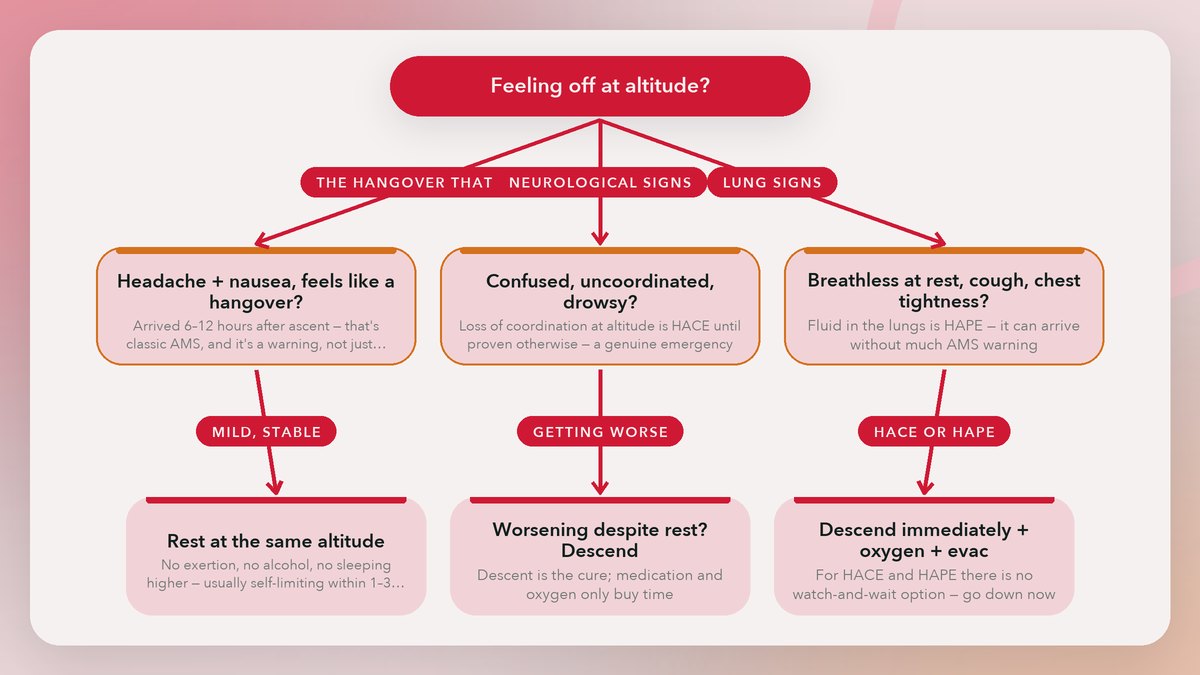
Acute mountain sickness (AMS) is the common one, a headache plus nausea, dizziness, fatigue or poor sleep that arrives 6–12 hours after ascent and feels precisely like a hangover. It hits about a quarter of visitors sleeping above 2,450 metres in Colorado, and where a flight drops you straight above 3,400 metres, as in Cusco or La Paz, illness rates approach half of all arrivals. It’s miserable, usually self-limiting within one to three days if you don’t go higher, and it works as a warning system rather than a mere nuisance.
HACE (high-altitude cerebral edema) is AMS progressing to the brain, with confusion, loss of coordination and drowsiness that can look like drunkenness to a travelling companion. It stays rare below about 4,300 metres, but once coordination fails, coma can follow within 12 to 24 hours without treatment or descent, which is what makes it a genuine emergency.
HAPE (high-altitude pulmonary edema) is fluid in the lungs, with breathlessness out of proportion to effort, a cough and chest tightness that can progress to breathlessness at rest over a day or two. It’s also rare, roughly 1 in 10,000 skiers in Colorado but closer to 1 in 100 travellers above 4,300 metres, and it can arrive without much AMS warning, with oxygen saturations in severe cases running 50–70%.
For both severe forms the one treatment that cures is descent; oxygen at 1–2 litres a minute can clear an AMS headache in about half an hour, and dexamethasone buys time, but going down is what fixes it. The CDC’s three survival rules deserve repeating. Know the early symptoms (they feel like a hangover) and admit to them. Never ascend to sleep higher while symptomatic, however minor it feels. Descend if symptoms worsen despite rest, since even uncomplicated AMS usually improves with a drop of just 300 metres. Nobody dies of altitude illness who descends in time.
The Altitude Map of the Americas
Know your numbers before you book
| Place | Elevation | What it means for visitors |
|---|---|---|
| Mexico City | 2,240 m | Mild for most; winded on stairs; hangovers arrive faster |
| Bogotá | 2,640 m | Noticeable; take day one easy |
| Quito | 2,850 m | Genuine altitude; light AMS possible on arrival |
| Cusco | 3,400 m | The classic arrival shock; AMS common in the unprepared |
| Puno / Lake Titicaca | 3,810 m | High; arrive acclimatised from Cusco, not from sea level |
| La Paz (El Alto airport) | 3,640–4,060 m | The world’s highest major airport — you land in it |
| Potosí | 4,090 m | Among the highest cities on Earth; acclimatise first |
| Inca Trail high point (Warmiwañusca) | 4,215 m | Trekking altitude; insurance and acclimatisation both apply |
| Rainbow Mountain / Ausangate region | 5,000–5,200 m | Day-trip altitudes that flatten the unacclimatised |
The pattern that matters is that the famous Andean circuit, Lima, Cusco, Sacred Valley, Machu Picchu, Puno, La Paz, works as a vertical ladder, and the order you climb it decides how you feel. The well-designed itinerary descends on arrival, sleeping the first nights in the lower Sacred Valley around 2,800 metres before climbing to Cusco and higher. The badly designed one flies from sea level to 3,400 metres and schedules a trek on day two, which is the exact profile that puts illness rates near 50%.
The Acclimatisation Rules
The part that prevents everything
The established guidance, in traveller-usable form, comes down to five rules.
Don’t jump to a high sleeping altitude on day one. Avoid going from near sea level to sleeping above roughly 2,750 metres in a single day where you can help it, the exact line the Wilderness Medical Society draws. If you must, and the Cusco and La Paz flights make that common, treat the first 24–48 hours as recovery with no exertion and light food; the coca tea the hotel offers is harmless tradition, although the evidence for it is folk-grade.
Above 3,000 metres, gain sleeping altitude slowly. The rule of thumb is no more than about 500 metres of sleeping-elevation gain per night, with an extra rest day for every 1,000 metres gained. Trekkers compress the same idea into “climb high, sleep low”, because day excursions to high passes with a return to a lower bed are far gentler than sleeping at the pass.
Stage your ascent when you can. The CDC calls a minimum of two or three nights at moderate altitude, somewhere in the 2,450 to 2,750 metre range, markedly protective against AMS, which makes a stop in the Sacred Valley at 2,800 metres or Arequipa at 2,300 metres the single most effective intervention available; it costs nothing but itinerary design.
Alcohol waits 48 hours. It worsens sleep, blunts the breathing response the body needs at altitude, and mimics AMS symptoms, so the welcome pisco sour can wait two days. Regular caffeine users should keep drinking it, because a withdrawal headache masquerades as an altitude headache.
Fitness doesn’t protect you. Susceptibility is partly genetic and stubbornly unrelated to how fit you are; marathoners get AMS, and the CDC notes that sex plays little role while travellers over 50 carry slightly less risk. The only honest predictor is your own previous response to altitude, and even that fails if the altitude or the ascent rate differs from before.
“Fitness doesn’t protect you from altitude. It just means you can be sick at 4,000 metres with excellent cardiovascular efficiency.”
The Medication Question
Acetazolamide and friends
Acetazolamide (Diamox) is the standard. It speeds acclimatisation from the usual three to five days down to about one, it’s used preventively when abrupt ascent is unavoidable (flying straight to Cusco or La Paz is the textbook case), and it treats mild AMS. The usual preventive dose is 125 mg twice a day, rising to 250 mg twice a day for people over 100 kg, and the drug is FDA-approved for exactly this use. Side effects are familiar and mostly benign, tingling fingers and the odd fact that carbonated drinks taste flat, since acetazolamide lets you actually taste the carbon dioxide on your tongue. Dexamethasone, typically 4 mg every six hours, is the stronger medicine for moderate to severe AMS and is carried for emergency use on remote treks; ibuprofen 600 mg every eight hours has shown some preventive effect in recent studies, though usually less reliably than acetazolamide. Supplemental oxygen is standard in Andean hotels and clinics and works within minutes, and a pulse oximeter, available for under $30, is a cheap way to watch acclimatisation happen. Because acetazolamide is prescription-only, that conversation happens at a travel-medicine clinic before departure, which you should book anyway for a multi-country trip. The broader travellers’-health resources at the CDC and the lay-accessible reference at altitude.org, run by APEX, the University of Edinburgh charity that has sent six student research expeditions to South America since 2001, are the two bookmarks worth keeping.
The Other Climate Whiplash
Sun, cold, and the jungle below
Altitude is the headline, but vertical travel in the Americas packs a supporting cast of four more.
UV radiation rises with elevation. It’s meaningfully stronger at 3,000 metres than at the coast and roughly doubled again by reflection off snow or salt flats, and the classic Andean sunburn arrives through cloud, in cool air, before lunch. High-SPF sunscreen, a real hat and sunglasses rated for glacier light count as health equipment at that point.
Cold arrives differently at altitude. High Andean days can run t-shirt warm while the same night brings hard frost. What you pack for is the diurnal swing rather than the average, which is why layers usually beat a single heavy coat.
The descent to the jungle reverses the risks. The same trip that takes you to 4,000 metres may end in the Amazon basin, where the planning shifts to mosquito-borne illness, heat and yellow-fever vaccination requirements, since some countries demand the certificate from travellers arriving from risk areas. A travel clinic sequences all of this, and vaccines need lead time, because some combinations can’t be taken together at short notice.
Disturbed sleep is the early warning sign most people misread. Above roughly 2,700 metres, periodic breathing with frequent waking is nearly universal. It’s mostly harmless and improves with acclimatisation, but it frightens travellers who weren’t told to expect it; consider yourself told, and know that acetazolamide steadies nocturnal breathing too.
Who Needs Extra Caution
An honest section
Most healthy travellers can visit the high Americas safely with the rules above. The CDC’s altitude table puts anyone with significant heart or lung disease (severe COPD, pulmonary hypertension with artery pressure above 60 mm Hg, untreated obstructive sleep apnea), sickle cell disease or trait, poorly controlled hypertension, a heart attack or stroke within the past 90 days, or pregnancy in the caution-or-worse column, and that’s because the margin for error narrows rather than because altitude is automatically forbidden. For pregnancy specifically, many specialists advise keeping sleeping altitudes below about 3,050 metres. Children acclimatise much like adults but can’t describe symptoms, so the preverbal signs matter: irritability, appetite loss, unusual tiredness. And everyone, regardless of health, should carry travel insurance whose trekking-altitude limit actually covers their itinerary, a subject our insurance guide covers in detail, because claim denials at 4,200 metres are a genre of their own.
The 72-Hour Plan
What good acclimatisation looks like
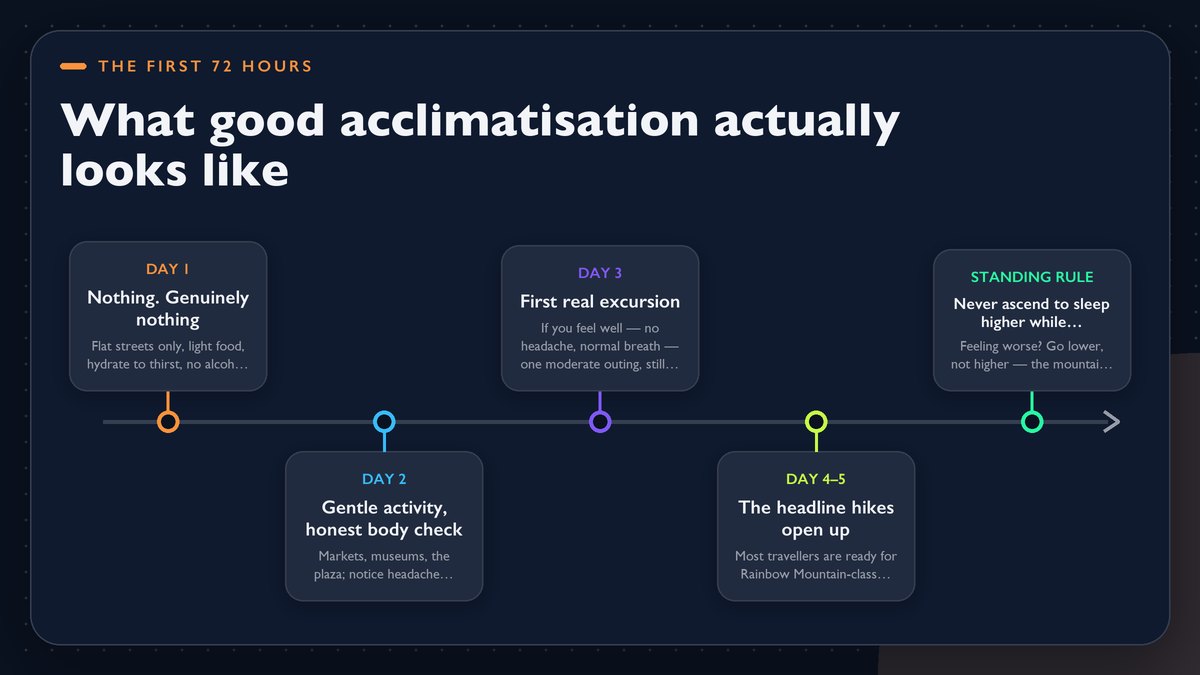
Land at altitude and give the first day away entirely. Walk only the flat streets around the plaza, eat light, and drink to thirst plus a bit, since the force-gallons-of-water advice is overstated; no alcohol, and an early night. Day two allows gentle activity, the markets, the museums, the plaza, while you take an honest inventory of how your body feels; a pulse oximeter costing under $30 can reassure you that your oxygen saturation is trending up as it should. Day three, if you feel well, earns the first real excursion, still short of any big pass. By day four or five, most travellers are ready for the headline hikes. The traveller who follows this sees everything, a few days slower, while the one who schedules Rainbow Mountain, at 5,000-plus metres, on day two sees the inside of a clinic or a very memorable ambulance. The mountains have been there for millions of years, and they will still be there on Thursday.
Climate by Region
What to actually pack
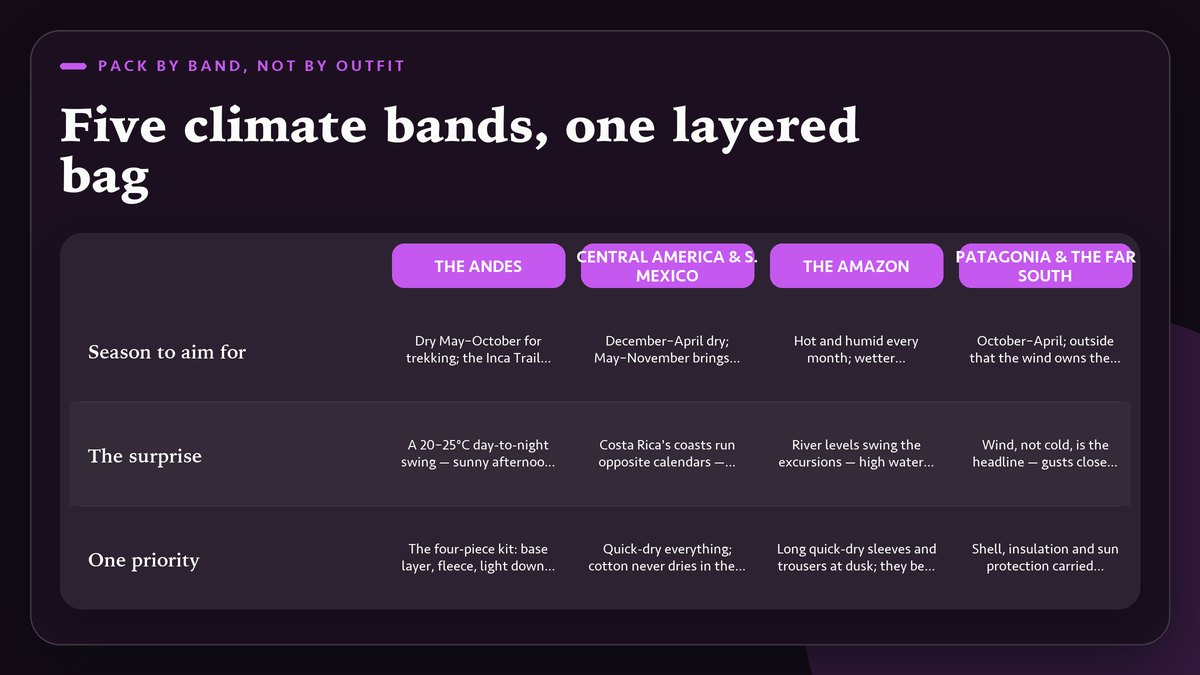
The hemisphere packs as three climate bands, and a single bag can cover all of them if it’s built on layers rather than outfits.
The Andes run on two seasons rather than four. The dry window from May to October is trekking season, blue days and freezing nights, while the wet months from November to April are green, uncrowded and stormy by afternoon, with some trails closing outright (the Inca Trail shuts every February). The signature is the swing, often 20–25°C between a sunny afternoon and a 3 a.m. bathroom run at altitude. The kit that works everywhere from Quito to Ushuaia is the same four pieces (base layer, fleece, light down jacket, rain shell) plus two hats, one for the sun and one for the cold.
Central America and southern Mexico run a dry season of roughly December to April. The “green season” from May to November means short, theatrical afternoon downpours rather than all-day rain, lower prices, and a hurricane watch on the Caribbean side from August to October. The wrinkle nobody expects is that Costa Rica’s two coasts run on opposite calendars, since when the Pacific is parched the Caribbean is pouring and vice versa, so “when to go” depends on which slope you’re aiming at. Pack quick-dry everything, because cotton that stays wet for days in the green season turns miserable by the third afternoon.
The Amazon is hot and humid every month, wetter from December to May, and the seasons matter less than the bug spray. Long sleeves and long trousers in quick-dry fabric beat any repellent at dusk, a light rain layer earns its space daily, and river levels shift excursions by season, with high water opening flooded forest to canoes and low water opening beaches and trails, so the month you pick should follow what you want to see rather than any weather chart.
Patagonia and the far south keep their season to October through April, and the headline there isn’t cold but wind, with summer gusts that knock trekkers sideways and close the famous lookout points for hours at a time. The local saying about four seasons in a day works as a packing instruction; carry a shell, insulation and sun protection together every day regardless of the morning sky, because south of the lakes nothing stays waterproof forever and the wind finds seams.
North America compresses its alpine hiking into July through September in the Canadian Rockies, where snow is possible in any month at elevation and winter-driving rules with proper tires apply from October. The US Southwest inverts the logic, because summer turns Death Valley and the low desert genuinely dangerous and the classic road-trip windows are spring and autumn. The continent’s single best weather bargain is October, when the Rockies are golden, the deserts are civilised and the crowds have gone.
Jet Lag, Bugs and the Rest
The non-altitude remainder
North–south jet lag barely touches the clock. Lima keeps roughly Eastern Time and Santiago runs about an hour ahead, so the lag only arrives on transatlantic or transpacific legs, and it hits harder flying east than west. Morning light at the destination, no naps past mid-afternoon, caffeine in the mornings only and a gently scheduled first big day do most of the work; melatonin helps some travellers, and timing matters more than the pill.
The realistic tropical risk is mosquitoes. Dengue is the one to respect, since the region has seen record outbreaks in recent years, including in temperate Argentina, alongside chikungunya and Zika, all carried by day-biting city mosquitoes. Malaria, by contrast, is confined mostly to deep Amazonia and matters mainly for jungle-lodge and river trips; that’s a travel-clinic conversation about prophylaxis, and it shouldn’t stop anyone from visiting Iquitos. The defence is unglamorous and it works, plain 30–50% DEET or picaridin, long sleeves at dawn and dusk, and air-conditioning or nets at night, and it’s worth the bother. A dengue vaccine exists in some countries but isn’t a standard traveller recommendation, so ask your clinic what’s current for your itinerary.
Treat the equatorial sun as medical kit. At equatorial altitude the UV index regularly exceeds 11, and a noon walk in Cusco can burn unprotected skin in fifteen minutes, through cloud, in weather that feels cool. SPF 50, a real hat, lip block and sunglasses rated for high UV are the kit in question; the high-altitude sunburn is a rite of passage worth declining.
Stomachs, water and bites reward a small pharmacy. Outside the big cities, drink bottled, filtered or treated water, and carry oral rehydration salts (the actual treatment for most travel stomachs), loperamide strictly for bus days, and a standby antibiotic course from your travel clinic for the cases that don’t resolve. Stray dogs and charming monkeys both carry the risk that a single bite means a rabies vaccine series on a deadline, so admire the street dogs with your hands in your pockets and never feed the wildlife, however practiced its begging face.
This article summarises published travel-medicine guidance (CDC Yellow Book and related sources, current as of 2026) for general information; it is not medical advice and cannot account for individual health conditions. Consult a travel-medicine physician before high-altitude travel, particularly with any pre-existing condition. This article contains no affiliate links. All outbound links checked live in August 2026.