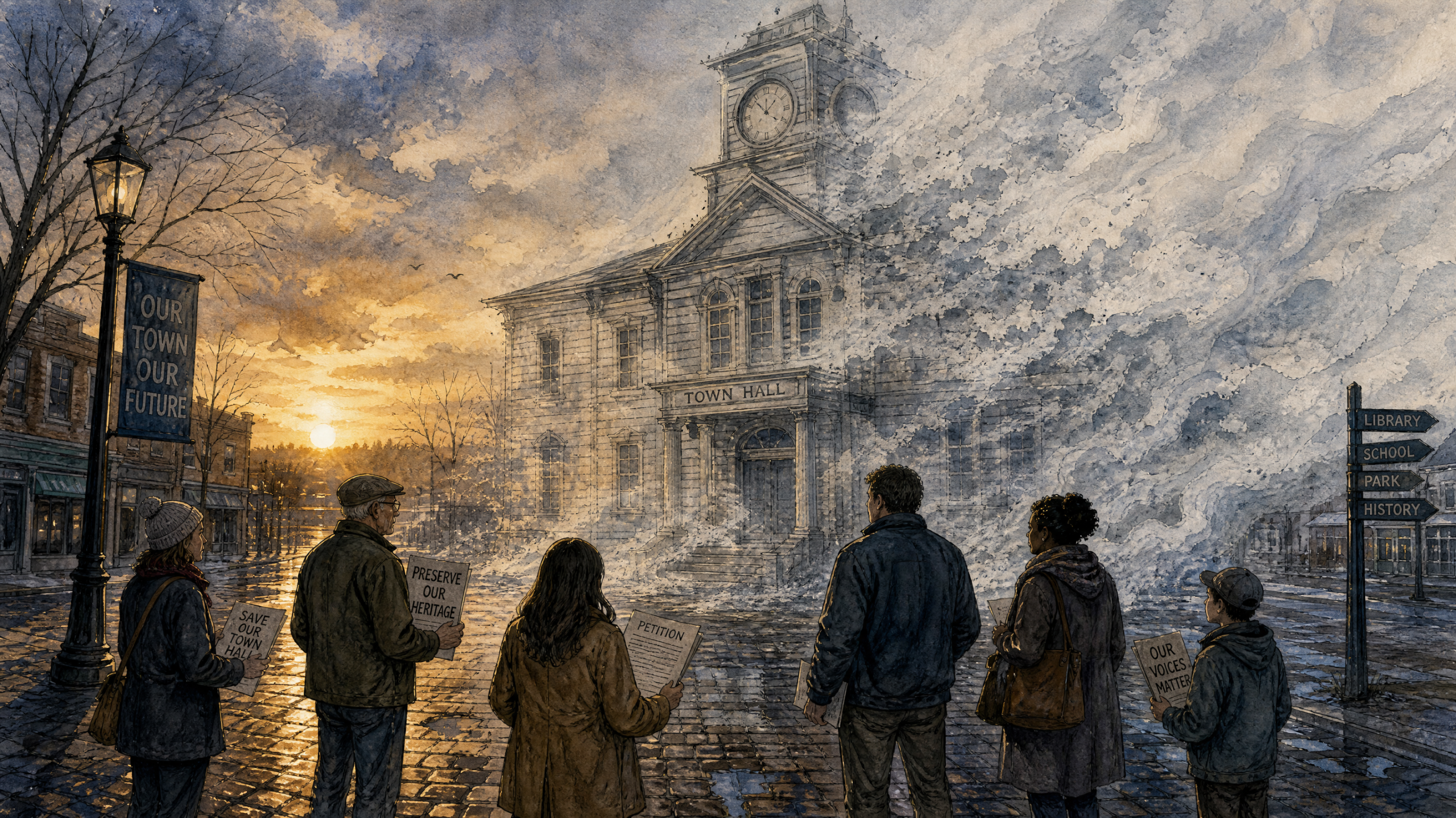
The most consequential room in your town is usually the emptiest
The Most Powerful Room You’ve Never Sat In
Ask most adults when they last attended a city council, county commission, school board, or zoning meeting, and you will get an uneasy laugh. We follow national elections like a sport, complete with rosters and rivalries, yet we cannot name our own council member. This is not a personal failing so much as a cultural habit. The big stage is loud, dramatic, and endlessly covered; the local stage is quiet, procedural, and largely uncovered. So we end up intensely engaged with the decisions we can least affect and almost entirely absent from the ones we could shape with an afternoon and a willingness to raise our hand.
The irony is hard to overstate. A single citizen at a sparsely attended zoning hearing carries weight that the same citizen could never carry in a national debate. When a board sees three residents in the audience, each of those three represents, in the officials’ minds, dozens of silent neighbors who feel the same way. The math of attention works in your favor precisely because so few people show up. Power at the local level is not hoarded by a cabal; much of it is simply left lying on the table because we have stopped reaching for it.
It helps to remember what these bodies actually are. A city council is not a miniature Congress arguing ideology. It is closer to the board of a very large, very specific cooperative that you are automatically a member of by living where you live. The agenda is rarely about grand principles. It is about a stop sign, a liquor license, a sidewalk repair, a bus route, a property tax rate. These are the texture of daily life, and they are decided by people who would genuinely like to know what you think, if only you would tell them.
What Actually Gets Decided There
Consider how much of your ordinary day is governed locally. The school your child attends, its calendar, its budget, and what it teaches are largely set by an elected school board. Whether a developer can build apartments, a bar can open, or a corner lot becomes a park is decided by planning and zoning boards. The frequency of your bus, the timing of road repairs, the location of a new fire station, the rules for short-term rentals, the fate of a beloved old building — all local. Even property taxes, often the single largest recurring bill a homeowner faces, are set in these meetings, line by line, by people you can email.
The federal government commands the headlines, but it is a blunt instrument in your daily experience. It does not pick up your trash, decide whether your street floods, or determine whether the library stays open on Sundays. Those choices live at the city, county, and special-district level. The directory at USA.gov is a useful reminder of how many distinct local bodies quietly run the machinery of a normal life — water districts, transit authorities, library boards, park commissions — each with its own meetings, its own budget, and its own near-empty public comment period.
And these decisions compound. A zoning choice made at a lightly attended meeting in 2024 determines what your neighborhood looks like in 2044. A school board’s curriculum vote shapes a generation of local kids. A transit decision can decide whether a part of town thrives or withers for decades. Because the participants are few and the consequences are long, the leverage of showing up is extraordinary. You are not one voice among millions. You are one voice among a dozen.
Decisions Made in Rooms You Can Walk Into
Land and housing. Zoning, permits, density, and what can be built where you live.
Schools. Budgets, calendars, boundaries, and curriculum, set by an elected board.
Money. Property tax rates, local fees, and how your tax dollars get spent.
Daily infrastructure. Roads, transit, water, parks, libraries, and public safety.
Why the Seats Are Empty
If the leverage is so high, why does no one go? Part of the answer is simple friction. Meetings are held at inconvenient hours, in buildings with bad parking, and they run long. The agendas are written in dense procedural language that seems designed to repel the casual reader. You arrive wanting to talk about a pothole and find yourself sitting through forty minutes about a sewer easement. The format rewards the patient and the professional — lobbyists, developers, and single-issue activists — and quietly filters out the ordinary resident who has dinner to make.
A deeper reason is a learned sense of futility. Many people assume the decisions are already made, that the fix is in, that showing up is theater. Sometimes that is even true. But far more often the apparent inevitability is an illusion created by the absence of any opposing voice. Officials default to the loudest or the only voice in the room. When that voice is a developer’s attorney and yours is nowhere, the outcome feels predetermined — but only because you weren’t there to make it otherwise.
There is also a coverage problem. As local newspapers have shrunk or vanished, the reporter who once sat through every council meeting and translated it for the public is gone. Pew Research Center has tracked the steep decline of local news, and the consequence is that most residents have no idea what their local government is even discussing. You cannot show up to a meeting you never heard about, on a decision you never knew was pending. The empty seats are partly the residue of an information vacuum.
Finally, we have miscalibrated where power lives. Decades of nationalized politics have trained us to pour our civic energy into presidential races and cable arguments, as if that were the whole of citizenship. It is the least efficient possible use of civic effort. The returns on local engagement are vastly higher per hour invested, yet they feel less important because they are less dramatic. We have confused volume with significance.
The Quiet Cost of Staying Home
When ordinary residents disappear from local government, the vacuum does not stay empty. It is filled by whoever has a direct financial or organizational stake in the outcome. That is not a conspiracy; it is just incentives. The people who profit from a decision will always find the time to attend. If they are the only ones there, policy bends steadily toward their interests, meeting by meeting, year after year. The result is a town shaped by the preferences of the few who showed up rather than the many who didn’t.
The cost also shows up as a slow erosion of trust. When residents feel that decisions happen to them rather than with them, cynicism grows, and cynicism is self-fulfilling: the more people believe their voice doesn’t matter, the fewer show up, and the less their collective voice actually matters. Reversing that spiral does not require a movement. It requires a few people deciding that the spiral is worth interrupting, and treating local presence as a normal civic habit rather than an act of heroism.
| Where a Decision Gets Made | What It Quietly Controls |
|---|---|
| City or town council | Budgets, ordinances, fees, and how the town is run day to day |
| Planning and zoning board | What can be built, where, and how your neighborhood changes |
| School board | School budgets, boundaries, calendars, and curriculum |
| County commission | Roads, public health, courts, and county-wide services |
| Special districts | Water, transit, parks, and libraries you use every week |
How to Actually Start Going
Begin small and specific. Pick the one issue you already care about — the intersection that scares you, the school policy that affects your kid, the park that is being eyed for development — and find the single body that controls it. You do not need to understand the whole apparatus. You need to understand the one room relevant to your one concern. Most local governments post agendas online days in advance; reading the agenda is half the work, because it tells you exactly when your issue will come up so you can show up only for the part that matters.
Learn the unglamorous mechanics. Nearly every public body reserves time for public comment, usually with a strict limit of two or three minutes per speaker. That is more than enough. A specific, calm, factual statement from a resident who clearly lives with the consequences lands harder than any polished speech. You do not need credentials. You need to be there, to be concrete, and to be reachable afterward. Leave your name and email; officials remember the residents who follow up.
Then make it social and durable. Going alone once is a gesture; going with two neighbors repeatedly is a force. A small, persistent group that attends the same board’s meetings becomes a known quantity that officials cannot ignore. You can also lower the friction for everyone by simply summarizing what happened for your neighbors afterward — an email, a group chat, a short post. In doing so you become the local-news function that has gone missing, and you make the next person’s first meeting far less intimidating than yours was.
Treat your first few meetings as reconnaissance, not performance. The goal is not to win anything immediately; it is to learn the rhythm, recognize the faces, and discover that the room is far more approachable than it looked from the outside. Almost everyone who starts attending says the same thing: it was less mysterious, less hostile, and far more winnable than they had assumed.
Frequently Asked Questions
Are local government meetings really open to anyone?
Yes. Meetings of councils, school boards, and most public bodies are open to the public by law, with agendas typically posted in advance and a set period reserved for public comment. You do not need to register a position in advance or hold any title to attend and speak.
I only have time for one thing — which meeting matters most?
Pick the body that controls the issue you care about most. For housing and development it is usually planning and zoning; for schools it is the school board; for taxes, roads, and most daily services it is the city or town council. Start there rather than trying to follow everything.
Does showing up actually change anything?
More often than people expect, because attendance is so low that each resident carries outsized weight. A few specific, persistent voices frequently shift an outcome simply by being the only counterweight to the people with a financial stake in the decision.
The Room Is Open. The Seat Is Yours.
The decisions that shape your street, your school, and your tax bill are made in public, by people who would like to hear from you, in rooms that are nearly empty. That emptiness is not a sign that nothing matters there. It is an open invitation, and a quiet transfer of power to whoever bothers to attend.
You don’t need expertise, a title, or a movement — just an agenda, two minutes, and the willingness to be the voice that would otherwise be missing. The stage is small, the audience is thin, and that is exactly why your presence counts for so much.
Find the meeting. Take the seat. Say the thing.
This article is for general informational purposes and is not legal or civic-procedure advice. For how local government works, see the National League of Cities, the National Civic League, and your local government’s official website for meeting schedules and rules.