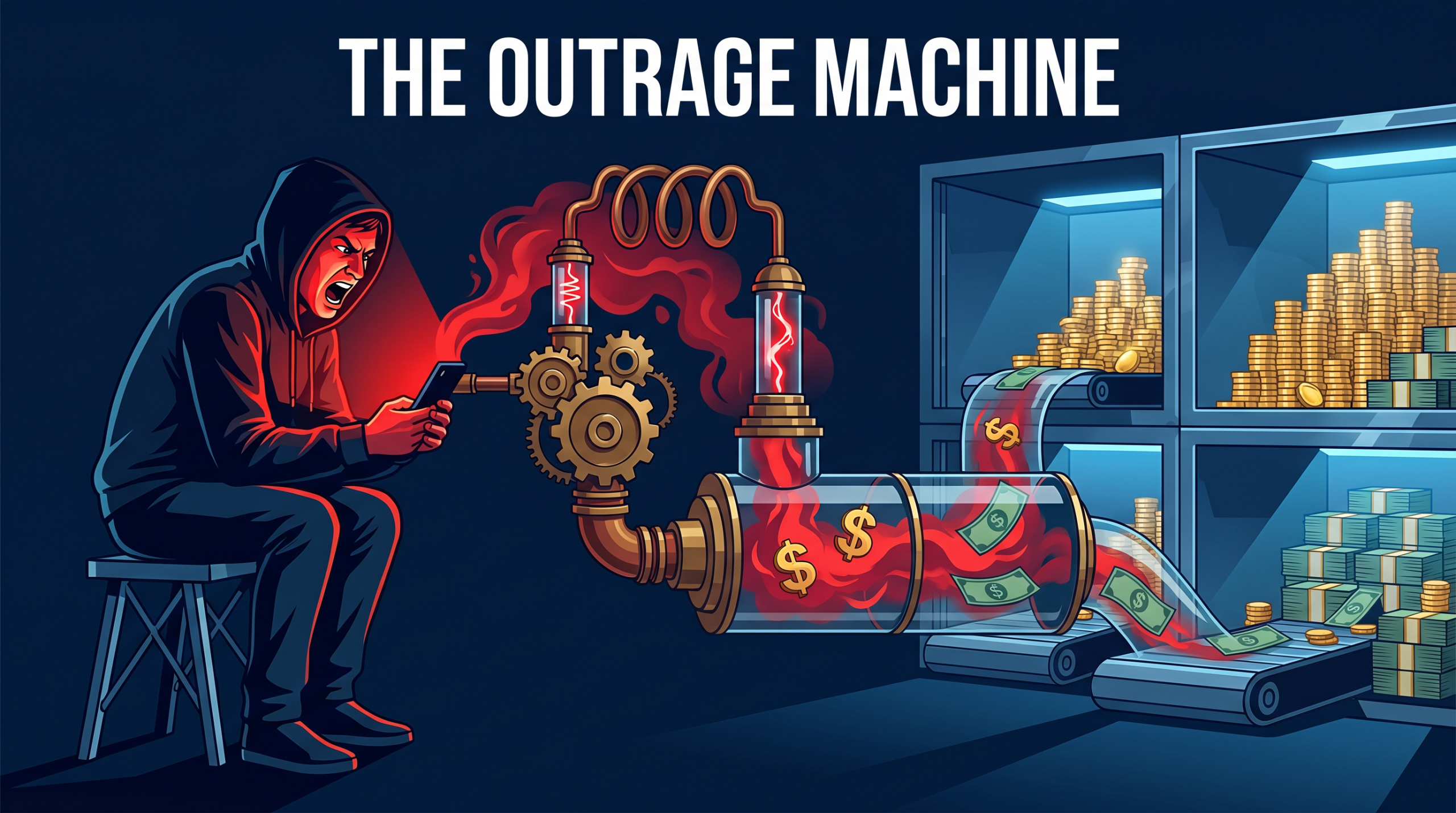
The feeds that feel like they’re showing you the world are quietly optimizing you for fury.
01The Business Model Behind the Feeling
Start with the economics, because everything else follows from it. The dominant social platforms are advertising businesses, and advertising businesses sell one thing: human attention. Their revenue is a direct function of how long you stay and how often you come back, which means every design decision, every algorithmic tweak, is ultimately judged by a single question — does it increase engagement? This is not a sinister conspiracy whispered in boardrooms. It is the open, structural logic of the business, as ordinary as a store arranging its shelves to make you buy more.
The trouble is what happens when you optimize relentlessly for engagement and discover, as these companies did, that certain emotions engage far more powerfully than others. Calm agreement does not spread. Nuance does not spread. But moral outrage — the hot, righteous anger at someone who is wrong and bad — spreads explosively, drawing comments, shares, and the compulsive checking that follows a fight. An algorithm with no opinions of its own, simply maximizing engagement, will therefore learn to show you the content most likely to make you angry, not because it wants you angry but because angry is what keeps you there.
This is the crucial point that reframes the whole experience: the system did not set out to enrage you. It set out to engage you, discovered that enraging you was the most reliable way to do so, and proceeded accordingly. The outrage is not a side effect the companies regret; it is the engine doing exactly what it was built to do. Once you see the feed as a machine tuned to find and feed you whatever provokes the strongest reaction, its contents start to look less like a window onto reality and more like a funhouse mirror calibrated for maximum agitation.
“The algorithm does not want you angry. It wants you engaged — and it learned that anger is the cheapest way to keep you that way.”
02Why Anger Is the Perfect Fuel
Outrage is uniquely suited to the attention economy for reasons rooted deep in human psychology. Anger is arousing in the physiological sense: it raises the heart rate, sharpens focus, and creates a compulsion to act — to respond, to share, to set the record straight. Where a sad story might make us look away and a complex one might make us think, an enraging one makes us do something, and doing something on a platform is precisely the engagement the platform is measuring. Anger converts passive scrolling into active participation more reliably than almost any other emotion.
Moral outrage in particular comes with a sense of righteousness that feels good even as it feels bad. Condemning a wrongdoer affirms our own values and our membership in the group of good, right-thinking people; it is socially rewarded with likes and agreement from our side. So we get a small hit of moral satisfaction for engaging with outrage content, which trains us to seek more of it. The platform has, in effect, found a way to make us feel virtuous while behaving in exactly the way that serves its bottom line, which is a remarkably durable trap.
Outrage also travels because it simplifies. A complicated situation with reasonable people on multiple sides is hard to share and harder to feel strongly about. Convert it into a story of villains and victims, of obvious wrong and obvious right, and it becomes instantly shareable. The algorithm therefore rewards the most simplified, most emotionally charged version of any issue, which is almost never the most accurate version. Over time, a media environment optimized for outrage does not just make us angrier; it makes us dumber about the very issues we are angriest about.
That you’re seeing the real state of the world, that things are uniquely terrible, and that the people on the other side are uniquely awful — and that your anger is a simple, honest response to what’s in front of you.
A system is selecting, from billions of possible items, the small set most likely to provoke you, then showing you those. Your feed is a curated extreme, not a representative sample — outrage engineered, not reality observed.
03The Distortion of the Whole Picture
The deepest harm of the outrage machine is not the unpleasantness of feeling angry. It is the systematic distortion of our picture of reality. Because the feed shows us the most extreme and enraging examples of any group or position, we come to believe those extremes are typical. We see the worst thing a member of the other side said this week, presented as if it represents all of them, and conclude that the other side is composed of monsters. The reasonable majority, who said nothing inflammatory and were therefore never shown to us, become invisible.
Research on political attitudes consistently finds that people dramatically overestimate how extreme the other side is, and the gap between perception and reality tracks closely with heavy social media use. Surveys by the Pew Research Center have documented both the rising tide of perceived hostility and the role of online platforms in shaping it. We are not, for the most part, encountering each other; we are encountering algorithmically selected caricatures of each other, and then reacting to the caricatures as though they were the people.
This creates a vicious cycle that extends well beyond any single platform. Convinced by our feeds that the other side is extreme and hostile, we become more extreme and hostile in response, which produces more outrage content, which further distorts everyone’s picture. The machine does not merely report on polarization; it manufactures it, profits from it, and feeds the result back into the culture, where it hardens into the genuine mutual contempt that the feeds claimed merely to be describing all along.
The Vocabulary of the Outrage Economy
Engagement — any measurable interaction — clicks, comments, shares, time spent — that platforms maximize and sell to advertisers.
Moral outrage — righteous anger at perceived wrongdoing, which spreads faster online than almost any other emotional response.
Amplification — the algorithmic boosting of content that provokes strong reactions, regardless of whether it is accurate or representative.
Affective polarization — growing emotional hostility between groups, driven less by policy disagreement than by mutual dislike and distrust.
04The Private Toll of a Public Rage
Beyond distorting our view of the world, the outrage machine extracts a quiet personal cost that rarely gets counted. Living in a state of low-grade, chronic anger is genuinely bad for us. The body was built to handle acute threats and then return to calm, not to marinate all day in the diffuse fury that a steady feed of provocation produces. People who spend hours immersed in outrage content frequently report feeling more anxious, more exhausted, and more pessimistic about the world — not because the world has changed, but because their window onto it has been tuned to show them its worst.
There is also a corrosion of our capacity for proportion and joy. When everything is presented as an emergency and everyone as either an ally or an enemy, the ordinary texture of life — its ambiguity, its small pleasures, its mostly-decent strangers — gets flattened into a permanent battle. We lose the ability to find anything merely interesting rather than infuriating, to encounter a difference of opinion without girding for war. The machine does not just take our attention; it slowly reshapes our temperament in its own image, leaving us more reactive and less at peace than we were before we picked up the phone.
Perhaps most insidiously, the outrage habit is self-reinforcing in the brain. Each hit of righteous anger, each satisfying condemnation, each rush of agreement from our side delivers a small reward that trains us to come back for more, much like any other compulsive behavior. We can end up genuinely addicted to being angry — seeking out the next infuriating thing, feeling restless without it — while experiencing the whole cycle as simply caring deeply about important issues. Naming the compulsion for what it is, is the beginning of being able to step outside it.
05Taking Back the Controls
The good news is that seeing the machine clearly already weakens its grip, and a few deliberate habits weaken it further. The single most powerful move is to insert a pause between feeling and reacting. The outrage machine depends on the reflexive share, the instant furious comment, the reaction before reflection. Simply asking, before you react, whether a piece of content was designed to make you feel exactly this way — and whether the extreme example in front of you is really typical — interrupts the automatic loop the system relies on.
It also helps enormously to diversify and slow your information diet. A feed is a machine for showing you the most provocative version of everything; a good newspaper, a long article, a book, or a direct conversation is not. Deliberately seeking out longer, calmer, more complete sources of information — and treating the feed as entertainment rather than as a reliable map of reality — restores a sense of proportion that the algorithm is actively working to destroy. The goal is not to become uninformed but to get your information from sources not optimized to enrage you.
Finally, resist the temptation to fight the machine on its own terms. The furious reply, the dunk, the share-with-condemnation all feel like resistance but are actually fuel: every reaction, including the angry one aimed at the content you hate, is engagement that teaches the system to show more of the same. The most genuinely subversive act available to an individual is often simply to disengage from the outrage — to scroll past, to refuse the bait, to spend the attention elsewhere. The machine cannot profit from a reaction it never gets.
✓ Pause before reacting and ask if the content was built to provoke you.
✓ Get your news from longer, slower sources, not just the feed.
✓ Treat the most extreme example as the exception, not the rule.
✓ Disengage from bait instead of fighting it — silence starves the machine.
✗ Sharing in anger before checking what’s actually true.
✗ Treating your feed as a representative picture of the world.
✗ Assuming the worst example you saw represents a whole group.
✗ Believing the furious reply is resistance — it’s engagement.
06Frequently Asked Questions
Q.Are platforms really trying to make me angry?
Not directly — they’re trying to maximize engagement. But because outrage engages more powerfully than calm or nuance, algorithms optimizing for attention reliably learn to surface anger-provoking content. The anger is a means to the end of keeping you on the platform.
Q.Does this mean the things I’m angry about online aren’t real?
Not necessarily — real problems exist. The point is that your feed shows you a curated, extreme, unrepresentative slice of reality selected to provoke you, which distorts your sense of how common and how typical those things are.
Q.What’s the most effective thing one person can do?
Insert a pause between feeling and reacting, get information from slower sources, and disengage from bait rather than fighting it. Every reaction, even an angry one, is engagement that trains the system to show you more of the same.
See the Machine, Reclaim the Mind
The outrage you feel scrolling is not simply an honest reaction to a worsening world. It is, in large part, a product — the output of systems optimized to keep you engaged, which learned that anger does that better than anything else.
Seeing this clearly is most of the defense. Pause before reacting, widen and slow your information diet, treat extremes as exceptions, and starve the machine of the reactions it feeds on. The world is rarely as enraging as the algorithm needs you to believe.
Pause before you react. The machine can’t profit from silence.
This article is for general educational purposes. For research on social media, news, and public opinion, see the Pew Research Center and the Knight Foundation.