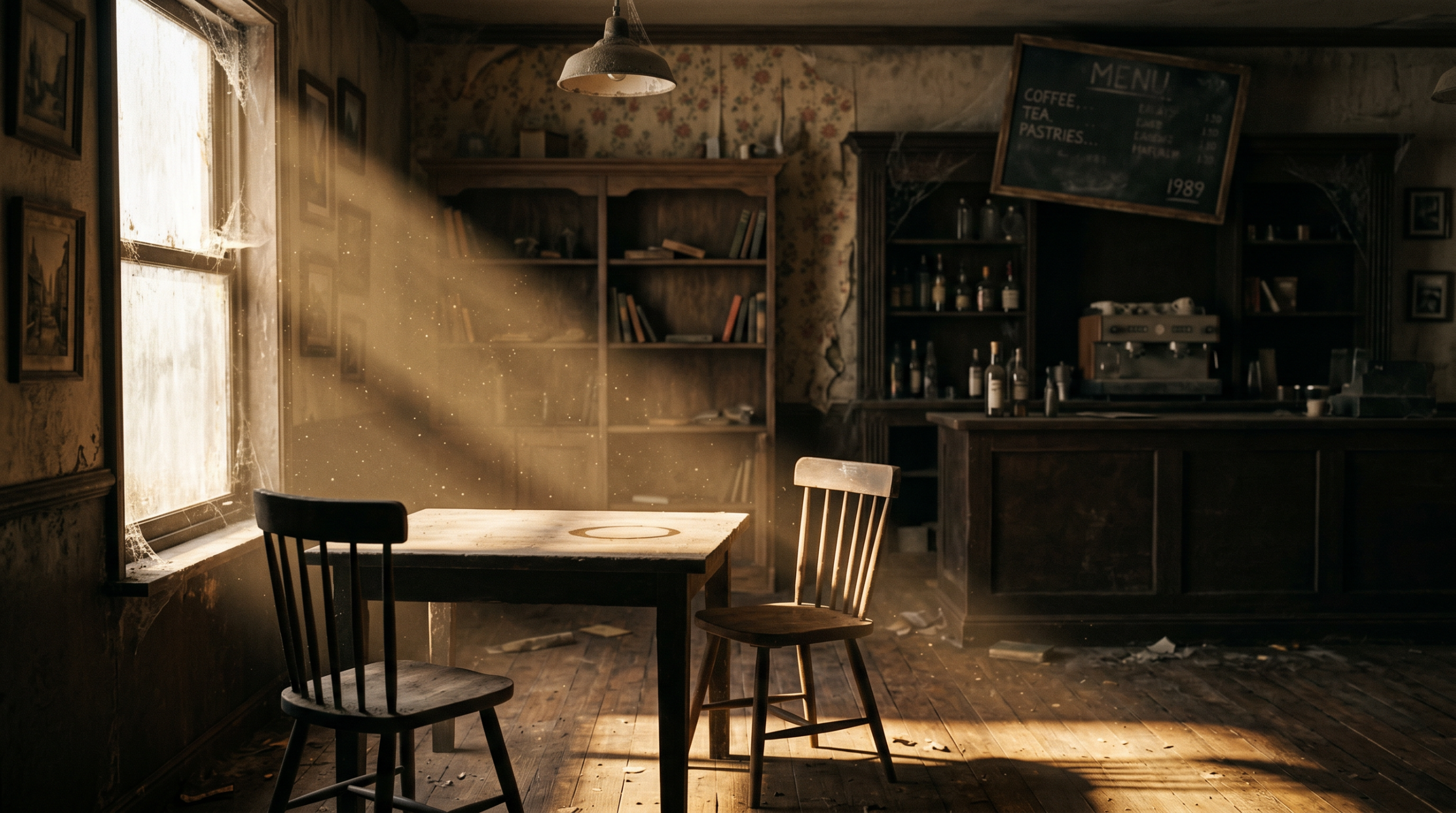
Not home, not work — the in-between places where community quietly happened.
There is a particular kind of place that most of us no longer have, and many of us never learned to miss because it disappeared so gradually. It is not your home and not your workplace. It is the third place: the diner where the regulars are known by name, the barbershop where the conversation outlasts the haircut, the corner pub, the church hall, the neighborhood library, the park bench that the same faces occupy each morning. These were the unhurried, low-stakes settings where community was not organized but simply happened — and across a generation, an astonishing number of them have quietly closed, gone digital, or been priced out of reach. Their loss is one of the least-discussed drivers of how disconnected modern life has come to feel.
The In-Between Places That Held Us Together
The idea of the third place comes from the observation that a healthy social life rests on three legs. The first place is home, the second is work, and the third is everything in between: the informal public spaces where people gather without an agenda. What makes a third place special is precisely that nothing important is supposed to happen there. You are not being productive, not performing a role, not obligated to anyone. You are simply present, available, and among others — and that low-pressure availability is exactly the condition under which casual ties form.
Third places did something no app and no scheduled event can replicate: they produced connection as a side effect of mere presence. You did not go to the diner to make friends; you went for coffee and the friends accumulated anyway, conversation by conversation, over months of showing up. This is the secret ingredient that modern social life keeps trying and failing to manufacture. We schedule networking events and friend dates and team-building exercises, but connection resists being the explicit goal. It arrives sideways, through repetition in a shared place, which is exactly what the third place provided and exactly what we have lost.
Crucially, third places were also the great mixers of a community. Unlike our carefully sorted social media feeds, the old corner establishment threw together people of different ages, backgrounds, and opinions who would otherwise never meet. The young and the old, the rich and the struggling, the agreeable and the infuriating all shared the same counter. That accidental mixing built a kind of social trust and mutual familiarity that a sorted, filtered world simply does not generate, and its absence is felt in how foreign our fellow citizens have come to seem to one another.
Marks of a True Third Place
▪ Neutral ground. No one is host or guest; people come and go freely without obligation.
▪ A leveler. Status from home and work is left at the door; the regular is what matters.
▪ Conversation is the main event. Talk, not consumption or productivity, is the point of being there.
▪ Regulars set the tone. A core of familiar faces makes newcomers feel the place is alive and welcoming.
▪ Low profile and accessible. Plain, comfortable, cheap or free, and easy to drop into on a whim.
“You did not go to the diner to make friends; you went for coffee, and the friends accumulated anyway.”
How They Slipped Away
The death of the third place was not a single event but a slow squeeze from several directions at once. Economics did much of the work: rising commercial rents made the lingering, low-margin establishment — the place where one cup of coffee bought three hours of a table — financially impossible, and replaced it with businesses engineered for turnover rather than dwelling. The modern cafe that hurries you out, the restaurant designed to flip tables, the shop with nowhere to sit are all responding rationally to costs, but the rational response quietly eliminates the loitering that made a place a third place.
Sprawl and car dependence finished much of what economics began. The third place depends on being walkable, casual, and close — somewhere you can drift into without a plan. A landscape of highways, parking lots, and destinations that require a deliberate drive destroys the spontaneity that third places run on. When getting anywhere takes a car trip, every outing becomes an errand, and the unplanned drop-in — the lifeblood of informal community — simply stops happening.
And then the screen offered a frictionless substitute that asks nothing of us. Why sit in a slightly awkward room full of strangers when you can scroll an endless feed from the couch? The trouble is that the digital third place, for all its convenience, delivers stimulation without belonging. It is the third place hollowed out: the noise of others without the presence of them, the appearance of community without its substance. We accepted the trade because each individual choice was easier, and woke up in a world short on the real thing.
The Quiet Cost of Their Absence
When third places vanish, social life does not simply shrink — it polarizes into two extremes. We are left with the intimacy of home and the obligation of work, and nothing in the comfortable middle. Without the casual, undemanding setting where acquaintances are made, every new relationship now requires a deliberate effort: an invitation, a plan, a scheduled commitment. The threshold for connection rises, and as it rises, fewer connections clear it. Many people who feel they cannot make new friends as adults are really experiencing the loss of the places where adult friendships used to form effortlessly.
Older adults feel this loss most acutely, which is why organizations like AARP have warned about the link between vanishing community spaces and isolation later in life. For someone no longer anchored by a workplace, the third place was often the last reliable source of regular, unplanned human contact. Its disappearance can turn retirement from a release into a slow isolation. But the cost is not theirs alone; a society without shared casual spaces becomes a society of strangers who encounter one another only through screens and headlines, which is a recipe for suspicion rather than fellow feeling.
Why the Digital Version Doesn’t Satisfy
It is fair to ask whether online communities have simply become the new third place — the forum, the group chat, the comment section, the game lobby where people gather without an agenda. In some respects they qualify: they are neutral ground, they level status, and conversation is the main event. But they are missing the ingredient that turns out to matter most, which is embodied co-presence. A third place works partly because you are physically there, sharing the same air, recognizable by face, accountable to people who can see you. Strip that away and you keep the conversation but lose much of the belonging.
The digital gathering also lacks the friction that, paradoxically, made physical third places valuable. Online, you can leave any conversation instantly, block any irritant, and sort yourself into a space populated entirely by the like-minded. The old diner offered no such exits. You had to sit with the bore, the crank, and the person whose politics you despised, and in doing so you slowly learned the civic skill of coexisting with people you did not choose. That friction was not a bug; it was a school for tolerance, and the frictionless feed quietly abolished it.
None of this means digital spaces are worthless — for the housebound, the remote, and the rare-interest enthusiast they can be genuine lifelines. But it does mean they are a supplement, not a substitute. Treating the group chat as a full replacement for the corner cafe is like treating a photograph of a meal as dinner. It captures something real about the original while delivering almost none of its actual nourishment, and a diet of it leaves us, again, hungry in the midst of apparent plenty.
Nostalgia or Necessity?
It would be easy to dismiss all this as sentimentality — an older generation mourning the soda fountain. But the third place is not a nostalgic luxury; it is civic infrastructure as real as roads and water, and its loss has measurable consequences for loneliness, trust, and the basic ability of a community to know itself. The places where strangers become familiar are the places where a collection of individuals slowly becomes a public, and a society that loses them does not simply become less charming. It becomes harder to govern, easier to divide, and lonelier in ways its members feel but struggle to explain.
Recognizing the third place as necessary rather than quaint changes how we treat the ones that survive. The neighborhood library, the public park, the community center, the diner that still lets you linger — these are not amenities to be cut when budgets tighten but the load-bearing walls of a connected community. We defend the infrastructure we understand to be essential. The first step in saving our third places is simply to see them clearly for what they are. Once we do, the case for funding a library, protecting a park, or zoning for a walkable main street stops looking like discretionary spending on nice-to-haves and starts looking like exactly what it is: an investment in the social health of the people who live there.
Finding or Building Your Own
Become a regular somewhere. Pick one accessible place — a cafe, library, gym, park, or shop — and go at the same time repeatedly. Familiarity is built by showing up, and regulars eventually recognize regulars.
Choose places that allow lingering. Favor the spots that let you stay: a counter, a comfortable corner, a bench. The businesses that tolerate dwelling are the ones where third-place magic can still occur.
Champion the public options. Libraries, parks, and community centers are free third places hiding in plain sight. Use them, support their funding, and treat them as the civic infrastructure of belonging that they are.
Host the in-between yourself. If the places are gone, recreate the function: a standing open-door coffee, a weekly porch hour, a recurring casual gathering with no agenda but showing up.
Protect the spontaneity. Resist over-scheduling the result. The point of a third place is that nothing is required; keep it loose enough that people can drift in, stay a while, and leave without explanation.
“A society without shared casual spaces becomes a society of strangers who meet only through screens and headlines.”
Frequently Asked Questions
What exactly counts as a ‘third place’?
Any informal public setting that is neither home nor work where people gather without obligation — cafes, pubs, barbershops, libraries, parks, community centers. The defining features are neutral ground, easy conversation, and a core of regulars.
Why do third places matter so much for connection?
Because they produce relationships as a side effect of mere presence rather than requiring connection to be the explicit goal. Casual ties form through repeated, low-pressure contact, which is exactly what these spaces uniquely provide.
Can online communities replace them?
They can supplement but rarely replace them. Digital spaces deliver the noise of others without full physical presence, offering stimulation more than belonging. The embodied, accidental mixing of a real third place is hard to reproduce on a screen.
Reclaiming the Middle Ground
▪ Third places are the informal, in-between spaces where community used to form by accident.
▪ Rising rents, car-dependent sprawl, and the screen squeezed most of them out of daily life.
▪ Their loss raised the threshold for connection, hitting older adults and social trust hardest.
▪ You can revive the function — become a regular, use public spaces, and host the unscheduled middle.
Find your counter, your bench, your corner — and keep showing up.
This article is for general educational purposes. For research on community spaces and isolation, see the Pew Research Center, AARP, and the American Library Association on libraries as community spaces.