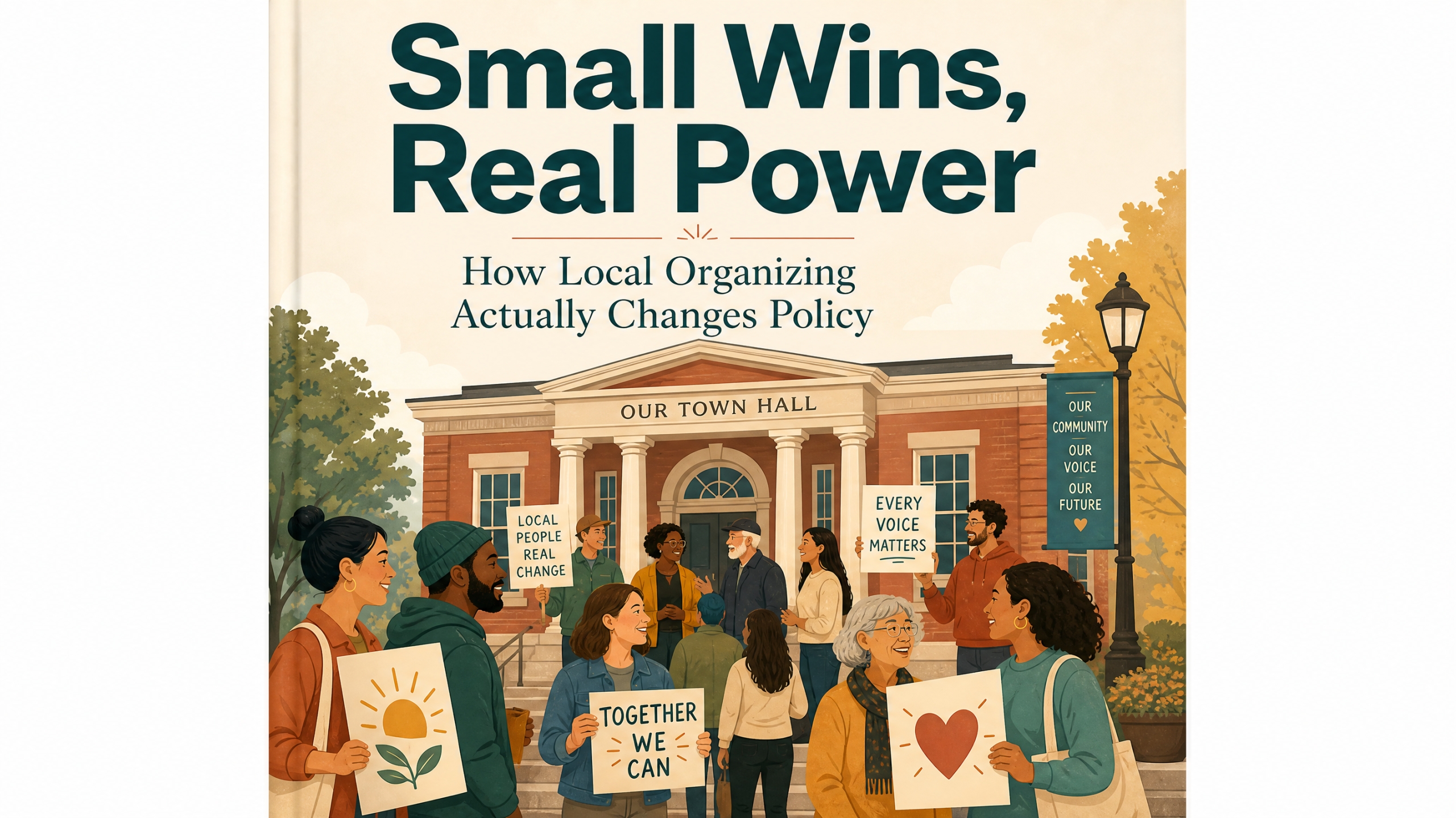
Big change rarely starts big. It starts with a handful of people and one winnable fight.
Why Small and Local Beats Big and Loud
The instinct to start big is the instinct that kills most civic energy before it does anything. A vast, abstract goal — fix the schools, end the housing crisis, clean up government — has no obvious first step, no clear opponent, and no achievable finish line, which means it generates frustration rather than progress. Local organizing works in the opposite direction. It picks a goal small enough to actually win, wins it, and uses that win as the foundation for the next one. The scale is the strategy, not a compromise of it.
Small and local also means the levers are real and within reach. You cannot, as one person, change national education policy, but you can absolutely persuade a school board of seven people to change a single policy in your district. You cannot reform the national housing market, but you can get your city council to approve a specific project or change a specific rule. The decision-makers are reachable, the rooms are open, and the number of people you need to persuade is small enough to fit at a table. That is what makes local change possible where national change feels hopeless.
Finally, small wins do something psychologically essential: they prove that effort produces results. The greatest enemy of civic engagement is not opposition; it is the belief that nothing you do matters. A single concrete victory — a stop sign installed, a budget line restored, a bad rule reversed — permanently rewires that belief for everyone involved. It converts cynicism into momentum, and momentum is the actual fuel of every sustained effort.
There is a visibility dividend, too, that national fights almost never offer. When you win something local, you can see it, point to it, and walk past it. The crosswalk is painted; the streetlight works; the program is funded. That tangibility matters enormously, because abstract victories fade from memory while physical ones stand in the world as permanent advertisements for the idea that ordinary people changed something real. Every neighbor who uses that crosswalk is, whether they know it or not, living inside proof that organizing works. National politics rarely hands anyone such a clean, concrete, repeatable demonstration — which is part of why it leaves so many people feeling that effort is futile, and why patient local work so reliably produces the opposite feeling.
The Anatomy of a Winnable Fight
Effective local organizing begins not with passion but with selection. The first and most important skill is choosing the right fight: an issue that is specific, locally controlled, broadly sympathetic, and genuinely winnable with the people and time you have. A good first issue is concrete enough that everyone can picture the outcome, controlled by a body you can actually reach, and modest enough that victory is plausible. Picking a fight you are likely to lose as your opening move is the fastest way to burn out the few people willing to help.
Once the issue is chosen, the work is research and relationships, not noise. You need to know exactly which body decides the matter, when it meets, what the process is, and who the individual decision-makers are. You need a clear, specific ask — not ‘do something about traffic’ but ‘install a four-way stop at this intersection.’ A decision-maker can say yes to a specific request; they cannot say yes to a grievance. The clarity of the ask often matters more than the volume of the support behind it.
Then you build just enough visible support to make the decision easy to say yes to. This rarely requires a crowd. It requires a handful of credible residents showing up consistently, a stack of signatures or letters that proves the concern is shared, and a few brief, factual statements at the public meeting from people who plainly live with the problem. Decision-makers are not moved by spectacle; they are moved by the sense that a real, persistent constituency cares and is watching. A small group that keeps showing up reads as exactly that.
Ingredients of a Win
The right issue. Specific, locally controlled, sympathetic, and genuinely winnable.
A clear ask. A precise request a decision-maker can actually say yes to.
A few persistent people. Consistency beats crowd size at the local level.
Visible, credible support. Letters, signatures, and residents who live the problem.
The Long Game of Stacked Wins
A single victory is satisfying, but the real power of local organizing lies in stacking wins over time. Each success does three things at once: it solves a real problem, it grows your group as new people join a thing that visibly works, and it builds your credibility with the decision-makers themselves. The second time you approach a council with a clear ask and a track record of being reasonable and accurate, you are no longer a stranger with a complaint. You are a known, trusted constituency — and that standing is worth more than any one-time crowd.
Stacked wins also reshape the incentives of the officials. Once a group has demonstrated that it shows up, follows through, and remembers what was promised, decision-makers begin to factor that group in before decisions are even made. You graduate from reacting to decisions to influencing them in advance. This is the quiet, durable form of power that ordinary residents can actually accumulate: not the power to dominate, but the power to be reliably consulted and not ignored.
The pattern compounds across issues, too. Skills learned winning a stop sign — reading agendas, making the ask, organizing testimony, following up — transfer directly to bigger fights later. A group that started by getting a single crosswalk painted can, a few years and several wins later, credibly take on a budget priority or a zoning overhaul, because it has built the muscle, the relationships, and the confidence that come only from a string of earlier victories. Big change, when it comes, is usually the accumulated weight of many small ones.
Stacked wins also let you build the one asset that beats money in local politics: a coalition. After a victory or two, other groups with adjacent interests — a parents’ association, a neighborhood watch, a local business or congregation — begin to see you as a competent ally worth partnering with rather than an unknown quantity. Each alliance multiplies your reach without diluting your focus, because you bring them a track record and they bring you their members. Over a few years, a small group that started alone can find itself at the center of a loose network that no official wants to cross. None of that is available to the group that demands everything at once and wins nothing; coalitions form around demonstrated competence, and competence is precisely what a string of small wins proves.
| Organizing Step | What It Accomplishes |
|---|---|
| Choose a winnable issue | Ensures an early victory that builds momentum |
| Define a specific ask | Gives decision-makers something they can approve |
| Research the process | Reveals who decides, when, and how to reach them |
| Show up consistently | Establishes you as a real, watching constituency |
| Stack the next win | Turns one success into durable, ongoing influence |
Starting Where You Are
You do not need permission, a nonprofit, or a budget to begin. You need one issue you care about, one or two other people who care about it too, and the willingness to learn the process. Start by identifying the single body that controls your issue and attending one of its meetings purely to observe. Watch how decisions move, who speaks, what lands and what doesn’t. That one evening of reconnaissance teaches more about real power than any amount of theorizing, and it almost always reveals that the system is more open than you assumed.
Keep the group small and serious rather than large and loose. Three reliable people who attend every meeting and follow through outperform thirty enthusiastic people who show up once. Assign clear roles so that responsibility never diffuses into the group — one person tracks the agenda, one drafts the ask, one coordinates who speaks. The discipline of named responsibility is what separates a group that wins from a group that vents.
Document and share every win, however small, because visible success is how you recruit and how you sustain morale through the inevitable losses. When neighbors see that your effort produced a real, named result, the abstract idea that ‘getting involved is pointless’ dies a little, and a few more people decide to join. Each win you publicize lowers the barrier for the next person and the next fight. You are not just changing a policy; you are slowly rebuilding the local belief that change is possible at all.
Above all, be patient with the pace and impatient with the cynicism. Local change is slow, procedural, and unglamorous, and it will test the resolve of anyone hoping for a dramatic breakthrough. But it is also real, durable, and genuinely within reach of ordinary people in a way that national politics almost never is. The handful of residents willing to learn the mechanics and keep showing up will, over time, shape their community far more than the millions who stayed home convinced it was hopeless.
Frequently Asked Questions
Do I need a large group to change local policy?
No. At the local level, a few persistent, credible residents who consistently show up and make a clear ask routinely outperform large but disorganized crowds. Consistency and follow-through matter more than headcount.
How do I pick the right first issue?
Choose something specific, controlled by a local body you can reach, broadly sympathetic, and genuinely winnable with the people you have. An achievable first victory builds the momentum and credibility you need for bigger fights later.
What if we lose the first fight?
Losses happen and are part of the process. Treat them as information, document what you learned, and choose the next fight more strategically. Persistence and a track record of showing up build influence even across occasional defeats.
Big Change Is a Stack of Small Wins
Policy that touches your daily life is mostly made locally, by small bodies, and changed by small groups who learned the unglamorous mechanics. You don’t need a movement or a megaphone — you need one winnable fight, a clear ask, and a few people willing to keep showing up.
Win the small thing. Publicize it. Use the credibility and the skills to win the next one. Over time, a handful of persistent residents shape their community far more than the crowds who stayed home certain that nothing could be done. That is not an exhortation so much as an observation about how local power has always actually worked: it accrues, quietly and unglamorously, to whoever is still in the room when the decision is made.
Pick one winnable fight. Win it. Then pick the next.
This article is for general informational purposes and is not legal or organizing advice. For how local government and civic processes work, see the National League of Cities and the National Civic League.