Great Smoky Mountains National Park: A Practical Guide to America’s Most Visited Park
More than 13 million people a year walk these ridgelines, yet the Smokies still hand out quiet mornings and empty trailheads to anyone willing to show up early. Here is how to plan a trip that sidesteps the crowds.
Morning in the Smokies starts with fog. It gathers in the valleys first, then climbs the ridges in silent drafts until the whole range looks like it’s breathing. By the time the sun burns through, you can be standing on a balcony of quartzite at 6,600 feet with nothing but spruce-fir forest in every direction, wondering where all those visitors went. They are still in the park, of course. They are just not where you are.
That is the first thing to understand about Great Smoky Mountains National Park. It is the most visited national park in the United States, and it can feel like a theme park on a Saturday afternoon in October. But it is also half a million acres of Southern Appalachian forest straddling the Tennessee-North Carolina line, with more than 850 miles of trail, hundreds of backcountry campsites, and enough side roads to lose a crowd in minutes. The difference between a frustrating visit and a great one is rarely the park. It is the plan.
Why This Park Draws 13 Million People a Year
The numbers are almost hard to believe. In 2024, the park logged roughly 12.1 million recreation visits, putting it roughly twice ahead of the Grand Canyon and three times ahead of Yellowstone. Some of that is geography. The Smokies sit within a day’s drive of roughly half the U.S. population, sandwiched between Atlanta, Nashville, Charlotte, and Knoxville. Some of it is price. Unlike most major national parks, the Smokies charge no entrance fee, a legacy of the 1930s deal that transferred the land to the federal government.
But the biggest draw is the mountains themselves. The park protects the largest remaining stand of old-growth Eastern deciduous forest in the country, and the biodiversity is staggering. Researchers have documented more than 19,000 species here, including over 1,500 flowering plants, 200 birds, and 65 mammals. In spring, the understory turns into a carpet of trillium, lady slippers, and jack-in-the-pulpit. In fall, the ridges catch fire with sugar maple, sourwood, and scarlet oak.
The park is also a UNESCO World Heritage Site and an International Biosphere Reserve. Those designations matter mostly because they reflect what you will notice on the ground: this is not a scenic overlook with a gift shop attached. It is a living, breathing chunk of temperate rainforest that happens to have a road through it.
When to Go: Reading the Seasons
Timing a Smokies trip is a trade-off between weather, crowds, and what you actually want to see. There is no perfect month. There is only the month that matches your tolerance for traffic and your reason for coming.
Spring runs from late March through May and is the secret season. Wildflowers peak from mid-April to early May, especially on trails like Porter’s Creek and Andrews Bald. Temperatures are mild, waterfalls are full, and the summer hordes have not arrived yet. Rain is common, and snow can still fall at elevation in March, but the payoff is empty trails and neon-green new leaves.
Summer is the busiest season and the least comfortable. July and August bring heat, humidity, and afternoon thunderstorms that roll over the ridges like clockwork. The Cades Cove loop can turn into a parking lot, and Gatlinburg feels like a theme park on a holiday weekend. On the other hand, higher elevations stay cool, and the long days give you time to hike early, retreat for lunch, then head out again after the storms pass.
Fall is the show everyone comes for. The colors usually peak between mid-October and early November at lower elevations, earlier up high. The problem is that everyone knows it. Weekends in October can bring gridlock on Newfound Gap Road and hour-long backups in Cades Cove. If you can swing a weekday visit, or arrive before 8 a.m., fall is genuinely magical. If you cannot, you will spend more time looking at brake lights than leaves.
Winter is the underrated season. Many high-elevation roads close, including the final stretch to Clingmans Dome, but the lower valleys stay open and quiet. Snow is intermittent but beautiful when it happens, and you can sometimes have a waterfall trail entirely to yourself. Just check the park’s road closure page before you commit to a route.
Where to Stay Inside and Around the Park
The Smokies have no lodging inside the park except campgrounds and backcountry shelters. Everything else is in the gateway towns, and each one has a different personality. Picking the right base camp matters almost as much as picking the right season.
Gatlinburg, Tennessee, is the most famous gateway and the most crowded. The town sits at the park’s northern entrance and is packed with restaurants, distilleries, arcades, and traffic. It is convenient if you want a hot dinner and a comfortable hotel within ten minutes of the Sugarlands Visitor Center. It is exhausting if you were hoping for a quiet mountain retreat. Use it as a base for Roaring Fork, the Gatlinburg Trail, and Newfound Gap Road.
Townsend, Tennessee, is the anti-Gatlinburg. It sits on the park’s quiet western edge, 25 miles from Gatlinburg but a world away in tone. The town is small, the traffic is light, and the Cades Cove entrance is right there. If your trip centers on hiking, biking the Cades Cove loop, or just avoiding neon signs, Townsend is the better choice. The trade-off is fewer restaurants and almost no nightlife.
Cherokee, North Carolina, is the park’s southern gateway and the best base for the quieter half of the park. It is the capital of the Eastern Band of Cherokee Indians, and the Museum of the Cherokee Indian is worth a visit on its own. From Cherokee, you are close to the Oconaluftee Visitor Center, Mingus Mill, and the road up to Newfound Gap. The town feels more relaxed than Gatlinburg, and the mountain views from the main highway are hard to beat.
Inside the park, the front-country campgrounds fill up months in advance for summer and fall. Elkmont, Cades Cove, and Smokemont are the largest and most popular. The park also operates ten front-country campgrounds total, plus backcountry sites that require a permit and a reservation through Recreation.gov. If you want to camp, book as soon as the reservation window opens.
The Best Drives and Day Hikes
You could spend a week in the Smokies and never hike the same trail twice. But most first-time visitors want a short list. Here is the one I would give a friend who had three days and a pair of decent boots.
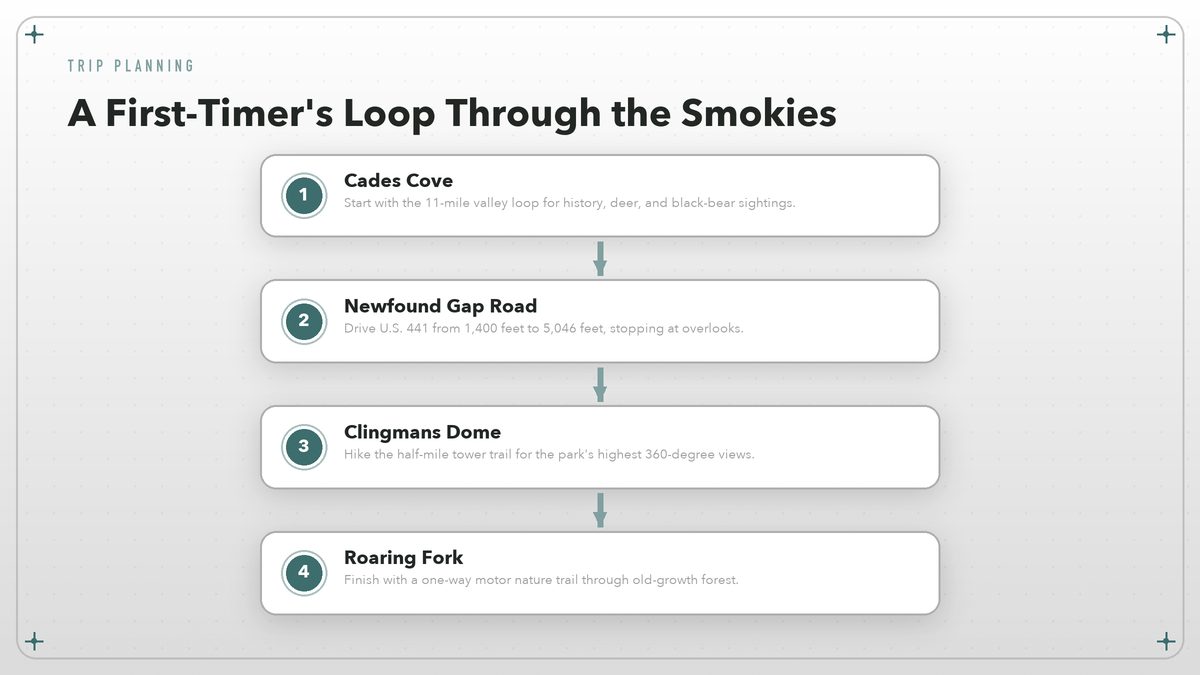
Cades Cove is the obvious starting point. This 11-mile one-way loop winds through a broad valley surrounded by mountains, past cabins, churches, and mills that date back to the 1800s. The road is closed to cars until 10 a.m. on Wednesdays and Saturdays from early May through late September, which makes those mornings a paradise for cyclists and walkers. Even when it is open to cars, the loop is worth it for the wildlife. Deer are everywhere, black bears are common, and the historic buildings give the valley a sense of lived-in history that many parks lack.
Newfound Gap Road, also known as U.S. 441, is the park’s main artery. It climbs from 1,400 feet in Cherokee to 5,046 feet at Newfound Gap, then drops down to 3,000 feet in Gatlinburg. The drive itself is the attraction, especially in fall and after a fresh snow. Pullouts like Clingmans Dome Road, Morton Overlook, and Oconaluftee Valley Overlook offer views that justify the traffic. Just do not expect to rush. The road is narrow, winding, and often full of visitors who are seeing elk for the first time.
For hikers, the Alum Cave Trail is the classic moderate route. It climbs 4.6 miles and 2,760 feet to the summit of Mount LeConte, passing through Arch Rock, a natural stone staircase, and the bluff known as Alum Cave. You do not have to go all the way to the summit. The views from the bluff are rewarding enough for a 4.4-mile round trip. If you do want the full LeConte experience, the lodge at the top books up many months in advance.
Laurel Falls is the easiest waterfall hike in the park and one of the busiest. The paved 2.3-mile round-trip trail leads to an 80-foot cascade that is perfect for families. Go early, ideally before 9 a.m., or you will be sharing the trail with strollers, dogs, and people wearing flip-flops. For a slightly harder waterfall with fewer people, try Grotto Falls or Rainbow Falls.
Clingmans Dome is the highest point in Tennessee and the third-highest peak east of the Mississippi. The observation tower at the end of a steep half-mile paved trail offers 360-degree views on clear days. On hazy days, which are common in summer, you might see almost nothing. The road to Clingmans Dome is closed from December 1 through March 31, and often longer if weather is bad.
Wildlife Watching: What You Are Actually Looking For
The Smokies are one of the best places in the eastern United States to see large mammals, but wildlife does not perform on schedule. Your best odds come early in the morning, late in the evening, and in the less visited corners of the park.
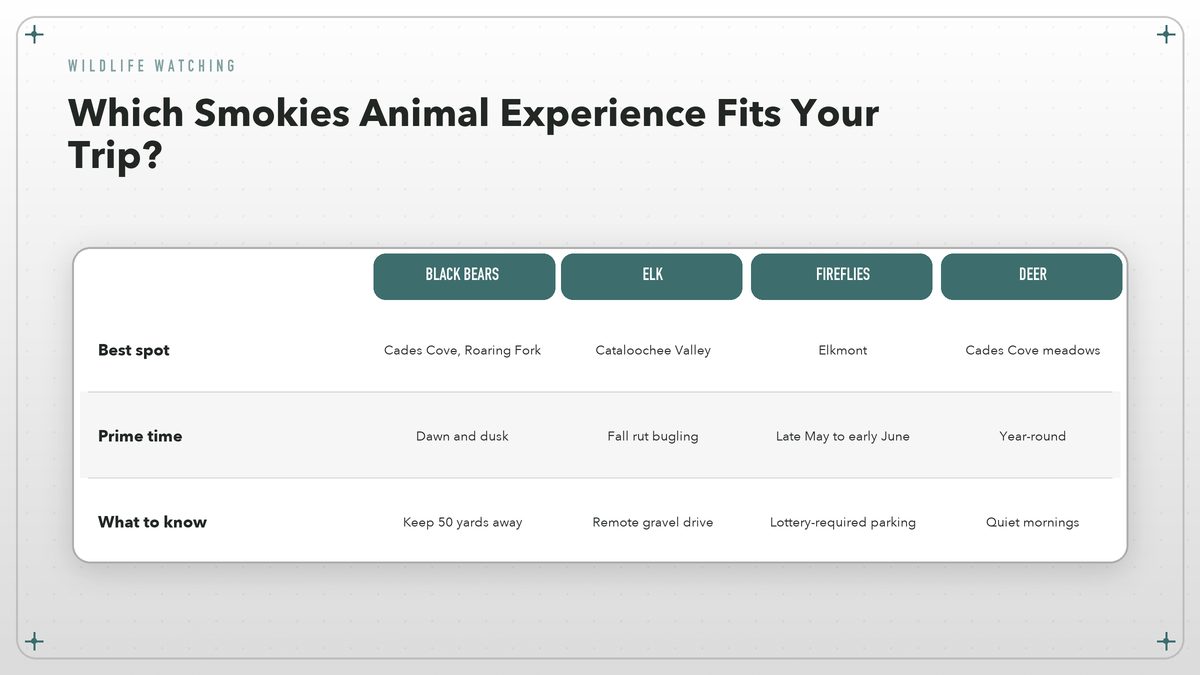
Black bears are the headliners. The park estimates a population of roughly 1,500 to 1,900 bears, which works out to about two bears per square mile in suitable habitat. Cades Cove, Roaring Fork, and the roads around Sugarlands are common sighting areas. The standard advice is to keep 50 yards away, never feed them, and store food properly. Bears that learn to associate people with food usually end up dead. That is a harsh reality, but it is worth remembering when someone in the next car rolls down the window for a better photo.
Elk were reintroduced to the park in 2001 after being hunted out more than a century earlier. The best place to see them is Cataloochee Valley, a remote corner on the North Carolina side. Dawn and dusk are prime time, and the bull elk bugle during the fall rut. Cataloochee is a long drive from any gateway town, involving steep gravel roads, but the valley feels like a hidden park within the park.
Then there are the synchronous fireflies. For about two weeks in late May or early June, a species called Photinus carolinus flashes in unison along the Little River in Elkmont. The event is so popular that the park runs a lottery for parking passes and closes the road to regular traffic. If you want to see it, apply for the lottery in April through the park’s firefly event page. It is one of the few natural displays in the country that genuinely lives up to the hype.
Beyond the marquee species, the park is full of smaller surprises. Wild turkeys strut through Cades Cove. Otters slide through the deeper streams. Peregrine falcons nest on the cliffs. And if you hike quietly in the morning, you will almost certainly see white-tailed deer doing their calm, deer-ish thing at the forest edge.
A Three-Day Smokies Itinerary
This itinerary assumes you are staying in Gatlinburg or Townsend and want a mix of driving, hiking, and wildlife. Adjust based on where you sleep and how early you are willing to wake up.
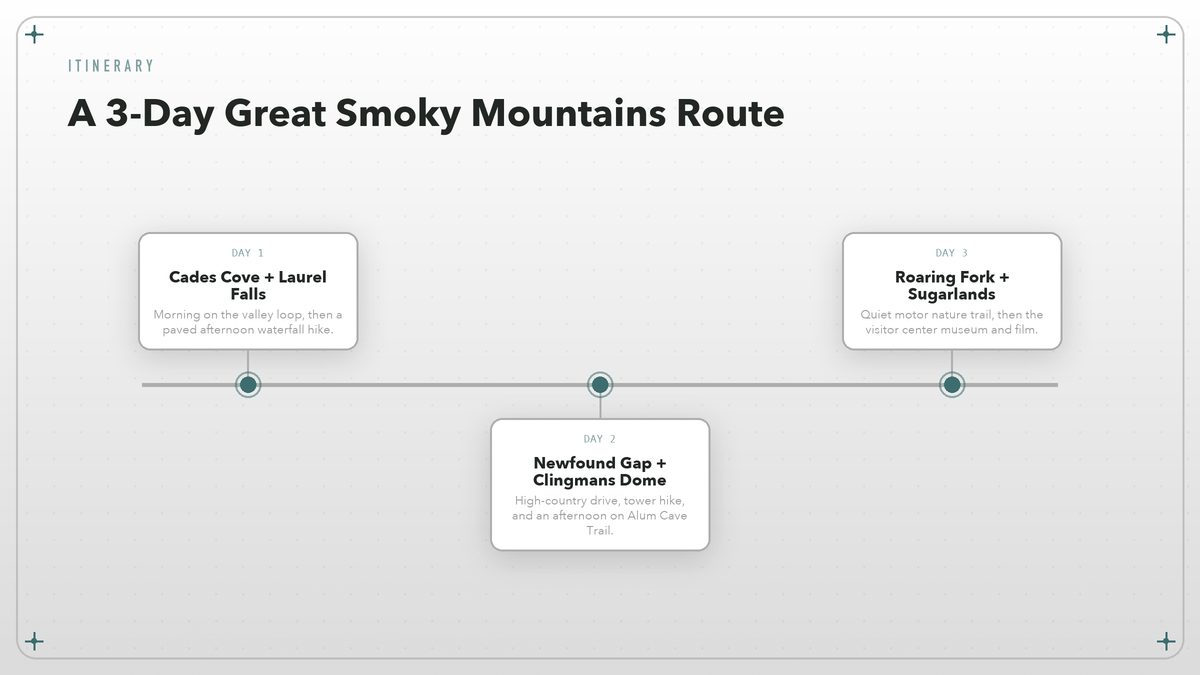
Day one is Cades Cove. Leave your lodging by 7 a.m. to beat the traffic, and plan to spend the whole morning on the loop. Bring a bike if you have one and it is a car-free Wednesday or Saturday. After lunch, drive back toward Townsend and hike Laurel Falls in the late afternoon, when the light on the cascade is better and some of the crowds have thinned.
Day two is the high country. Drive Newfound Gap Road to Clingmans Dome, stopping at the overlooks that catch your eye. Hike the half-mile to the tower if the road is open, then backtrack to the Alum Cave Trailhead for a moderate afternoon hike. If Alum Cave feels too ambitious, substitute the Chimney Tops Trail or the shorter Andrews Bald route from Clingmans Dome.
Day three is the quieter side. Start early for Roaring Fork Motor Nature Trail, a one-way loop past old-growth forest, log cabins, and the trailhead for Grotto Falls. Afterward, visit the Sugarlands Visitor Center for the museum and a park film, then spend the evening in Gatlinburg or drive down to Cherokee for a different perspective on the mountains.
What to Pack and How to Avoid the Crowds
The Smokies are not a rugged wilderness for most visitors, but they can still humble you if you show up unprepared. Weather at elevation changes fast. A 70-degree morning in Gatlinburg can turn into a 50-degree afternoon with rain on a ridge ten miles away.
Layers are the answer. Pack a rain jacket even if the forecast looks perfect. Bring sturdy shoes with grip, because many trails are rocky and rooty. Carry more water than you think you need, especially on summer hikes where the humidity makes sweat evaporate slowly. Sunscreen, bug spray, and a small first-aid kit round out the basics.
Bear safety is simple but non-negotiable. Use bear boxes or cable systems at campgrounds. Never leave food, trash, or toiletries in your car overnight. If you see a bear, stay calm, back away slowly, and make yourself look big. Running triggers a chase response. The park’s black bear page has the full protocol.
Crowd avoidance is mostly about timing and location. Arrive at trailheads before 8 a.m. Visit Cades Cove on a car-free morning. Explore the North Carolina side, which gets far less traffic than the Tennessee side. Save the most popular trails for weekdays. And remember that rain is your friend: a light drizzle clears out overlooks faster than any posted sign.
Finding Your Own Quiet Corner
The Smokies are not a secret. They have not been for decades. But the park is big enough that quiet still exists if you are willing to work for it. Some of my favorite moments here have been on trails that do not make the top-ten lists, on ridge tops where the fog moved in before dawn, or in campground loops where the only sound was a barred owl.
That is the real promise of the place. You can do the highlights in three days and leave happy. Or you can come back for a lifetime and still find new hollows, new waterfalls, and new views. The mountains do not change much. The fog still lifts the same way every morning. What changes is you, and how willing you are to get up before the crowds do.
So pick a season, pick a trailhead, and show up early. The rest usually takes care of itself.
All links were checked before publication. Park hours, road closures, and campground availability change with the season, so confirm current details on the official National Park Service websites before you leave.