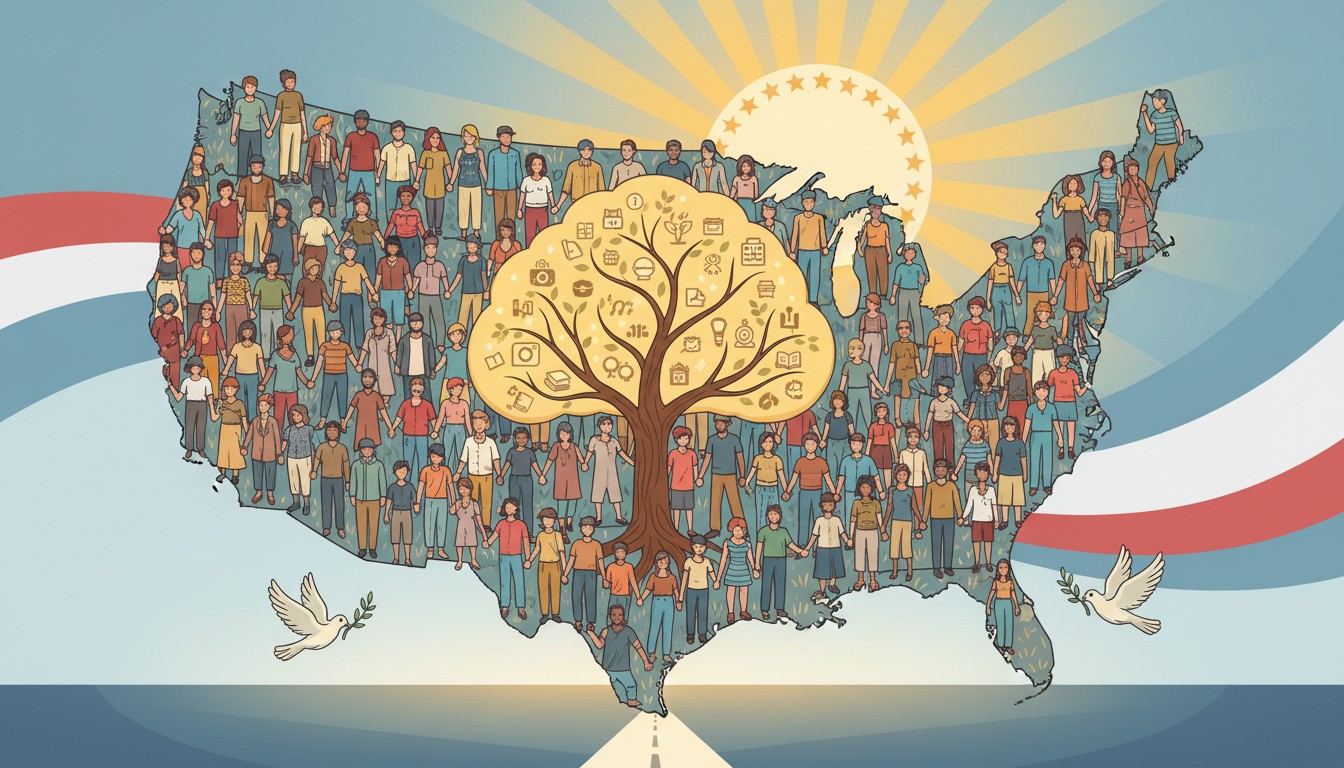
For most of its history, America had a simple answer to the question of identity: the American Creed. This constellation of ideals—individualism, liberty, equality, hard work, and the rule of law—offered a unifying framework that transcended ethnicity, religion, and birthplace. As Swedish economist Gunnar Myrdal noted in his 1944 study, being American meant endorsing these core values; everything else was secondary. But that consensus has shattered. Research from The Zebra reveals that one fifth of white Americans now identify more strongly with their race than their nationality, and those who do are most likely to view white political candidates as important. This isn’t just political preference—it’s tribal fragmentation that threatens the very concept of a shared nation.
The United States is no longer divided merely by politics, class, or geography. As the Milwaukee Independent notes, it is divided by reality itself. What once separated Americans were interpretations of fact; now they cannot even agree on what a fact is. The result is a civic culture unable to govern itself because it cannot share a common foundation of reality. The flag, the ballot, and even the Constitution have become symbols of sides rather than shared ownership. The question isn’t whether America has an identity crisis—it is whether America has any identity left to salvage.
The Fracturing of the American Creed: From Shared Values to Parallel Realities
The American Creed was brilliant in its simplicity: believe in these ideals, and you’re one of us. It worked because it was aspirational and inclusive, allowing a nation of immigrants to cohere without a shared ethnic or religious origin. But creeds require institutions to reinforce them, and institutions require trust. When trust collapses, the creed becomes just another contested ideology.
The Trust Death Spiral
Pew Research shows trust in government, media, and even science at record lows. This isn’t accidental—it’s engineered. The deregulation of broadcast media in the 1980s created partisan cable networks that blurred commentary and reporting. The internet dissolved gatekeeping, making every opinion equal to every fact. Social media algorithms discovered that division drives engagement, monetizing outrage and creating parallel information ecosystems where Americans live in “different worlds of information, each with its own heroes, villains, and alternate truths.”
When trust evaporates, the creed becomes weaponized. “Liberty” means freedom from masks to one group and freedom from viral exposure to another. “Rule of law” means prosecuting insurrectionists to some and persecuting patriots to others. The words remain the same, but the meanings diverge so completely that communication becomes impossible. We’re not having different opinions about the same reality—we’re living in different realities.
Identity as Team Membership
Social identity theory explains what’s happening: group membership’s power derives from how important it is to our self-concept. As the University of Colorado’s Ryan Dawkins notes, while the American Creed suggests anyone endorsing core values can belong, in practice, “the normative content of that identity can vary greatly across groups.” Elites establish prototypes—stereotypes about who is “truly American” that include racial, cultural, and religious boundaries.
This explains the rise of identity politics on all sides. When national identity feels meaningless, subgroup identities—racial, political, regional—become primary. The PRRI research shows this starkly: since 2015, the percentage of Americans who believe being born in the U.S. is important to being “truly American” has remained high (55% in 2022), while belief that being Christian matters has dropped from 32% to 26%. But beneath these averages lie massive partisan splits—85% of Republicans vs. 28% of Democrats emphasize native birth. We’re not just divided on policy; we’re divided on who belongs.
The Creed vs. Culture War
Traditional Creed: Belief in liberty, equality, hard work, rule of law = American
Emerging Culture: Shared ancestry, language, religion, birthplace = American
The fracture: One is inclusive and ideological; the other is exclusive and ethnic. They cannot coexist as definitions of the same identity.
Pluralism vs. Exclusion: The Two Competing Visions
PRRI’s research identifies two dominant visions of American identity that have always been in tension but are now in open competition:
The Pluralist Vision: America as a nation of immigrants where diverse religious, political, and cultural backgrounds coexist. This view affirms that society is a “land of others” and invokes constitutional ideals to argue for an inclusive democracy. It sees American identity as constantly evolving through new social movements and demographic change.
The Exclusionary Vision: American identity as exclusively available to white people of European ancestry, particularly white men. Historically, this vision enforced boundaries through citizenship laws that forced Asian and Latino Americans to fit “white” or “black” definitions. Today, it manifests in beliefs that being born in America, speaking English, and being Christian are essential to being “truly American.” This vision views change as loss, not evolution.
The 2022 PRRI data reveals how these visions split the country: 55% of Americans believe being born here matters to “true” American identity, but this masks a 57-point partisan gap. Among those who identify with the exclusionary vision, citizenship is insufficient—immigrants and racial minorities remain perpetual outsiders. This isn’t just disagreement; it’s a struggle to define the boundaries of the national community itself.
The White Identity Crisis
The most dangerous fracture is the emergence of white racial identity as a competing loyalty. The 2012 survey cited by The Zebra found that one fifth of white respondents preferred identifying as “white” rather than “American.” This group was also most likely to view white political candidates as important. Social identity theory explains why: when national identity feels threatened or meaningless, subgroup identities become primary.
This creates a zero-sum dynamic. For those whose American identity is rooted in whiteness, demographic change—rising diversity, immigration, multiculturalism—is experienced as existential loss. The 2045 projection that America will become majority-minority isn’t just a statistic; it’s a death knell for their identity. This explains the intensity of political battles over immigration, voting rights, and “replacement theory” rhetoric. It’s not about policy—it’s about who gets to be “American” in a country where whiteness is no longer the default.
The Institutional Collapse: When Symbols Become Sides
National identity requires institutions that all citizens view as legitimate. When institutions lose trust, identity fragments. The military, once the most trusted institution, saw confidence drop from 70% to 60% between 2020-2022. Congress polls at 8% trust. The Supreme Court, designed to be above politics, is viewed as partisan by 62% of Americans. These aren’t disagreements about policy—they’re rejections of shared governance infrastructure.
The Constitution as Rorschach Test
The Constitution was supposed to be the creed’s scripture—a common text binding diverse peoples. Today, it’s a Rorschach blot. Originalists see it as a fixed document protecting traditional values; living constitutionalists see it as evolving with society. Both claim fidelity to the same text, but they might as well be reading different languages. When the foundational document itself becomes a source of division, identity has no anchor.
This is exacerbated by the proliferation of “patriot” movements that claim exclusive ownership of constitutional meaning. The “patriot” label, once universal, is now claimed by specific political factions, implying others are not patriotic. The flag, once a unifying symbol, becomes a team jersey. The national anthem, once a shared ritual, becomes a performance of allegiance to one side.
The 250th Birthday Problem
America’s upcoming 250th anniversary in 2026 should be a unifying milestone. Instead, as The Atlantic notes, it risks becoming “an embarrassingly accurate reflection of America’s identity crisis.” The federal commission planning the celebration has been mired in infighting, leadership changes, and funding disputes. More fundamentally, half the country doesn’t want to celebrate a history they view as irredeemably flawed, while the other half rejects any critique as unpatriotic.
The question isn’t whether to have a party—it’s whether we share enough identity to even attend the same event. When one side’s semiquincentennial theme would be “perfecting the union” and the other’s would be “restoring greatness,” the event itself becomes a battleground.
Institutional Trust Collapse (2020-2022)
Military: 70% → 60% trust
Supreme Court: 40% → 25% trust, 62% view as partisan
Congress: 8% trust (lowest ever recorded)
Media: 70% believe “fake news” is major problem
Result: No institution remains that can credibly arporate what “American” means
Can Identity Be Rebuilt? Pathways Forward
The crisis feels existential, but identity is not fixed—it is constantly negotiated. The question is whether we can negotiate a shared identity without a shared reality. History suggests three possible paths:
1. Class Consciousness as Unifier
Harvard’s Guy-Uriel Charles suggests we might coalesce around class identity, with economic precarity becoming the new “American” experience that transcends race and geography. The COVID-19 pandemic briefly created this solidarity—”essential workers” became a unifying category. But class consciousness competes with racial and cultural identities that are often more salient. Without institutions to nurture it, it remains a hypothesis.
2. Political Tribalism as Destiny
The darker path is that we devolve into “racial essentialized tribalism” or ideological warfare where liberalism battles illiberalism. In this scenario, “American” becomes a meaningless umbrella term covering two hostile nations that happen to share a passport. We already see this in “national divorce” rhetoric and the blue-state/red-state mental migration. If this path continues, the question won’t be what American means—it will be whether America continues to mean anything at all.
3. Civic Reconstruction Through Deliberate Practice
The hopeful path is active reconstruction. This requires:
- Rebuilding local institutions: Civic identity forms in churches, schools, and community groups that require face-to-face interaction across difference. National identity is the accumulation of local relationships.
- Media literacy as civic duty: Teaching citizens to distinguish fact from opinion, source from echo. This isn’t censorship—it’s inoculation against misinformation.
- Reclaiming shared rituals: National service, voting holidays, and universal experiences that remind us we’re more than consumers of different newsfeeds.
- Confronting exclusion directly: Acknowledging that American identity has always been contested, and that inclusion requires active work, not passive tolerance.
This path asks more of us than the creed ever did. It requires practicing citizenship, not just professing it. It means having uncomfortable conversations across divides, not just shouting in our echo chambers. It demands we rebuild trust by being trustworthy, even when others aren’t.
The Hard Truth: Unity Is a Verb
American identity was never a fixed inheritance—it was always a work in progress, a story we told ourselves about who we wanted to be. The problem isn’t that the story has changed; it’s that we’ve stopped telling it together. We’ve replaced the shared narrative with competing scripts, each casting the other as villain.
The uncomfortable truth is that identity requires effort. It demands we choose to belong to something larger than our tribe, even when that choice feels like betrayal of our values. It means accepting that being American can mean different things to different people without becoming meaningless to everyone. It requires building bridges while others burn them.
The word “American” isn’t meaningless yet. But it will be if we keep filling it only with what divides us. The creed still exists—in our founding documents, in our best traditions, in the aspirations of immigrants who still risk everything to join this experiment. Rebuilding identity means choosing to believe in that creed again, not because it’s perfect, but because it’s the only thing big enough to hold all of us. Unity isn’t a feeling. It’s a practice. And practice starts today.
Key Takeaways
The “American Creed”—liberty, equality, hard work, rule of law—has fractured as trust in institutions collapsed and identity became tribal rather than national.
Two competing visions dominate: pluralism (America as diverse nation of immigrants) and exclusion (American identity as white, native-born, Christian), creating irreconcilable definitions of belonging.
White racial identity has emerged as a competing loyalty for 20% of white Americans, creating a zero-sum dynamic where demographic change is experienced as existential loss.
Institutional trust has collapsed across the board (military 60%, Congress 8%, Supreme Court viewed as partisan by 62%), leaving no credible arbiter of shared identity.
Rebuilding identity requires civic reconstruction through local institutions, media literacy, shared rituals, and confronting exclusion directly—unity is a practice, not a feeling.