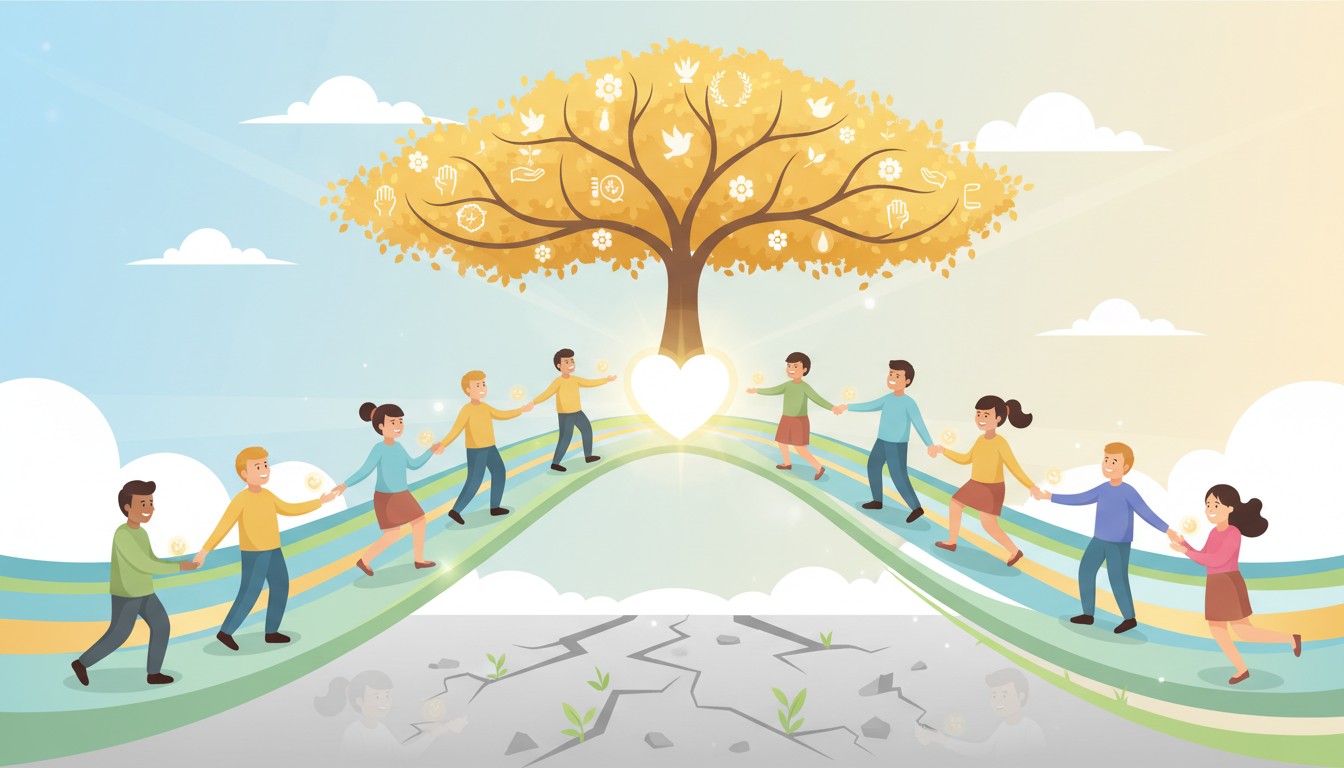
We live in a moment of profound contradiction. Surveys show that over 90% of Americans believe gratitude makes life richer and personally report feeling thankful with remarkable consistency. Yet the public spaces where our community life unfolds have become remarkably thankless. Political discourse rewards outrage, not appreciation. Customer service interactions are measured in efficiency, not mutual recognition. Community volunteers serve without acknowledgment while critics receive the microphone. Research from longitudinal polling data reveals a startling gap: while 87% of individuals describe themselves as thankful, only 19% believe most people today have an “attitude of gratitude” compared to a generation ago.
This gratitude deficit creates a silent erosion of the social fabric. Every omitted “thank you” to a public servant, every unacknowledged act of community care, every absence of appreciation in civic discourse sends a message: your contribution doesn’t register. The cumulative effect is a civic culture where participation feels thankless, burnouth dominates elected office, and ordinary citizens retreat from public engagement. Understanding why we’ve stopped expressing gratitude publicly—and learning to rebuild this practice—transforms passive consumption of community life into active stewardship of our shared world.
The Invisible Void: Where Public Gratitude Used to Live
Public gratitude once flowed through familiar channels. The mayor received letters of appreciation after a storm response. The principal got a plate of cookies from the PTA. The volunteer fire department’s fundraising dinner sold out because the whole town showed up to say thanks. These weren’t formal ceremonies—they were organic gestures that signaled recognition and reinforced social bonds.
Consider the town hall meeting. A decade ago, residents might have prefaced criticism with “I appreciate the council’s hard work, but…” Today, Zoom meetings feature direct attacks without preamble. The buffer of acknowledgment has vanished. This isn’t just politeness declining—it’s a structural shift in how we frame public contribution. Social scientists call this “contribution invisibility,” where the work of maintaining community infrastructure disappears from collective awareness.
Local journalism’s collapse has accelerated this void. When a newspaper covered the school board meeting, it might have noted the superintendent’s decade of service alongside the budget debate. Now, Facebook groups highlight only the controversial vote, stripping context and history from public figures. The local librarian who ran summer reading programs for twenty years becomes “the administration” in online commentary, their specific contributions erased.
The workplace mirrors this pattern. A John Templeton Foundation survey found that 35% of Americans never thank their bosses, while less than 15% express daily gratitude to colleagues. Yet these same respondents overwhelmingly agreed that grateful leaders are more successful. We know appreciation matters, but we’ve stopped practicing it in professional spaces where collective effort produces public goods.
The Recognition Spectrum: Where Gratitude Goes Missing
Government: Council members serve without acknowledgment, facing only criticism at public forums
Education: Teachers receive parent complaints instantly, gratitude only occasionally
Community Service: Volunteers show up reliably; their contributions become expected, not celebrated
Media: Local journalists investigate corruption; public reads without acknowledging their watchdog role
Business: Local employers provide community benefits; customers critique without appreciating their civic role
The Psychology of Silent Gratitude: Why We Don’t Say Thank You Anymore
The gratitude deficit stems from psychological and structural shifts that make public appreciation feel risky, performative, or unnecessary. Our brains have adapted to a digital sphere that rewards criticism over commendation, creating cognitive patterns that silence appreciation.
The Negativity Bias Amplified
Evolution wired us to notice threats more than benefits—a survival mechanism that social media algorithms exploit. A critical tweet about city services generates more engagement than a thankful one. Over time, this trains our attention toward what’s wrong rather than what’s working. Psychologists call this “attentional habituation”: we literally lose the cognitive capacity to notice contributions deserving thanks.
Research from decision-making studies shows that small cognitive patterns compound. Each time we scroll past a positive story to read a negative one, we reinforce neural pathways that scan for problems. Public gratitude requires stopping this scan—noticing the meeting that ran smoothly, the street repaired on time, the program that served its purpose without drama.
The Authenticity Trap
We’ve become hypervigilant about authenticity. Expressing gratitude publicly can feel like “virtue signaling”—a performance for social credit rather than genuine feeling. This creates a bind: sincere thanks feel vulnerable to misinterpretation, so we withhold them altogether. The result is a public sphere stripped of the very expressions that build trust.
This trap particularly affects civic leaders. A mayor who publicly thanks constituents risks appearing weak or insincere. A teacher who posts about loving their job invites accusations of being a “shill” for the district. We’ve pathologized positive expression, assuming ulterior motives while accepting cynicism as honest.
The Diffusion of Credit
Modern problems require complex solutions, making it hard to know who to thank. When a new bike lane opens, was it the planner, the council, the advocacy group, or the federal grant? This ambiguity leads to “bystander apathy” for gratitude—everyone assumes someone else will express thanks, so no one does. The more collaborative the effort, the more silent the response.
Private Thanks vs. Public Silence: The Growing Divide
The chasm between private gratitude and public expression has never been wider. According to Templeton Foundation research, 88% of Americans say they’re as or more grateful than they were a decade ago, yet 60% believe people are less likely to express gratitude today than 100 years ago. We’re living a collective lie—we feel it, but we don’t show it.
This divergence manifests in every sphere. In religious communities, 78% of evangelical Protestants and Latter-day Saints report feeling deep gratitude weekly, yet their public expressions of thanks to civic institutions remain scarce. The spiritual “thank you” to the divine doesn’t translate to a public “thanks” to the city worker who cleared the storm drain.
The workplace exemplifies this split. Employees crave appreciation—studies show recognition matters more than salary increases for job satisfaction—yet express it to colleagues less than 15% of the time. We’ve professionalized environments so thoroughly that gratitude feels unprofessional. The same manager who privately tells their family about a great team member publicly treats acknowledgment as a HR function, reserved for annual reviews.
Social media promised to democratize appreciation, but it algorithmically punished it. A heartfelt thank-you post reaches fraction of followers compared to a complaint. The dopamine hit comes from conflict, not commendation. We’ve trained ourselves to perform outrage because it gets likes, while gratitude gets scrolled past.
The Expression Gap in Numbers
90% believe grateful people lead richer lives
19% believe most people are more grateful than 20 years ago
35% never thank their bosses, despite wanting more thanks themselves
62% feel weekly gratitude, but <15% express daily thanks to colleagues
78% of religious Americans feel deep gratitude weekly, yet civic thanks remain rare
The Erosion Effect: How Absence of Appreciation Cascades
Like a slow-motion chemical reaction, the absence of public gratitude corrodes civic life. Each omitted “thank you” doesn’t just disappear—it creates feedback loops that discourage future contributions. This erosion operates through mechanisms that compound silently over time.
Consider the volunteer firefighter. She misses dinners, sleeps interrupted, risks injury. For years, she receives no public acknowledgment—her service becomes invisible. When the department starts recruiting, potential volunteers see only silence. “Why would I give up my time?” they think. “No one notices.” The original volunteer burns out, recruitment fails, and response times lengthen. A neighborhood’s safety degrades not from lack of courage, but from lack of thanks.
The same cascade afflicts democratic participation. A school board member votes for an unpopular but necessary budget cut, absorbing public anger. When they receive no counterbalancing appreciation for ten years of service, they don’t run for re-election. The replacement is either an ideologue who thrives on conflict or no one at all—another seat filled by default. The quality of governance declines because the quiet work of competent stewardship goes unacknowledged.
The Tipping Point Into Cynicism
Communities reach a threshold where public gratitude becomes so rare that its absence is normalized. At this tipping point, cynicism becomes the default public stance. Young people who’ve never witnessed a city council meeting where someone says “thank you for your service” learn that civic participation equals antagonism. They don’t model gratitude because they’ve never seen it modeled.
This explains the generational data. 18-to-24-year-olds express gratitude less frequently than any other age group, not because they feel less thankful, but because they’ve learned to associate public expression with vulnerability. In a hyper-critical digital environment, thanks become a weapon you hand to opponents. “You’ll just get called a bootlicker,” one college student explained when asked why he never thanks professors publicly. The risk-reward calculation has inverted.
Real-World Impact: Communities Starved of Appreciation
The abstract becomes concrete through specific failures. These case studies demonstrate how communities suffered when public gratitude vanished—and how they healed when it returned.
The Volunteer Crisis That Almost Killed the Library
In a midwestern town, the library depended on volunteers to run after-school programs. For years, the director thanked them privately but never publicly. When budget cuts loomed, the library board proposed eliminating volunteer coordinator position—a role that cost almost nothing but represented “administrative fat.” The volunteers, feeling invisible, staged a quiet strike. Programs collapsed. Only when parents complained did the board realize 40% of library services had vanished overnight. The director began publicly acknowledging volunteers at city council meetings, in newsletters, on social media. Within six months, volunteer recruitment exceeded previous levels. The work hadn’t changed—only its visibility.
The City Council That Rebuilt Trust Through Thanks
A western city council became so toxic that meetings lasted until midnight with constant conflict. A new mayor instituted a simple rule: every meeting would begin with public comment period where residents could only thank city staff or council members for specific actions. Initially, few participated. But over months, the practice normalized. Residents thanked the public works director for fixing a sinkhole. They thanked a council member for explaining a complex zoning issue. The shift was measurable: meeting length decreased by 40%, staff turnover dropped, and public satisfaction scores rose. Gratitude didn’t eliminate disagreement, but it rehumanized the participants.
The Business District That Thrived on Public Praise
A struggling downtown business association tried everything—grants, marketing campaigns, street festivals. Then they tried gratitude. They created a simple chalkboard on Main Street where residents wrote public thank-yous to businesses: “Thanks for staying open late during the snowstorm.” “Appreciate your sponsoring the Little League.” Business owners reported a 30% increase in job satisfaction. Foot traffic increased. The district’s culture shifted from transactional to relational. As one shop owner noted, “I used to feel like a vending machine people yelled at when it didn’t give them what they wanted. Now I feel like a community member.”
The Rebuilding Imperative: How to Replant Gratitude in Public Life
Restoring public gratitude requires intentional action, not just good intentions. Here are concrete strategies for moving from silent appreciation to vocal recognition.
Start with Specific, Public Acknowledgment
General gratitude (“thanks to everyone”) disappears. Specific gratitude (“thanks to Public Works Director Chen for fixing the Oak Street sinkhole within 24 hours”) sticks. Use names, cite actions, mention impact. Post on public forums where others can see and amplify. The visibility creates a template others follow.
Create Gratitude Rituals in Public Meetings
Institutionalize appreciation by reserving meeting time for public thanks. School boards can open with parent shout-outs. City councils can have “constituent gratitude” periods. The ritual signals that thanks aren’t extra—they’re essential. Research from gratitude intervention studies shows that structured appreciation reduces stress and increases cooperation.
Leverage Social Media Algorithmically
Fight fire with fire. When you post public thanks, tag relevant accounts, use hashtags, and encourage sharing. Algorithms reward engagement, so make gratitude engaging. A thank-you video from residents to healthcare workers during COVID generated millions of views because it broke the negative content cycle. Make appreciation go viral.
Measure and Publish Gratitude Data
What gets measured gets managed. Track public acknowledgments like any other metric. The philanthropy research shows that other-focused gratitude (“you’re thoughtful”) is more effective than self-focused (“I love what you gave me”). Apply this to civic life—thank the person, not just the outcome.
Model Vulnerability in Leadership
Elected officials and community leaders must publicly express gratitude first. When a mayor thanks the opposition party for a good idea, it gives everyone permission to appreciate across divides. When a principal thanks a critical parent for their passion, it reframes conflict as shared investment. Vulnerability from the top transforms cultural norms.
From Private Feeling to Public Action: A Gratitude Protocol
Notice: Train yourself to spot contributions (the repaired street, the timely email, the extra effort)
Name: Identify the specific person or group responsible
Voice: Express thanks verbally in the moment when possible
Amplify: Post publicly within 24 hours while memory is fresh
Reinforce: Thank the thankers to create cascade effects
The Cultural Shift: Reclaiming Gratitude as Civic Duty
Gratitude is not a feeling to be privately harbored—it’s a public act that maintains the infrastructure of community life. Every time we thank a public official, we make public service more sustainable. Every time we recognize a volunteer, we model participation for others. Every time we appreciate a business’s civic contribution, we strengthen the connection between commerce and community.
The cultural shift we need moves gratitude from the category of “nice to have” to “essential for survival.” We must teach children not just to feel grateful but to express it publicly. Civic education should include how to thank elected officials effectively—yes, even ones you disagree with. Community organizing training should cover appreciation campaigns alongside advocacy efforts.
This shift isn’t naive; it’s strategic. Research consistently shows that appreciated people work harder, stay longer, and collaborate better. A staff member thanked by the community will go the extra mile during the next crisis. A council member recognized for difficult votes will have courage to make the next hard call. Gratitude is the cheapest and most effective public investment we can make.
Your Thanks Is a Public Act
The gratitude deficit won’t be solved by policy or programs. It will be solved by you. Your decision to thank the crossing guard by name, to write the city planner a note of appreciation, to publicly acknowledge the librarian’s extra effort—these are not private courtesies. They are public infrastructure. They are the mortar holding community together.
Every time you cross the gratitude chasm—from private feeling to public expression—you give others permission to do the same. You model the behavior our democracy desperately needs. You make the next hard decision easier for someone serving your community. You prove that appreciation isn’t weakness, it’s the foundation of strength.
Start today. Pick one person who serves your community invisibly. Thank them specifically, publicly, and sincerely. Your words won’t just make their day—they’ll rebuild the connective tissue of public life, one thank you at a time.
Key Takeaways
A stark gap exists between private gratitude feelings (felt by nearly 90% of people) and public expression (seen by only 19% as increasing), creating a cultural deficit in civic appreciation.
Cognitive biases like negativity amplification, authenticity traps, and diffusion of responsibility silence public thanks, while social media algorithms reward criticism over commendation.
The absence of gratitude creates cascading negative effects: volunteer burnout, public official turnover, decreased civic participation, and normalized cynicism.
Rebuilding public gratitude requires specific acknowledgment, institutional rituals, leveraging social media for good, and modeling vulnerable appreciation from leadership positions.
Expressing gratitude is not a private virtue but a public necessity—each thank you strengthens the infrastructure of community life and encourages continued service.