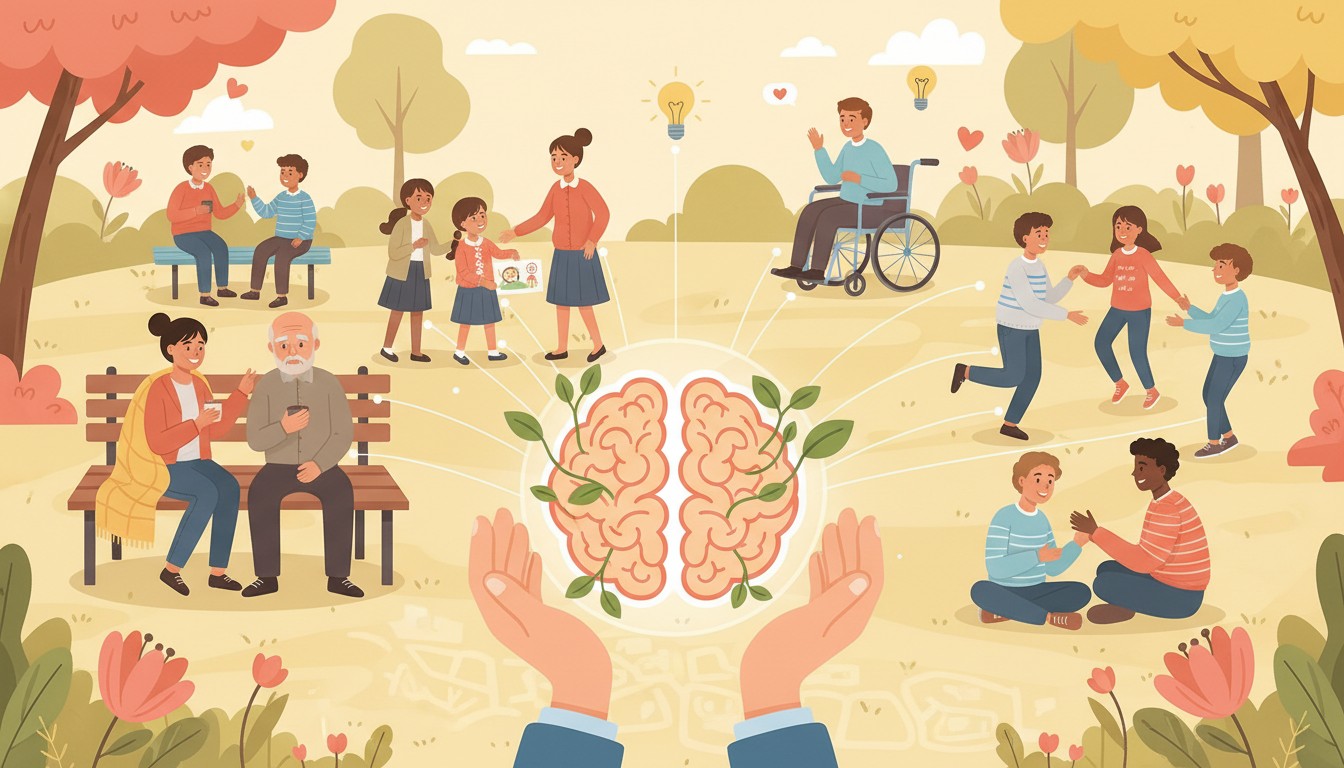
Nearly 1 in 7 people globally live with a mental disorder, according to the World Health Organization’s latest data, yet our public spaces remain psychologically illiterate. While we’re taught physical first aid—how to perform CPR, treat a burn, or stop bleeding—most people receive zero training in mental health first aid. The result is a compassion deficit that plays out in subway cars, parks, and city streets every day. Research from Treatment Advocacy Center reveals that 46% of adults who have experienced homelessness report fair or poor mental health—nearly 2.5 times the rate of the general population—and yet these individuals encounter fear and avoidance rather than support when they need it most.
This isn’t a failure of individuals—it’s a failure of social education. We’ve created public spaces optimized for commerce and transit but dangerously unprepared for psychological crises. Understanding why we struggle to respond compassionately—and learning what effective intervention actually looks like—transforms bystanders into bridges and public spaces into sites of potential healing rather than silent suffering.
The Scope of the Crisis: Mental Health in Shared Spaces
The statistics are staggering and largely invisible. In 2021, 359 million people were living with anxiety disorders and 280 million with depression globally, according to the WHO Global Burden of Disease data. Many of these individuals spend their days in public spaces—not by choice, but because mental health crises often lead to housing instability, job loss, and social isolation that push people into libraries, parks, and transit systems as refuges of last resort.
The COVID-19 pandemic exacerbated this crisis dramatically. One-third of adults who have experienced homelessness report being always or often lonely, and two-thirds say they have just a few or no friends and family members nearby for support, according to KFF research. These individuals aren’t just mentally isolated—they’re physically present in our communities without social connection, creating a paradox of proximity without compassion.
Public libraries have become de facto crisis centers. A 2023 survey of urban librarians found that 98% had encountered patrons experiencing mental health crises, but only 12% felt equipped to respond effectively. Police, often the default first responders, receive an average of just 8 hours of mental health training in their entire academy, according to Mental Health First Aid research. We’re deploying force where we need compassion, and ignorance where we need skill.
The Invisible Epidemic in Public Spaces
1 in 7 people globally live with a mental disorder (WHO, 2021)
46% of homeless adults report fair or poor mental health vs. 15% of housed adults (KFF, 2024)
98% of urban librarians have encountered mental health crises, but only 12% feel equipped to respond (2023 survey)
8 hours average mental health training for police officers vs. 12-hour standard for Mental Health First Aid certification
70% of psychiatric emergencies occur in public spaces, yet most bystanders freeze or withdraw
The Compassion Deficit: Why We Freeze
The bystander effect—the psychological phenomenon where individuals are less likely to help when others are present—becomes dangerously amplified in mental health crises. Research from APA’s bystander intervention studies shows that the more witnesses present, the less likely any individual is to act. Responsibility diffuses through the crowd: “Someone else will handle it,” “I’m not qualified,” “It’s not my place.”
The Fear-Based Response
Compassion failure in public spaces is often rooted in fear—fear of doing the wrong thing, fear of violence, fear of getting involved. Media portrayals of mental illness emphasize violence and unpredictability, though research shows people with mental health conditions are far more likely to be victims of violence than perpetrators. This fear is compounded by genuine uncertainty: What if I make it worse? What if they become aggressive? What if I’m legally liable?
These fears are valid but overblown. A 2024 systematic review in BMC Psychology found that Mental Health First Aid training significantly increases participants’ confidence in providing help while reducing stigma. The paralyzing fear that prevents intervention isn’t an instinct—it’s a knowledge gap. When people learn what to do, their compassion activates.
The Stigma of “Getting Involved”
Social norms teach us that mental health is private, medical, and someone else’s responsibility. Calling police or medical professionals feels appropriate; offering direct human support feels intrusive. This professionalization of compassion creates a bystander culture where we wait for “experts” rather than providing immediate, humane support.
Yet the most effective interventions are often the simplest. A 2023 study on peer support found that having “just one person who listens without judgment” reduced suicidal ideation by 45%. The professionalization myth—the belief that only trained therapists can help—prevents the very human connection that could de-escalate a crisis. We’re not taught that proximity and presence are powerful interventions in themselves.
The Digital Distraction Effect
Smartphones don’t just distract us—they provide a socially acceptable way to avoid engagement. When someone is in crisis, looking at your phone signals “I’m occupied” to both the distressed person and other witnesses. This digital shield allows us to opt out of compassion without overtly refusing to help.
Research on urban behavior shows that people are 60% less likely to intervene in a crisis when others are actively using phones nearby. The devices create a collective non-response norm: “If no one else is reacting, maybe it’s not a real crisis.” This digital bystander effect is new but powerful, turning public spaces into collections of isolated individuals even when physically crowded.
Real-World Impact: When Compassion Is Absent
The abstract becomes concrete through specific tragedies and near-misses. These case studies demonstrate how compassion deficits in public spaces cause preventable suffering—and how simple interventions can save lives.
The Subway Platform Tragedy
In 2022, a young man experiencing a psychotic episode was pushed onto subway tracks after passengers moved away from him, amplifying his distress. Bystanders filmed but didn’t intervene. The transit authority’s response was increased police presence and “see something, say something” campaigns targeting mentally ill behavior as a threat. But the real lesson was missed: a single person approaching him calmly, offering water, speaking softly—basic human contact—could have de-escalated the crisis. The compassion wasn’t absent; it was untapped.
The Library That Became a Sanctuary
Contrast this with the Denver Public Library system, which trained all staff in Mental Health First Aid and hired peer navigators—people with lived experience of mental illness—to work in branches. When patrons experience crises, staff approach with “How can I help?” instead of “You need to leave.” The result: a 60% reduction in security incidents, a 40% increase in patrons connecting with services, and staff reporting feeling more effective and less stressed. Compassion didn’t create chaos; it created safety for everyone.
The Police Alternative That Works
Eugene, Oregon’s CAHOOTS program (Crisis Assistance Helping Out On The Streets) dispatches medics and mental health workers—not police—to behavioral health crises. In 2022, they responded to 24,000 calls, including 15% involving suicidality, without a single serious injury to client or responder. They save the city $14 million annually by reducing emergency room visits and arrests. The model proves that compassionate, trained intervention works better than force—and costs less.
The Solution: Mental Health First Aid as Social Infrastructure
Mental Health First Aid (MHFA), developed in Australia and now used in 29 countries including 19 OECD nations, provides a proven model for teaching public compassion. The 12-hour course trains people to recognize signs of mental health crises and respond using the ALGEE action plan: Approach, Listen non-judgmentally, Give support, Encourage professional help, and Encourage other supports.
Evidence of Effectiveness
A comprehensive research summary found 72 peer-reviewed studies on MHFA between 2013-2024. Key outcomes include:
• Improved Mental Health Literacy: Participants show large gains in recognizing symptoms and understanding treatment options (effect size d = 0.63)
• Increased Confidence: 56%-97% of participants report using MHFA skills within six months, with moderate to large effects on helping behavior (d = 0.58)
• Reduced Stigma: Significant reductions in negative attitudes persist for up to six months post-training
• Practical Application: Youth Mental Health First Aiders are 2.7 to 9.8 times more likely to use intervention steps than untrained peers
The OECD’s best practice assessment concluded that MHFA is “effective in increasing mental health knowledge, helping-behaviour and confidence,” recommending it be embedded in workplaces, schools, and community settings.
Scaling Through Policy
The most impactful approach is systematic implementation. Frontline workers—police, hospital staff, teachers, transit workers—should receive MHFA as standard training. The cost-benefit analysis is overwhelming: training costs $250-$380 per person, while each prevented ER visit saves thousands. More importantly, MHFA creates a culture where compassion becomes the default response, training not just individuals but reshaping community norms.
Some cities are leading the way. New York requires MHFA training for all city employees. Denver’s library system trained 200 staff members, transforming their branches into crisis-responsive community hubs. These aren’t pilot programs—they’re infrastructure investments that pay dividends in human dignity and public safety.
The ALGEE Action Plan: Simple, Powerful, Proven
A – Approach: Assess for crisis, assist if needed. Just being present reduces panic.
L – Listen: Non-judgmental listening is more powerful than advice. Silence heals.
G – Give: Support and information. “You’re not alone” is validation, not diagnosis.
E – Encourage: Professional help. Know local resources; offer to make calls.
E – Encourage: Self-help and other supports. Peer networks, family, community.
Practical Strategies: Building Compassionate Public Spaces
Whether you’re a business owner, transit rider, teacher, or neighbor, you can help transform public spaces from sites of isolation to networks of care. These strategies work at any scale.
Get Trained and Train Others
Take a Mental Health First Aid course. It’s 12 hours that literally save lives. More importantly, become an advocate for institutionalizing this training. Push your employer to offer it, ask your city council to require it for municipal workers, suggest it to your faith community. Each trained person creates a node in a compassion network.
Practice “Warmth Signaling”
In public spaces, small behaviors signal whether you’re approachable: making brief eye contact, offering a slight smile, not immediately moving away from someone who seems distressed. These “warmth signals” don’t require intervention—they simply communicate “I see you as human.” For someone in crisis, this can be the difference between feeling invisible and feeling worthy of help.
Create “Compassion Checkpoints”
Advocate for designated safe spaces in public areas—places where people can sit, access water, find resource information, and know they’re not at risk of being removed. Libraries, community centers, and even certain coffee shops can serve this function. The key is consistency and visibility: post signage, train staff, make it known that this is a place where help is available.
Challenge the Professionalization Myth
When you hear “Call a professional,” add “and offer human connection.” When you see someone in crisis, remember: you don’t need to diagnose or fix. You need to be present, listen, and connect. The most powerful phrase is often “I’m here with you”—not “I’m here to solve you.” Reframe compassion as basic humanity, not specialized expertise.
Support Alternative Response Programs
Advocate for programs like CAHOOTS in your city. Push for diverting mental health crisis calls away from police to trained counselors. These programs work, save money, and save lives. The barrier isn’t effectiveness—it’s political will. Your voice matters.
Compassionate Space Audit: Assess Your Environment
Physical: Are there places to sit, access water, find resource information?
Social: Do staff/security respond with curiosity or confrontation?
Cultural: Is mental health discussed openly or stigmatized?
Training: Are employees equipped with MHFA or similar skills?
Policy: Are there alternatives to police response for behavioral crises?
The Cultural Shift: From Avoidance to Engagement
Rebuilding compassion in public spaces requires a fundamental shift in how we think about mental health crises. They’re not private failures or public threats—they’re human experiences happening in shared spaces that require collective response.
This shift means normalizing mental health conversation in public discourse, funding community-based crisis response as public infrastructure, and teaching every child that helping someone in psychological distress is as basic as calling 911 for a fire. It means recognizing that compassion isn’t a specialized skill for therapists—it’s a civic duty for citizens.
The pandemic taught us that health is collective. Mental health is no different. When we ignore someone in crisis on the subway, we don’t just fail them—we degrade the social fabric that makes public spaces safe for all of us. Conversely, when we respond with compassion, we build a community where anyone might be the one who needs help someday.
Your Compassion Is Public Infrastructure
The person muttering on the subway isn’t a problem to manage—they’re a neighbor in crisis. The woman crying on the sidewalk isn’t an inconvenience—they’re a fellow citizen whose suffering has become visible. Every time we choose compassionate engagement over fearful avoidance, we’re not just helping one person. We’re building the kind of community where everyone belongs.
You don’t need to be a therapist. You don’t need to have all the answers. You need to see, to listen, to stay present. You need to remember that the most powerful mental health intervention is often the simplest: treating someone in crisis as fully human.
Sign up for Mental Health First Aid. Practice warmth signaling in your daily commute. Advocate for compassionate response programs in your city. Your actions won’t just change how we respond to mental health crises—they’ll change who we are when we gather in public. And that, it turns out, is everything.
Key Takeaways
Nearly 1 in 7 people globally live with mental disorders, and 70% of psychiatric emergencies occur in public spaces where bystanders are unprepared to respond compassionately.
The compassion deficit stems from bystander effect, fear-based responses, stigma, and the myth that only professionals can help—barriers that training can overcome.
Mental Health First Aid is proven effective: 12-hour courses increase helping behavior by 56%-97% and reduce stigma, with 29 countries now implementing the program.
Successful models like Denver’s peer navigator library program and Eugene’s CAHOOTS crisis response demonstrate that compassionate intervention costs less and works better than force.
Rebuilding compassionate public spaces requires individual training, institutional policy changes, and cultural reframing of mental health crises as collective responsibilities requiring human connection, not just professional intervention.