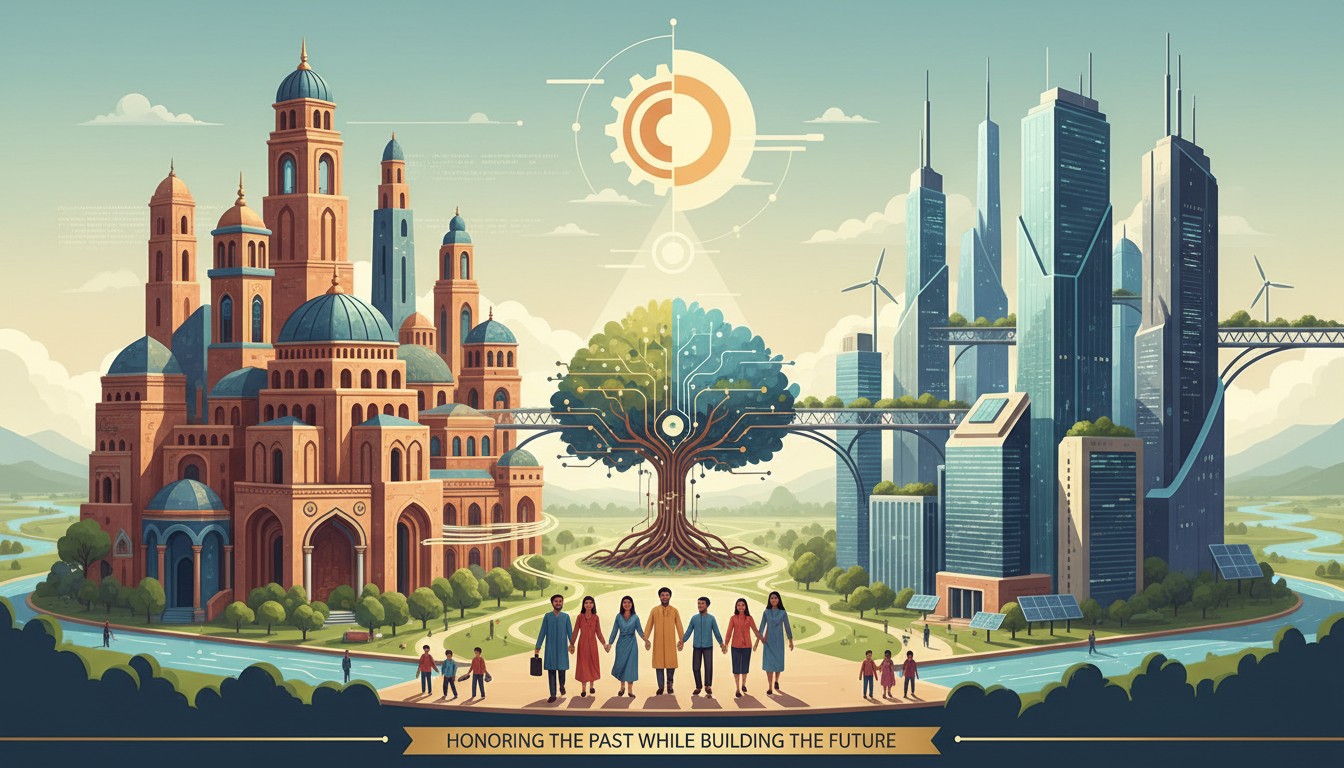
The tension between heritage and progress has become one of the defining conflicts of modern development. According to Mordor Intelligence research, the global heritage tourism market reached $608.8 billion in 2024 and is projected to grow at a 3.51% CAGR through 2033, demonstrating that our collective fascination with the past commands massive economic value. Yet this same reverence often becomes a weapon against innovation, with preservationists cast as obstructionists and developers painted as cultural vandals.
This false dichotomy costs us dearly. While we fight over whether to save a building or build housing, both crises deepen—the housing shortage worsens and historic structures decay. The Precedence Research report reveals that 73% of UNESCO World Heritage sites face high water-related hazards, demanding urgent adaptation that pure preservation cannot address. The resolution isn’t choosing sides; it’s discovering how heritage and progress can become unlikely allies. Understanding the psychology behind this conflict—and learning proven integration strategies—transforms us from combatants into architects of a future that honors its foundations.
The False Dichotomy: Why We’re Trapped in an Unnecessary War
The heritage vs. progress debate rests on a cognitive illusion: the belief that honoring the past and building the future are mutually exclusive. This binary thinking emerges from several psychological and structural forces that create artificial conflict where synergy is possible.
Status quo bias, identified by psychologists Samuelson and Zeckhauser, explains why preservation feels like resistance and innovation feels like destruction. Research from The Decision Lab demonstrates that people experience the pain of loss more acutely than the pleasure of equivalent gain, making the potential loss of a historic building feel disproportionately catastrophic compared to the abstract gain of future housing. Meanwhile, developers experience the same bias in reverse—regulations preserving heritage feel like concrete losses of profit and possibility.
This psychological deadlock is amplified by media incentives. A story about a conflict between preservationists and developers generates engagement; a story about successful integration doesn’t. We’ve been trained to see these as warring factions because narratives of conflict are more compelling than narratives of collaboration.
The result is what urban planners call “stasis through opposition”—projects become so mired in ideological battles that nothing happens. The historic structure continues deteriorating while the housing crisis deepens. Everyone loses, yet the combatants remain convinced they’re fighting for the greater good.
The Misconception Matrix: Common False Choices
Old vs. New: We must choose between preserving original structures or building modern replacements
Authenticity vs. Efficiency: Historical accuracy prevents energy upgrades, accessibility, and modern systems
Community Character vs. Density: Historic neighborhoods must remain low-density to preserve their “feel”
Memory vs. Prospect: Honoring the past means being stuck in it; building the future requires forgetting
Tourism vs. Livability: Historic districts become either museums for visitors or neighborhoods for residents
The Psychology of Preservation Paralysis
Understanding the cognitive biases that fuel heritage conflicts reveals why seemingly rational people become intractable. These mental shortcuts served our ancestors well but create chaos in modern civic decision-making.
The Endowment Effect on Steroids
The endowment effect—our tendency to overvalue what we already possess—becomes exponentially stronger with heritage. A building that’s stood for 100 years isn’t just structure; it’s identity, memory, and continuity. When preservationists fight to save it, they’re not being obstructionist—they’re experiencing a profoundly human attachment to inherited value.
But this same effect blinds them to possibilities. The building becomes sacred, making any adaptation feel like desecration. A proposal to add rooftop solar panels to a 1910 school building isn’t evaluated on its merits—it’s evaluated as an assault on heritage itself.
Loss Aversion and the Developer Mindset
Developers experience loss aversion just as powerfully, but in reverse. Every preservation requirement feels like a taking—of profit, flexibility, and design freedom. A zoning overlay protecting a historic district doesn’t register as “saving character”; it reads as “reducing developable square footage by 40%.”
This creates what behavioral economists call “prospect theory asymmetry.” The developer’s potential loss (restricted square footage) feels more painful than the community’s potential gain (preserved character). Meanwhile, the community’s potential loss (destroyed heritage) feels more painful than the developer’s potential gain (housing units). Both sides are fighting to avoid loss, making compromise feel like surrender.
The Curse of Binary Framing
Our brains crave simplicity, so we frame complex decisions as either/or. “You’re either with us or against us.” “Heritage or progress.” This binary framing is reinforced by legal processes—public hearings force people to testify “for” or “against” a project, with no middle ground.
But the most innovative solutions live in the gray zone. Adaptive reuse, integrative design, and phased evolution are “both/and” strategies that binary thinking makes invisible. When we’re locked in combat mode, we literally cannot see solutions that honor both heritage and progress.
The Integration Imperative: Strategies That Honor Both
Resolving the heritage-progress tension requires moving from opposition to integration. The most successful communities don’t choose between preservation and development—they design solutions that leverage heritage as an asset for progress. These strategies aren’t theoretical; they’re proven across industries and continents.
Adaptive Reuse: The Art of Respectful Transformation
Adaptive reuse stands as the most powerful resolution strategy, turning “either/or” into “both/and.” By repurposing historic structures for modern uses, communities preserve cultural memory while meeting contemporary needs. The Terner Center at UC Berkeley documents how a 1965 bank building in Santa Ana, California became the Santa Ana Arts Collective—58 units of 100% affordable housing for artists, preserving mid-century architecture while addressing the housing crisis.
The Domino Sugar Refinery in Brooklyn exemplifies industrial heritage transformed into vibrant residential lofts, maintaining its iconic brick façade while creating much-needed housing. As Metropolis Magazine reports, this approach reduces environmental impact by 50-75% compared to new construction while honoring community memory.
Community Co-Creation: Building Together
Top-down planning creates conflict; community co-creation creates consensus. Historic England’s community engagement framework outlines four levels of involvement: outreach, participation, partnership, and leadership. The most successful heritage-progress integration occurs at the partnership and leadership levels, where community organizations co-lead projects.
In Morazzone, Italy, the restoration of Casa Macchi transformed a historic house-museum into a cultural tourism hub through collaboration between public authorities, private associations, and local communities. As documented in ScienceDirect research, this project generated opportunities for local artisans while preserving authenticity, proving that community-led heritage preservation drives economic revitalization.
Integrative Design: Harmonizing Old and New
Rather than hiding modern additions, integrative design celebrates the dialogue between eras. New construction incorporates elements of historical architecture, creating a seamless blend that honors context while embracing innovation. The fashion industry provides a compelling model: Stella McCartney integrates sustainable materials with traditional craftsmanship, proving that innovation can revitalize heritage practices rather than replace them.
In agriculture, agroecology merges indigenous knowledge about crop rotation and polyculture with contemporary research on sustainable farming. This synergy enhances food security while preserving cultural wisdom, demonstrating that heritage and progress can solve modern problems together.
The Integration Cascade: How Small Changes Multiply
Initial Decision: Repurpose a vacant 1920s school building into senior housing instead of demolishing it
Direct Result: Preserves community memory while meeting urgent housing needs
Secondary Effects: Construction workers learn historic preservation skills, creating new expertise
Tertiary Effects: Tax credits attract further investment, revitalizing the entire neighborhood
Quaternary Effects: The project becomes a model for citywide policy, shifting from demolition to adaptation
Real-World Integration: Case Studies in Synergy
The abstract principles of integration become concrete through specific successes. These case studies demonstrate how communities resolved heritage-progress tensions through creativity, collaboration, and persistent vision.
The Sears Warehouse That Became a Community Ecosystem
In Memphis, Tennessee, an abandoned Sears warehouse stood as a 1.5 million-square-foot monument to industrial decline. Demolition would have cost millions and erased a landmark. Instead, community leaders pursued adaptive reuse, transforming it into Crosstown Concourse—a mixed-use “vertical village” with apartments, offices, health clinics, and arts spaces.
The project preserved the building’s Art Deco exterior and industrial character while creating 265 affordable apartments and 40 organizations serving 3,000 daily visitors. The key was treating heritage not as a constraint but as a catalyst. The building’s massive floor plates, once inefficient for modern retail, became perfect for healthcare facilities and open-plan offices. As Metropolis Magazine documents, this project generated $43 million in annual economic impact while maintaining a community icon.
The Italian Town That Turned Heritage Into Livelihood
Morazzone, a small Italian town with Roman origins, faced the familiar crisis: historic buildings requiring expensive maintenance, young people leaving for cities, tourism concentrated elsewhere. The restoration of Casa Macchi, a historic house-museum, became a test case for heritage-driven regeneration.
Rather than treating it as a static museum, stakeholders transformed Casa Macchi into a living cultural hub with an emporium for local artisans, event spaces, and sustainable tourism practices. The project balanced economic benefits with authenticity preservation, creating a replicable model. Within two years, the project increased local business revenue by 15% and reversed out-migration trends among young families who found new opportunities in heritage tourism and artisanal crafts.
The Brooklyn Power Station That Energized a Neighborhood
The Brooklyn Rapid Transit Power Station, a decommissioned industrial behemoth, could have been demolished for luxury condos. Instead, Herzog & de Meuron and PBDW transformed it into a 170,000-square-foot nonprofit manufacturing facility for artists and fabricators, preserving the building’s heroic industrial character while providing affordable workspace.
The project created 300 jobs for local residents and became an anchor for Brooklyn’s creative economy. By maintaining the building’s raw aesthetic—exposed brick, steel beams, and soaring ceilings—the developers created a space authentic to both its heritage and its new purpose. The community gained an economic engine without losing a landmark.
The Leadership Challenge: Bridging Divides
Leaders play a pivotal role in transforming heritage-progress conflicts into collaborations. Effective leaders don’t pick sides—they reframe the question from “which do we sacrifice?” to “how do we maximize both?” This requires specific skills and strategies.
The Bilingual Leader
Heritage experts and developers speak different languages. Preservationists discuss “cultural significance,” “period appropriateness,” and “integrity.” Developers talk about “pro forma,” “yield,” and “entitlements.” Leaders must become bilingual, translating between these worlds.
When a preservationist says “the cornice must be restored,” the leader translates: “This design element signals quality to buyers and creates a unique selling proposition.” When a developer says “the numbers don’t work,” the leader translates: “We need creative financing solutions that recognize the value of heritage.” This translation builds mutual understanding and reveals common interests.
The Reframe: From Scarcity to Abundance
Conflicts arise from scarcity mindsets: “There’s only so much land,” “Only so much budget,” “We can’t have both.” Leaders must reframe toward abundance: “Heritage gives us competitive advantage,” “Preservation unlocks tax credits,” “Unique character increases property values.”
The Texas Historical Commission’s economic data provides powerful reframing material: every dollar from federal and state incentive programs triggers $4 to $5 of private-sector investment. The Federal Historic Tax Credit has spurred $1.78 billion in private-sector rehabilitation in Texas alone, generating 35,000 jobs. These aren’t costs—they’re multipliers.
Governance Structures That Force Collaboration
Traditional governance separates heritage and development into siloed departments that rarely communicate. Integration requires breaking these silos. Some cities create “Heritage and Development Review Boards” with members from both camps required to approve projects jointly. Others embed preservation architects within planning departments from day one.
The most innovative approach is the “co-design charrette”—intensive workshops where preservationists, developers, architects, and neighbors design together over several days. This process builds relationships and reveals solutions that adversarial processes hide. When people design together, they develop ownership of the integrated solution.
Leadership Actions That Transform Conflict
Translate: Become bilingual, bridging technical and cultural languages
Reframe: Shift from scarcity (“we can’t have both”) to abundance (“heritage multiplies value”)
Co-Design: Bring adversaries into joint design processes that build relationships
Incentivize: Create financial structures that reward integration, not conflict
Celebrate: Publicly champion successful integrations to create new norms
Practical Protocol: How to Resolve Heritage-Progress Conflicts
Whether you’re a neighborhood activist, a developer, or a civic leader, you can apply these concrete steps to transform conflicts into collaborations. The protocol works at any scale—from a single building to an entire district.
Step 1: Map Hidden Values
Before any design discussion, map what each party truly values. Preservationists often care less about specific materials and more about continuity, identity, and craftsmanship. Developers often care less about maximum density and more about financial viability and clear timelines. Make these values explicit and find the overlaps.
Conduct separate workshops asking each group: “What would success look like in 20 years?” You’ll discover surprising convergence—both want vibrant neighborhoods, community pride, and long-term value creation.
Step 2: Generate “Both/And” Options
Explicitly forbid “either/or” proposals. Require teams to present at least three integrated solutions that honor both heritage and progress. This constraint forces creativity and reveals that integration is possible.
For example, instead of “preserve the building” vs. “build housing,” generate options: “Convert to affordable housing with restored façade,” “Build new housing on underused portion while preserving main hall,” “Create live-work spaces for artisans that activate heritage building.” Suddenly, choices multiply.
Step 3: Quantify the Full Value
Heritage value is often treated as intangible, making it easy to dismiss in financial calculations. Correct this by quantifying everything: tax credits for historic rehabilitation, increased property values in historic districts, tourism revenue from cultural landmarks, avoided environmental costs of demolition.
The Texas Heritage Trails Program increased revenue and visitation by 13.9% for participating sites, while historic preservation overall created 79,000 jobs in the state. These aren’t vague benefits—they’re line items that transform pro formas.
Step 4: Structure Incentives for Integration
Most zoning and financial incentives are siloed—preservation grants don’t cover new construction, and development loans don’t value heritage. Create stacked incentives that reward integration: additional density for projects that preserve historic fabric, expedited permitting for adaptive reuse, low-interest loans for projects meeting both heritage and affordable housing goals.
The Federal Historic Tax Credit, as documented by the Texas Historical Commission, has spurred $1.78 billion in private-sector rehabilitation by making heritage preservation financially attractive, not just morally compelling.
The Future Is Neither Old Nor New—It’s Both
The war between heritage and progress is a mirage created by our cognitive biases, reinforced by siloed institutions, and perpetuated by conflict-seeking narratives. The communities that thrive in the coming decades will be those that reject this false choice and embrace integration as the only sustainable path forward.
Heritage isn’t a chain holding us back—it’s a foundation supporting our next leap forward. Progress isn’t a wrecking ball—it’s a tool for adapting inherited value to contemporary needs. When we stop fighting and start integrating, we discover that the most innovative solutions are often those that honor what came before.
Your community doesn’t need another battle. It needs bridge-builders who can map values, generate “both/and” options, quantify full benefits, and structure incentives for integration. Be that bridge-builder. Start today by reframing the next heritage-progress conflict you encounter—not as a war to win, but as a puzzle to solve together.
Key Takeaways
The heritage vs. progress conflict is based on a false dichotomy—cognitive biases like loss aversion and binary thinking create artificial opposition where integration is possible.
Adaptive reuse is the most powerful resolution strategy, transforming vacant historic structures into housing, workplaces, and community assets while reducing environmental impact by 50-75%.
Community co-creation processes that include residents as partners (not just participants) generate solutions that honor both cultural values and contemporary needs.
Effective leaders reframe heritage from a cost to a multiplier—heritage preservation in Texas triggered $4-5 in private investment for every public dollar spent.
The practical protocol for resolution involves mapping hidden values, generating “both/and” options, quantifying full benefits, and structuring stacked incentives that reward integration.