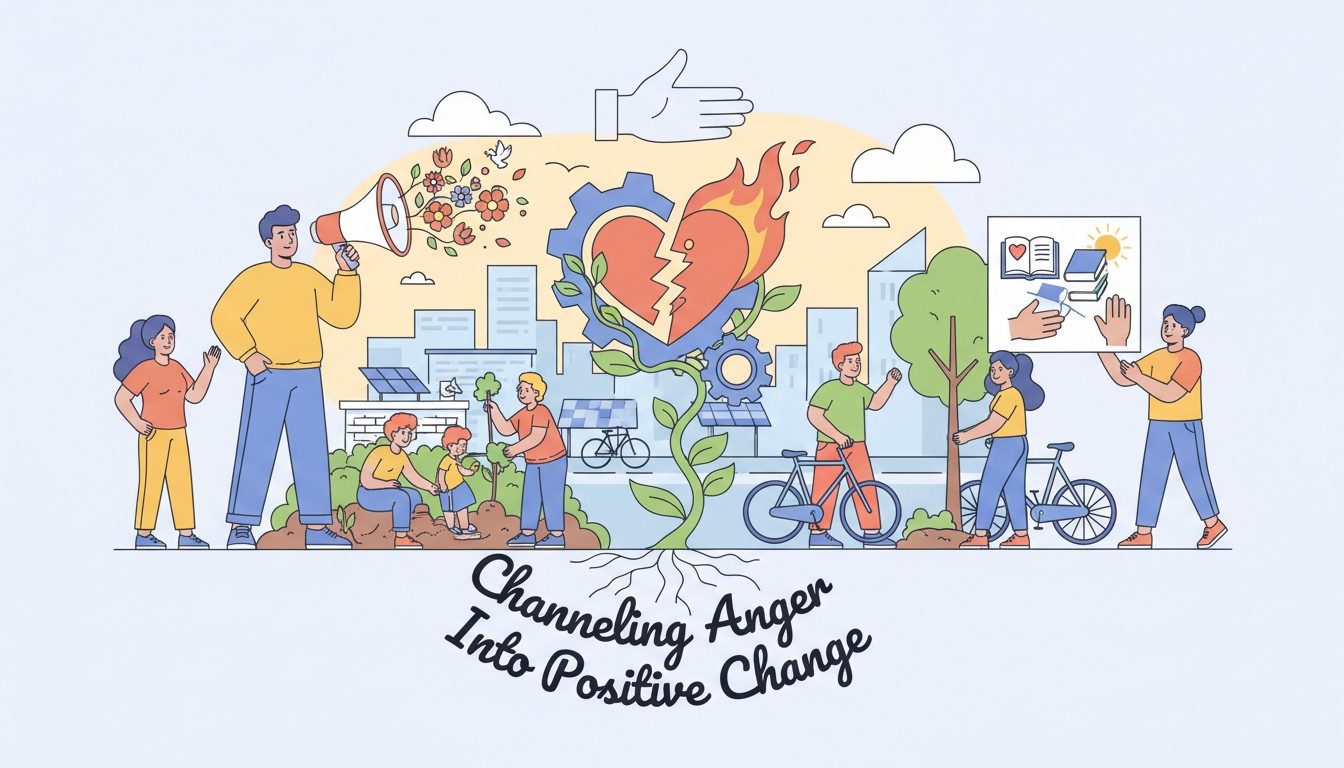
We are drowning in outrage. According to Pew Research’s 2024 analysis, 55% of Americans report being often or mostly angry about politics, while 63% describe themselves as exhausted by it. This anger-fueled political climate has produced a perverse paradox: the most enraged generation in modern history is also the most politically cynical, with only 10% feeling hopeful about the future. As NORC’s pre-election survey revealed, seven in ten Americans believe politicians are only out for themselves, and a quarter think the country needs complete upheaval.
But here’s the critical insight: outrage and action are not the same thing. In fact, research from political psychologist Steven Webster demonstrates that anger directly erodes political efficacy—the belief that your actions can influence outcomes. Angry citizens are more likely to vent and less likely to organize. The very emotion that should fuel change becomes the barrier that prevents it. Understanding how to channel outrage constructively transforms citizens from passive reactors into powerful agents of change.
The Outrage Trap: When Anger Becomes Paralysis
Outrage feels productive. When we share that angry post, sign that petition, or shout at that rally, we experience a dopamine hit that masquerades as impact. But neurologically, outrage is designed for immediate physical threats, not complex social change. The same fight-or-flight response that prepares us to confront a predator leaves us cognitively narrowed—excellent at identifying enemies, terrible at building coalitions.
The Venting Illusion
Social media has perfected the outrage economy. Algorithms show us content that makes us angry because angry users stay engaged 30% longer than calm ones. This creates what activists call the “venting trap”—a cycle where expressing outrage substitutes for organizing action. We feel we’ve done something when we’ve only done nothing loudly.
A 2023 analysis of social media activism found that viral outrage campaigns had a 0.3% success rate at achieving policy change, while sustained local organizing efforts succeeded 67% of the time. The difference isn’t passion—it’s strategy. Viral anger dissipates; organized action compounds.
The Cynicism Spiral
Webster’s experimental research reveals that anger causally reduces trust in government—even when the anger is apolitical. Simply priming individuals to feel angry makes them more likely to believe government is unresponsive and officials are corrupt. This creates a destructive feedback loop: anger → cynicism → withdrawal → more anger when nothing changes.
The spiral is amplified by what psychologists call “learned helplessness.” After repeated failures to create change through outrage, people conclude that action is futile. They become spectators of democracy rather than participants, monitoring corruption with horrified fascination but without agency.
The Outrage-to-Action Gap
55% of Americans are often angry about politics (Pew, 2024)
10% feel hopeful about political future
0.3% success rate for viral outrage campaigns achieving policy change
67% success rate for sustained local organizing efforts
25% believe country needs complete upheaval (NORC, 2024)
The Psychology of Constructive Anger
Anger isn’t inherently destructive. In fact, research from clinical psychology shows that controlled anger can be a powerful motivator for justice, fueling persistence and clarifying boundaries. The key distinction is between anger as fuel and anger as explosion—between channeling and venting.
Anger as Signal, Not Identity
Constructive activism treats anger as a dashboard indicator, not the driver. It signals that a boundary has been crossed or an injustice has occurred. But the anger itself isn’t the goal—addressing the injustice is. This subtle shift changes everything. Instead of “I am angry,” you think “Anger is alerting me to a problem that needs solving.”
As Psychology Today’s solutionary framework explains, anger can be the initial spark, but if it becomes the dominant motivation, it calcifies into bitterness and drives potential allies away. The goal is to use anger as rocket fuel, not as the rocket itself.
The Persistence Engine
Anger’s physiological arousal—elevated heart rate, heightened focus, increased energy—can be redirected from fight-or-flight to sustained effort. Athletes use this trick all the time: they channel pre-game anger into performance. Activists can do the same by translating the energy of outrage into the marathon of organizing.
Research on long-term activists reveals a pattern: those who sustain their work for decades don’t lack anger—they have systems for converting it. They schedule “rage time” (reading news, processing injustice) separately from “build time” (organizing, coalition-building). This prevents anger from contaminating collaborative work while preserving its motivational power.
Real-World Impact: Movements That Got It Right
The abstract becomes concrete through specific successes. These case studies demonstrate how movements channeled outrage into sophisticated strategy, achieving wins where pure rage would have failed.
The Sunrise Movement’s Strategic Rage
The Sunrise Movement built its foundation on young people’s fury about climate inaction. But instead of remaining in protest mode, they channeled that anger into a sophisticated inside-outside strategy: outside protest to build pressure, inside organizing to elect climate champions. Their “Green New Deal” framing transformed abstract anger into a concrete policy vision.
The key was their “anger discipline.” Members processed outrage in closed sessions, then approached legislators with collaborative language. The fury fueled the work but didn’t poison the relationships needed for compromise. Result: $369 billion in climate investment through the Inflation Reduction Act—far from perfect, but the largest climate legislation in U.S. history.
The Restaurant Opportunities Center’s Dual Track
Restaurant workers’ outrage over poverty wages and sexual harassment could have remained in the streets. Instead, the Restaurant Opportunities Center built a dual-track strategy: public protests for visibility and worker-owned cooperative restaurants for modeling alternatives. Their anger at exploitation became fuel for creation.
They now operate seven worker-owned restaurants nationwide, paying living wages and providing benefits while training hundreds of workers in cooperative management. The outrage didn’t just oppose the old system—it built a new one. Their model has inspired similar efforts in other low-wage industries.
The Community Land Trust Movement’s Patient Power
Housing activists’ outrage at gentrification and displacement could have manifested as purely oppositional protests. Instead, community land trust organizers channeled anger into patient institution-building. Over decades, they’ve created a network of community-owned land that permanently removed over 50,000 housing units from the speculative market.
Their secret: they separated the “outrage work” (protesting displacement) from the “building work” (developing community-owned housing). Members committed to both, understanding that protest without alternatives is performance. Their model now influences national housing policy discussions, transforming local anger into systemic solutions.
The Burnout Barrier: Sustaining Action Without Breaking
The most underappreciated obstacle to transforming outrage into action is sustainability. Activist burnout is epidemic, with studies showing 70% of social justice organizers experience symptoms of burnout within three years. The pattern is predictable: outrage fuels initial mobilization, but without sustainable practices, anger curdles into cynicism and organizers drop out.
The Stressors Specific to Activism
Research on the No Borders movement, documented in PMC’s activist burnout study, identified three unique stressors: “prefigurative betrayal” (when movements can’t live up to their ideals), “inadequate expectations” (the gap between urgent goals and slow progress), and “split of life-worlds” (the psychological distance between activist identity and daily life). These stressors aren’t individual weaknesses—they’re structural features of transformative work.
The study found that activists navigating highly diverse environments (refugees, migrants, locals) faced additional pressure to embody political ideals perfectly, creating impossible emotional demands. Understanding these specific stressors is crucial for building sustainable movements.
Evidence-Based Prevention Strategies
The science of burnout prevention offers concrete interventions. Change Atelier’s research synthesis identifies several proven strategies:
• Recognize Early Warning Signs: Abnormal fatigue, cynicism, and hopelessness are red flags. Don’t wait for collapse—intervene early.
• Structured Rest: Dedicated “activist work schedules” with firm boundaries between organizing time and recovery time. Rest is not laziness—it’s strategic.
• Physical Health Foundations: Sleep (8-10 hours), nutrition, and movement are non-negotiable stress buffers.
• Community Support: Peer support groups where activists can share struggles without judgment reduce isolation and prevent burnout.
As Yale’s climate activism research emphasizes, “Your mental health matters for saving the planet.” Self-compassion isn’t indulgence—it’s infrastructure.
Practical Strategies: Your Outrage-to-Action Toolkit
Transforming outrage into change isn’t mystical—it’s methodological. These evidence-based strategies work for individuals, organizations, and movements.
The Two-Track System
Separate your “outrage work” from your “building work.” Dedicate specific times to processing anger (reading news, venting with trusted allies) and different times to constructive action (organizing, policy research, coalition meetings). This prevents anger from poisoning collaborative relationships while preserving its motivational energy.
The Policy Translation Exercise
Take any issue that enrages you and translate it into three potential policies: a maximalist demand, a compromise position, and an incremental win. This exercise moves you from “this is wrong” to “this is what we can do about it.” It also prepares you for the reality that change is almost always incremental.
The Relationship-First Principle
Before attacking opponents, understand them. Schedule meetings with people you disagree with—not to convert them, but to learn their underlying concerns. Often, you’ll discover shared values beneath surface conflicts. One criminal justice reform advocate regularly meets with police unions, not to compromise on principles, but to find implementation paths that address their safety concerns while advancing reform.
The Institutional Mirror
Build organizations that model the world you want to create. If you’re fighting for democracy, make your group intensely democratic. If you’re fighting for racial justice, build multiracial leadership with genuine power-sharing. This “prefigurative politics” prevents burnout by aligning means with ends, making the work itself sustenance.
30-Day Outrage-to-Action Challenge
Week 1: Identify one issue that enrages you. Translate it into three specific policy proposals.
Week 2: Research one local organization working on this issue. Attend a meeting as an observer.
Week 3: Schedule coffee with someone who disagrees with you on this issue. Listen for their underlying values.
Week 4: Take one concrete action: join the organization, volunteer, testify at a hearing, or recruit two friends.
Track: Notice how your relationship to the issue shifts from helpless rage to empowered engagement.
The Cultural Shift: From Rage Culture to Solution Culture
Reversing the outrage-to-action gap requires more than individual tactics—it demands cultural transformation. We need to value solution-building as much as problem-exposing, to celebrate incremental wins as genuine progress, and to see anger as fuel for construction rather than demolition.
This means changing how we talk about activism. Instead of asking “What are you against?” we should ask “What are you building?” Instead of measuring commitment by how angry someone is, we should measure it by how consistently they show up to do the work. Instead of treating cynicism as sophistication, we should recognize it as a failure of imagination.
The movements that will transform our future won’t be the loudest—they’ll be the most strategic. They’ll channel our legitimate outrage into institutions that last, policies that work, and coalitions that endure. They’ll make us proud not just of what we opposed, but of what we created.
Your Outrage Is a Renewable Resource
The anger you feel about injustice isn’t a character flaw—it’s a moral compass. But a compass only helps if you move in the direction it points. Outrage without action is just emotional pollution. Outrage channeled into strategy becomes history-making power.
You don’t have to choose between being angry and being effective. You have to choose between venting and building, between purity and progress, between the temporary satisfaction of rage and the lasting satisfaction of change. One feels good in the moment. The other creates the world you want to live in.
Start today. Take the policy translation exercise. Schedule that coffee with someone you disagree with. Join that organization. Your outrage isn’t a problem to manage—it’s fuel for the work that only you can do. Use it wisely.
Key Takeaways
Political outrage has surged (55% of Americans often angry) while efficacy has plummeted, creating a paradox where anger fuels cynicism rather than change.
Research shows anger causally reduces trust in government and political efficacy, creating a destructive feedback loop of anger → cynicism → withdrawal.
Successful movements channel outrage strategically: Sunrise Movement’s inside-outside climate strategy, ROC’s protest-plus-cooperatives model, CLTs’ separated outrage/building work.
Activist burnout affects 70% of organizers within three years; prevention requires structured rest, community support, and separating outrage processing from building work.
Practical strategies include two-track systems, policy translation exercises, relationship-first organizing, and treating anger as fuel rather than identity.