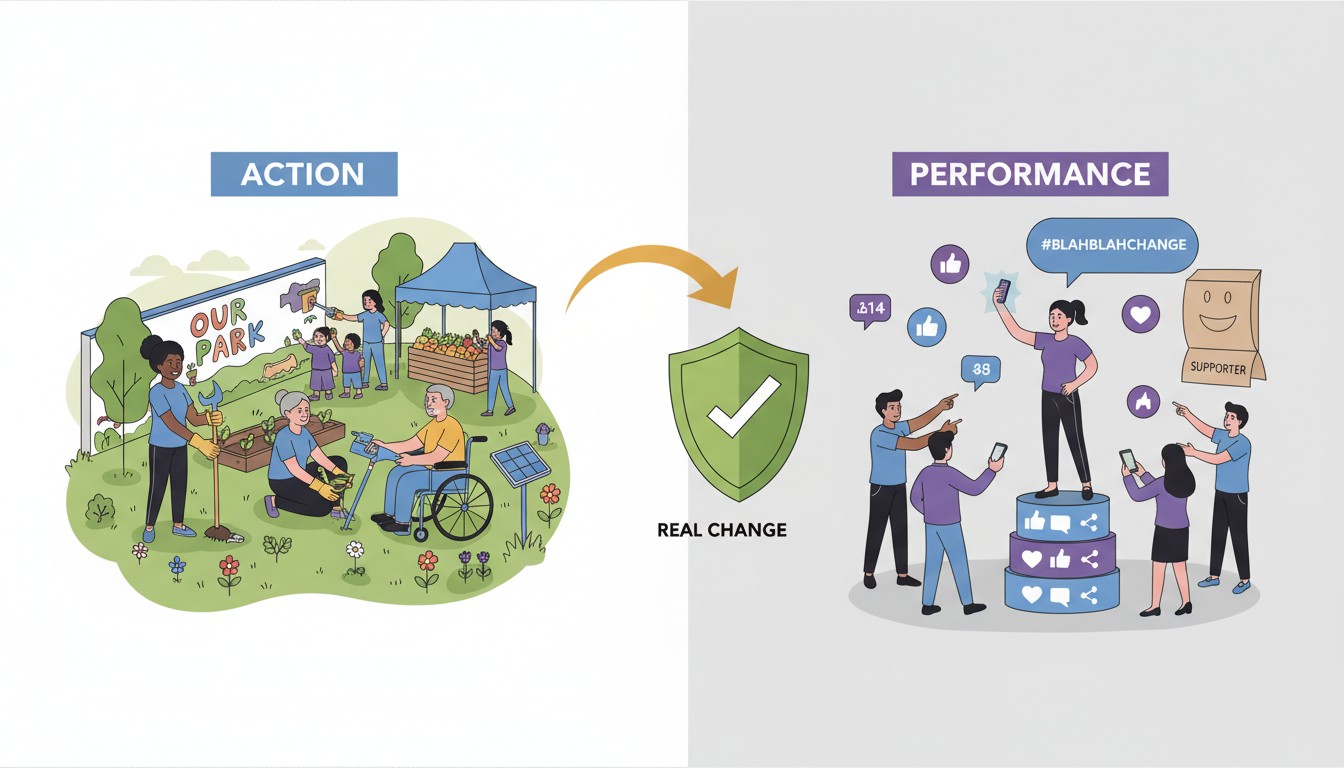
The modern activist faces a seductive illusion: that volume equals impact. A hashtag trending nationwide feels more consequential than a zoning board vote affecting three city blocks. Research from social movement studies reveals that while online engagement can correlate with offline action, the relationship is neither automatic nor equal. The ease of digital participation creates a performance trap—where the act of posting substitutes for the work of organizing.
This isn’t a condemnation of social media as a tool. It’s a recognition that tools are not outcomes. The same platform that can mobilize a march can also absorb your energy in an infinite scroll of issue awareness without issue resolution. Understanding this distinction—between performing solidarity and building power—separates those who witness change from those who architect it.
The Performance Mirage: When Digital Clicks Create Illusions of Impact
Social media platforms engineer a specific neurological response: the dopamine hit of engagement. Each like, share, and retweet triggers a micro-reward, creating a feedback loop that feels like progress. A petition signed in 30 seconds delivers the emotional satisfaction of participation without the friction of perspiration. Researchers call this “slacktivism”—a portmanteau that captures the tension between low-cost online gestures and high-impact offline work.
The critical flaw isn’t the digital medium itself, but the transactional nature of most online activism. Reposting an infographic requires no relationship building. Sharing a call to action demands no follow-through. As one study noted, these actions may cultivate an “illusion of accomplishment” that actually reduces motivation for more demanding forms of engagement . When you’ve already signaled your virtue to your network, the psychological pressure to act diminishes.
The Connectivity Paradox
Paradoxically, social media’s greatest strength—connecting millions instantly—becomes its weakness in building sustained movements. Online networks are typically interest-based, not place-based. You can rally 50,000 Twitter followers who care about housing policy, but if none of them attend the planning commission meeting where a developer’s proposal gets approved, your digital army dissolves into ether.
Research on social media capital and civic engagement suggests that online relationships can translate to offline action—but only when intentionally cultivated. The critical variable isn’t the number of connections, but the depth of those connections. A thread of 100 comments among strangers is less valuable than three phone calls with neighbors who share your street.
The Invisible Infrastructure: Where Real Change Is Actually Built
Real community change operates in spaces that algorithms can’t reach. It’s built during Sunday afternoon door-knocking sessions, in the minutes of subcommittee meetings, and through the painstaking process of building trust with people who disagree with you. This invisible infrastructure doesn’t photograph well for Instagram, which is precisely why it works.
Consider door-to-door canvassing. Studies show this remains one of the most effective methods for both voter mobilization and issue advocacy. Why? Because it forces relational engagement. You must look someone in the eye, respond to their skepticism, and tailor your message to their specific concerns. As organizing experts note, this one-to-one education transforms passive sympathizers into active participants . The conversion rate is low—perhaps one in twenty doors—but the resulting commitment is deep.
Similarly, attending monthly city commission meetings builds institutional memory. You learn which officials respond to data, which respond to emotional stories, and which respond to electoral pressure. This intelligence is never posted publicly but becomes the foundation of effective strategy. A well-timed, three-minute public comment from a recognized resident carries more weight than 10,000 emailed form letters from outside the district.
The Anatomy of Effective Action
Performance (Digital-Only): Shares crisis infographic, signs online petition, changes profile picture
Real Action (Relational): Meets affected neighbors, researches policy history, presents to decision-makers, follows up monthly
The Difference: One registers disapproval; the other builds power to enforce change.
The Psychology of Digital vs. Physical Engagement
Our preference for digital activism isn’t accidental—it’s engineered by cognitive biases and platform design. Understanding these mental shortcuts reveals why we choose performance over practice.
The Immediacy Bias
Online actions deliver instant feedback. Post a hashtag and watch it spread. Sign a petition and receive an immediate thank-you email. This immediacy satisfies our brain’s desire for quick rewards. Real organizing operates on a timescale of months or years, with progress invisible for long stretches. The human brain is poorly wired for delayed gratification, making the quick hit of digital activism feel more satisfying—even when it achieves nothing.
The Effort-Reward Miscalculation (Digital Edition)
Just as voters miscalculate the impact of local elections, activists miscalculate the return on digital versus physical effort. A tweet reaching 10,000 people feels more impactful than convincing ten neighbors to attend a meeting. But those ten neighbors represent votes, relationships, and sustained pressure. The 10,000 Twitter followers, scattered across time zones, cannot vote in your local election or show up to the hearing. The math is wrong, but the feeling is powerful.
The Safety of Spectatorship
Online activism allows us to advocate without vulnerability. You can rage against systemic injustice without confronting your own biases. You can demand change without risking relationships with neighbors who disagree. This psychological safety is comforting but corrosive. Real change requires the discomfort of face-to-face accountability, of building coalitions with people who don’t share all your values, of persisting after public failure.
From Clicks to Concrete: Real-World Transformations
The path from online outrage to offline outcomes isn’t theoretical. Communities that successfully bridge this gap follow a pattern: they leverage digital tools for initial awareness, then rapidly transition to relationship-based organizing.
The Community Garden That Started with a Post
In a struggling Milwaukee neighborhood, a resident posted photos of a trash-filled vacant lot on Facebook. The post angered neighbors but generated no action. Months later, the same resident knocked on 40 doors, inviting people to a Saturday cleanup. Seven people showed up. They cleared the lot, then formed a nonprofit. Five years later, that lot is a vibrant community garden. Property values within three blocks rose 35%. Crime dropped. The digital post identified the problem; only the physical organizing solved it.
The School Board Victory That Required Phone Calls
After a district cut mental health services, outraged parents filled comment sections and tweeted at board members. Nothing changed. Then, twelve parents organized. They split the board member list and each made three personal phone calls, sharing specific stories about their children. They followed up with handwritten letters. At the next meeting, they sat together, wearing matching shirts. The board restored full funding. The Twitter storm had 500 angry tweets; the phone campaign had 36 conversations. One changed policy.
The Traffic Calming That Took a Year of Meetings
When a child was nearly hit by a car, neighbors created a viral video showing cars speeding through the intersection. It got 50,000 views and news coverage. The city promised “to look into it.” Six months later, nothing changed. Then three residents began attending monthly transportation committee meetings. They brought traffic data. They introduced themselves to committee members during breaks. They testified calmly, respectfully, repeatedly. After twelve months, the committee approved speed humps and a redesigned intersection. The video created urgency; the meetings created change.
The Research Is Clear: Depth Beats Breadth
Studies on grassroots organizing consistently show that relational, face-to-face engagement produces more durable outcomes than digital mobilization alone. One-to-one conversations, as labor organizers have long known, remain the gold standard for converting interest into commitment.
The Compound Effect: Building Power Through Relational Organizing
The most effective community organizers understand that power compounds through consistency, not virality. They practice “deep organizing”—building relationships that survive beyond a single campaign cycle. This approach prioritizes leadership development over mobilization, creating a sustainable infrastructure that outlives any individual issue.
Deep organizing follows a simple principle: every interaction should leave the other person more capable of acting without you. When you meet a new volunteer, you don’t just assign them tasks—you identify their skills, connect them to others, and gradually transfer responsibility. As scholars note, this “transformative organizing” creates movements that function as “prisms of the people,” amplifying constituent voices rather than centralizing power .
This compound effect operates in predictable stages:
- Visibility (Months 1-3): You attend meetings, introduce yourself, ask questions. Officials learn your name.
- Credibility (Months 4-8): You follow through on commitments, provide useful information, demonstrate seriousness.
- Influence (Months 9-18): Officials solicit your input. Other residents ask your opinion. You become a node in the network.
- Leadership (Months 19+): You run for office, chair committees, or become the person who trains the next wave.
This timeline is too slow for social media metrics, which demand constant content and immediate results. But it’s the only timeline that builds durable power.
Practical Strategies: Escaping the Performance Trap
Moving from digital performance to real action requires intentional strategy. Here are concrete steps to transform online energy into offline outcomes:
1. Use Digital Tools for One-to-One Conversion
Stop measuring success by reach. Instead, use social media to identify potential recruits, then immediately move to personal contact. When someone shares your post, send them a direct message: “Thanks for sharing! We’re meeting Tuesday at 7pm—can I send you the address?” The goal is always the face-to-face follow-up.
2. Build a Leadership Pipeline, Not Just a Following
Effective movements develop local leaders through progressive responsibility. Start by asking new volunteers to host a small gathering. Next, have them coordinate a canvassing route. Eventually, they run a campaign committee. This leadership development creates redundancy and scalability—your movement grows stronger as you share power, not just tasks.
3. Institutionalize Accountability
Create systems that track follow-through. After a public meeting, assign each volunteer two officials to contact by phone within a week. Use simple spreadsheets, not sophisticated apps. The point is visible commitment, not technological efficiency. Make commitments public within your core group—social pressure among trusted peers drives action more effectively than guilt.
4. Master the “Ask” Ladder
Don’t jump from online petition to “spend 10 hours a week organizing.” Create graduated asks: sign, then share, then attend a meeting, then bring a friend, then host a coffee. Each step builds investment. As research on grassroots mobilization shows, this “laddering” converts passive supporters into active leaders by respecting their capacity and building trust incrementally.
5. Document Process, Not Just Outcomes
Social media encourages celebrating wins. But real organizing requires celebrating process. Share photos of your canvassing team, not just the final vote count. Post about the boring committee meeting you attended, not just the policy change it enabled. This signals that consistent presence matters more than viral moments, training your network in the right values.
The Choice Is Yours: Viral or Viable?
Every day, you choose between two forms of activism. One delivers immediate validation, the approval of strangers, and the feeling of having done something. The other requires uncomfortable conversations, tedious meetings, and slow progress that often goes unrecognized.
The first builds a personal brand. The second builds community power. The first changes your profile. The second changes your neighborhood. The first is finite—it ends when you close the app. The second is generational—it creates infrastructure that outlives you.
Your anger is valid. Your concern is justified. But channeling that energy into performance is a waste of precious fuel. The playground is still broken. The street is still unsafe. The system is still rigged. You can tweet about it, or you can fix it. The choice is yours—and the difference is everything.
Key Takeaways
Social media activism often creates an illusion of impact through immediate feedback loops that satisfy our brain’s desire for quick rewards, but rarely translates into policy change.
Real community change is built through invisible infrastructure: door-to-door canvassing, committee meetings, coalition building, and consistent relational organizing that compounds over time.
Cognitive biases like immediacy preference, effort-reward miscalculation, and audience capture trap us in digital performance rather than physical practice.
Effective movements use digital tools for one-to-one conversion, building leadership pipelines, and institutionalizing accountability—not for mass broadcasting alone.
The choice between viral performance and viable action determines whether we witness change or architect it; depth of relationship always beats breadth of reach.