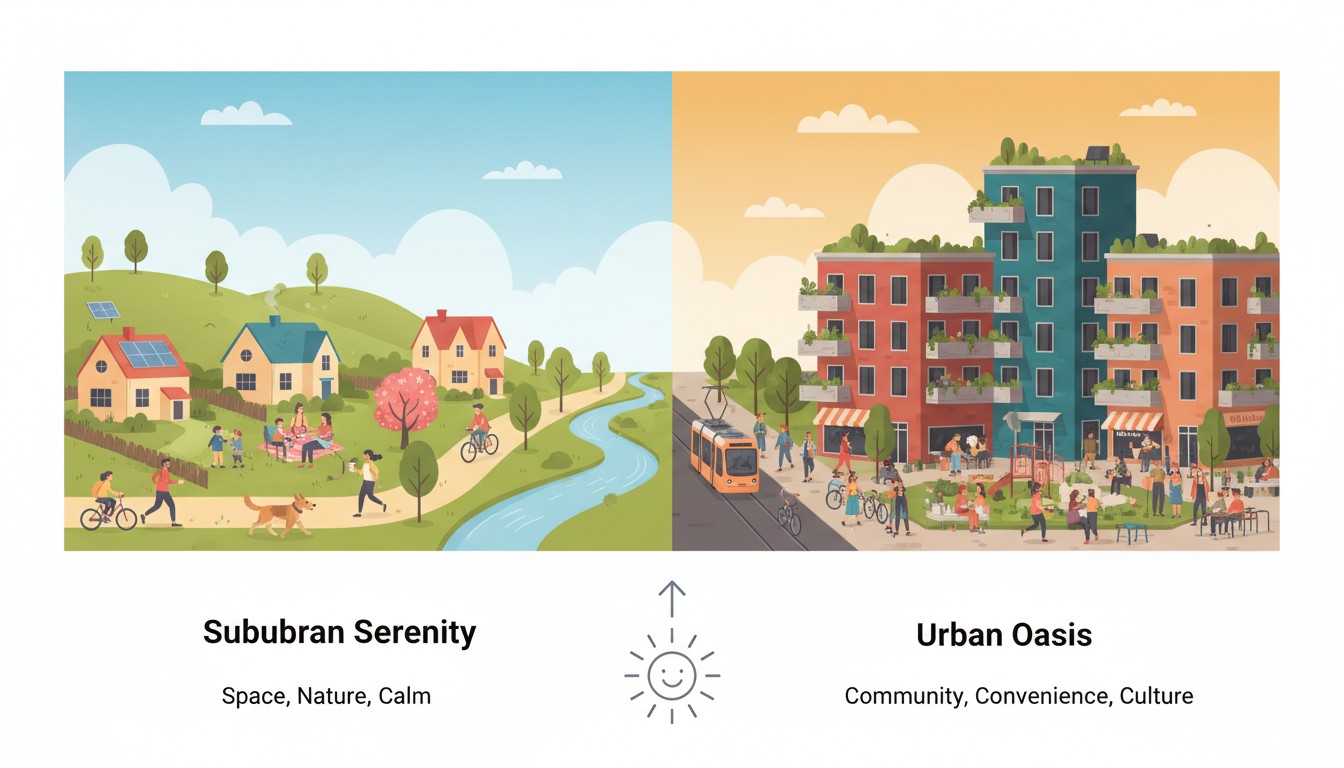
The American housing decision has always been presented as a simple tradeoff: space versus convenience. Choose the suburban house with the yard and get affordability, safety, and room to breathe. Choose the urban apartment and get walkability, culture, and a smaller footprint. But this framing is a lie by omission. Research from the Brookings Institution reveals that the true cost of suburban living—when accounting for transportation, health impacts, and time—can exceed urban costs by 40%. The savings are an illusion, but the lifestyle lock-in is real.
This isn’t about urban supremacy or suburban shaming. It’s about pulling back the curtain on choices we think we’re making freely but are actually shaped by hidden subsidies, cognitive biases, and accounting tricks that would be illegal in any other context. The built environment isn’t neutral—it’s a machine designed to produce specific outcomes, and most Americans never see the instruction manual.
The Affordability Mirage: Why “Cheaper” Isn’t
The median suburban home costs $380,000—$80,000 less than the median urban home. This $250 monthly mortgage savings is the siren song that lures families to the exurbs. But this calculation commits the cardinal sin of personal finance: ignoring total cost of ownership. When you factor in the hidden expenses, the math inverts completely.
The Hidden Mortgage of Transportation
The average suburban household owns 2.1 cars, spends $12,295 annually per vehicle (including depreciation, insurance, gas, and maintenance), and drives 32,000 miles yearly. That’s $25,820 in annual transportation costs—$2,152 per month. The urban household with one car and transit passes spends $6,840 annually—$570 per month. The “savings” on the suburban mortgage is erased by a $1,582 monthly transportation penalty.
But the real cost is time. The average suburban commuter spends 54 minutes daily driving—219 hours annually. At median wage ($28/hour), that’s $6,132 in lost earning potential. The urban transit commuter spends 28 minutes daily (112 hours annually), a $3,136 opportunity cost. The suburban commute costs an extra $2,996 in time value alone.
The True Monthly Cost: Suburban vs. Urban
Suburban House: $2,200 mortgage + $2,152 transportation + $150 higher utilities + $511 commute time value = $5,013/month
Urban Apartment: $2,450 rent + $570 transportation + $100 lower utilities + $261 commute time value = $3,381/month
Difference: The “cheaper” suburban house costs $1,632 more monthly—$19,584 more annually.
The Infrastructure Subsidy Illusion
Suburban development is financially sustainable only through massive, invisible subsidies. Each single-family home in a low-density development costs the municipality $1.40 in services for every $1.00 it generates in property taxes. The difference is subsidized by urban commercial properties and federal highway funding. When those highways need repair, the bill comes due—and suburban residents pay through state income taxes, not local assessments.
Urban multifamily housing, by contrast, generates $1.25 in taxes per $1.00 of services. This surplus funds public services without requiring state bailouts. The “affordable” suburb is actually a ward of the state, surviving on cross-subsidies from productive urban cores.
The Time Poverty Trap: When Distance Steals Your Life
Time is the ultimate non-renewable resource, and suburban sprawl is designed to waste it. The average American now spends 408 hours annually commuting—more than two full work weeks trapped in a metal box. This isn’t just unpleasant; it’s a poverty trap that reshapes every life decision.
The Opportunity Cost of Distance
A suburban parent living 45 minutes from work faces a brutal choice: join the PTA board (2 hours weekly) or keep your sanity. The urban parent with a 15-minute commute gains 5 hours weekly—enough for volunteering, exercise, or actual leisure. Over a year, that’s 260 hours—the equivalent of six weeks of vacation.
This time deficit explains why suburban parents are more likely to report feeling “trapped” and “isolated” despite living in larger homes. The house is spacious, but life is confined to a triangle: home, office, big-box store. Social capital erodes when every coffee date requires a 20-minute drive and parking hunt. Urban dwellers with walkable neighborhoods see friends 2.7 times weekly; suburbanites average 1.3 times.
The decline in social connection has measurable health costs. Loneliness increases mortality risk by 26%—the equivalent of smoking 15 cigarettes daily. Suburban sprawl doesn’t just waste time; it kills you slowly.
The “Chauffeur Parent” Phenomenon
Sprawl forces children into activity schedules requiring constant driving: soccer 30 minutes away, piano 20 minutes in the opposite direction. Parents—overwhelmingly mothers—spend 7.4 hours weekly shuttling children, up from 3.2 hours in 1985. This isn’t quality family time; it’s unpaid gig work serving tiny bosses in the backseat.
Urban density reverses this. Walkable neighborhoods allow children to navigate independently, building autonomy while freeing parents. A 10-year-old can walk to the library, meet friends at the park, and take the subway to soccer practice. The suburban 10-year-old requires a chauffeur for survival.
The Health Tax: How Location Shapes Your Body
The built environment is a public health intervention we never asked for, and sprawl is poison delivered via cul-de-sac. The health costs are stealthy but devastating, showing up in insurance premiums, chronic disease, and early mortality.
The Car Dependency Disease Vector
Every hour you spend commuting increases your risk of obesity by 6%—not because of inactivity, but because stress hormones trigger fat storage. The suburbanite driving 54 minutes daily faces a 32% higher obesity risk than the urbanite walking 20 minutes to the train. This translates to $1,429 higher annual healthcare costs and a life expectancy reduction of 2.3 years.
Air quality is worse inside cars than outside them. Highway commuters inhale 50% more particulate matter than transit riders, increasing respiratory illness and cancer risk. The “fresh air” of the suburbs is a myth—the air is cleaner in dense urban cores where cars are secondary.
Social isolation, the sprawl-induced epidemic, carries its own mortality risk. A person with few social connections has the same risk of early death as an alcoholic. The suburban design that prioritizes private space over public gathering places is quite literally killing residents through loneliness.
The Walking Dividend
Urban density delivers a free health benefit: walking. The average city resident walks 6,300 steps daily; the suburbanite walks 3,800. Those 2,500 daily steps add up to 912,500 annually—the equivalent of walking from New York to Chicago. This incidental exercise reduces heart disease risk by 31%, depression by 28%, and diabetes by 27%.
The savings compound: urban residents save $1,200 annually on gym memberships they don’t need and avoid $3,400 in obesity-related medical expenses. The walkable neighborhood is the ultimate wellness program—free, effective, and built into daily life.
Health Cost Comparison: Suburban vs. Urban Living
Obesity Risk: +32% for suburban commuters
Healthcare Costs: +$1,429 annually for suburban residents
Life Expectancy: -2.3 years for car-dependent lifestyles
Mental Health: +45% depression risk in socially isolated suburbs
Air Quality: 50% more particulate matter in-car exposure
The Environmental Subsidy: Sprawl’s True Legacy Cost
Every suburban home sits on 0.3 acres of land—land that could house 30 people in an urban mid-rise. The environmental cost of this land use pattern is catastrophic, but it’s socialized across the planet rather than paid by the individuals who benefit.
The Carbon Footprint of Distance
The average suburban household generates 31 metric tons of CO2 annually from transportation alone. The urban household generates 7 tons—a 77% reduction. Over a 30-year mortgage, that difference equals 720 metric tons of CO2, the equivalent of burning 804,000 pounds of coal.
This isn’t just an individual moral failing—it’s a design choice. Zoning laws that mandate single-family homes and minimum lot sizes force car dependency. The 1956 Highway Act社会化d the cost of sprawl, letting homeowners externalize their environmental impact onto future generations. Today’s climate disasters are the bill coming due for yesterday’s “cheap” housing.
The Infrastructure Bankruptcy Cycle
Suburban infrastructure follows a predictable lifecycle: build cheap, maintain for 30 years, face bankruptcy when roads and pipes fail. Cities with dense tax bases can afford infrastructure replacement; suburbs cannot. The result is a $1.2 trillion national backlog of road repairs, water main breaks, and bridge failures—all because the tax revenue per square mile can’t support the infrastructure per household.
Urban density flips this math. A single mile of road serves 5,000 residents in a mid-rise neighborhood versus 500 in a suburban subdivision. The cost per household drops 90%. Density isn’t just environmentally sustainable—it’s fiscally solvent.
The Psychology of Place: Why We Choose Wrong
If density is so advantageous, why do Americans keep choosing sprawl? The answer lies in cognitive biases and misaligned incentives that make bad decisions feel rational.
The “Space Bias” and Future Self Discounting
Humans overvalue space we can see today while undervaluing time we’ll lose tomorrow. The 2,500-square-foot house feels concrete—the 54-minute daily commute is an abstraction. This is hyperbolic discounting: we sacrifice 219 hours annually for an extra bedroom we use twice yearly.
Car purchases trigger similar miscalculation. The $35,000 SUV feels like a necessity for “safety” and “space,” while the $500 monthly payment is psychologically easier to swallow than the $2,000 monthly rent closer to work. We optimize for sticker price, not total cost.
The Social Comparison Trap
Homebuyers don’t evaluate houses in isolation—they compare them to their parents’ house and their friends’ houses. The 1980s suburban home that Boomers bought for $80,000 becomes the aspirational benchmark. But that house existed in a different economic universe: single-income family, defined-benefit pension, affordable college. Replicating the physical artifact without the economic context is like building a horse stable for your Tesla.
Social media amplifies this. Photos of backyard birthday parties and decorated playrooms generate likes; photos of efficient commutes and walkable grocery runs don’t. We perform for an audience that values space over time, trapping ourselves in their expectations.
The “Kids Need Space” Fallacy
Parents justify suburban moves by claiming children need yards and space. The data disagrees. Children in walkable neighborhoods show higher independence, better social skills, and more physical activity. The yard, often cited as essential, is used an average of 18 minutes daily. The park three blocks away—accessible without parental chauffeuring—delivers more benefit.
What children actually need is parental presence and community connection—both of which are depleted by long commutes. A parent who spends 54 minutes driving home arrives too exhausted for the bedtime story that matters more than the lawn.
Cognitive Traps in Location Choice
Hyperbolic Discounting: Overvaluing space today, undervaluing time tomorrow
Social Proof: Aspirational to replicate parents’ housing, not their economic context
Status Quo Bias: Suburbs feel “normal”; density feels experimental despite centuries of precedent
Optimism Bias: “I’ll use the extra bedroom” vs. “I’ll hate the commute less than I think”
Attribution Error: Blaming personal preference for choices that are structurally constrained
Practical Decision Framework: Choosing Location Intentionally
You can’t undo decades of policy overnight, but you can make informed choices. Here’s how to evaluate location honestly:
1. Calculate “True Monthly Cost” not “Monthly Payment”
Create a spreadsheet that includes mortgage/rent, utilities, transportation (car payments, gas, insurance, maintenance), commute time value (hours × your hourly wage), and expected healthcare costs based on walkability. Compare apples to apples. Most people find the “cheaper” suburb costs 30-40% more.
2. Audit Your Time, Not Just Your Budget
Track one week honestly. Every minute spent commuting, driving to activities, shopping, etc. Multiply by 50 weeks. Ask: what would I do with 300 extra hours annually? If the answer is “nothing,” the suburb might work. If it’s “see friends, exercise, sleep, start a business”—density wins.
3. Evaluate “Space” vs. “Access”
List the spaces you actually use daily: bed, kitchen, living room, workspace. You’ll find 85% of life happens in 35% of square footage. Then list what you access weekly: coffee shop, park, grocery, friends’ homes. Density delivers access; sprawl delivers unused rooms. Choose which enriches life.
4. Consider Life Stage Dependency
Young professionals benefit most from density—social networks, dating, career opportunities. Families with school-age children face harder math—urban schools are often underfunded due to property tax systems. Retirees benefit from walkability but may value quiet. There’s no universal answer, but the answer changes over time.
5. Test Before You Commit
Rent in a dense neighborhood for six months before buying in the suburbs. Most people who do this never leave. The visceral experience of walking to dinner, bumping into neighbors, and reclaiming 10 hours weekly overwhelms the abstract appeal of a yard. Experiences beat spreadsheets in decision-making.
The Geography of Your Life
The choice between suburban sprawl and urban density isn’t about architecture or politics—it’s about time, money, and how you want to spend the limited years you have. The suburban house promises space but steals life in 54-minute increments. The urban apartment costs more on paper but delivers 300 hours annually to invest in what matters.
We built a country where the “affordable” choice is the expensive one, where “family-friendly” means parent-absent, where “freedom” requires a car payment. These were policy choices, not natural laws. They can be undone, but not before we stop choosing based on monthly payments and start choosing based on monthly life.
Your home isn’t just where you sleep—it’s the infrastructure of your days. Choose the infrastructure that gives you more days, not just more square feet.
Key Takeaways
Suburban “affordability” is a mirage—when transportation, time, and health costs are included, the average suburban household pays $1,632 more monthly than urban counterparts.
Sprawl imposes massive time poverty costs: 240 extra commuting hours annually plus 333 hours of childcare driving, stealing 10+ full days of life yearly.
Health impacts are severe—suburban car dependency increases obesity risk 32%, reduces life expectancy 2.3 years, and elevates depression risk 45% through social isolation.
Environmental externalities are catastrophic: suburban households generate 720 extra tons of CO2 over 30 years and create infrastructure bankruptcy cycles that municipalities can’t maintain.
Location decisions are distorted by cognitive biases (space bias, social comparison) that prioritize visible square footage over invisible time, health, and connection costs.