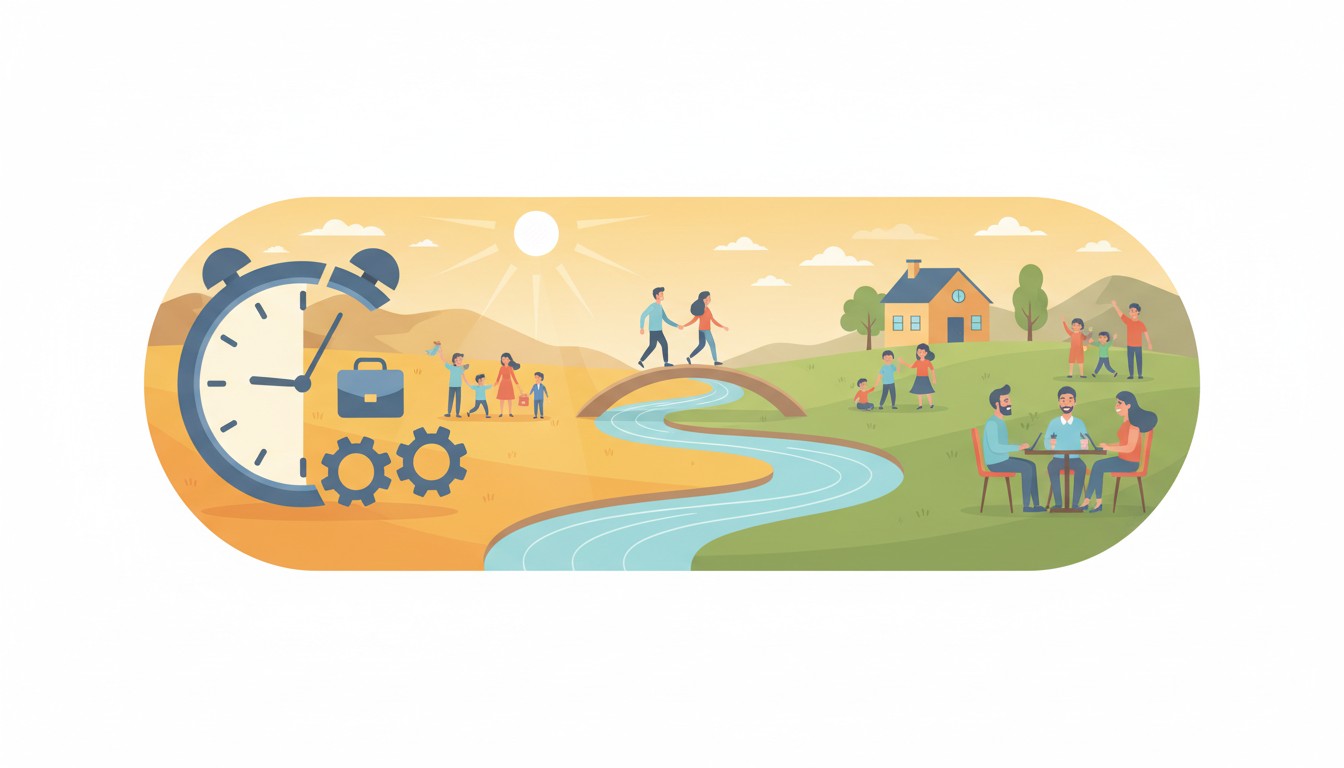
The American worker faces a paradox: unemployment sits at 4.3% (as of August 2025), yet burnout has reached epidemic proportions. The Bureau of Labor Statistics reports that employed persons work an average of 7.6 hours daily—but this captures only half the story. When Arlie Hochschild coined “the second shift” in 1989, she described the unpaid domestic labor that follows paid employment. Today, that shift has metastasized, colonizing weekends, lunch breaks, and the spaces between dinner and sleep. The result is a nation of workers who are physically present but psychologically depleted, running on a treadmill that never stops.
The exhaustion isn’t imaginary. The American Time Use Survey reveals that working parents spend an additional 3.2 hours daily on childcare and household chores—creating a 10.8-hour workday that repeats seven days a week. This isn’t about laziness or poor time management. It’s about a structural failure to account for the full scope of human labor. While we obsess over “work-life balance,” the second shift renders that concept meaningless. There is no balance when work simply changes venues from office to kitchen, laptop to laundry basket.
The Anatomy of the Second Shift: More Than Just Chores
The second shift has evolved far beyond vacuuming and dishwashing. It now includes a third category of “invisible work”—the mental load of planning, coordinating, and anticipating family needs. This cognitive burden is exhausting precisely because it’s never finished and rarely acknowledged.
Consider the modern parent’s evening: Physical chores (dinner, dishes, laundry) consume 2.5 hours. Childcare (homework, baths, bedtime stories) adds another 1.7 hours. But the mental work—remembering the pediatrician appointment, researching summer camps, tracking school project deadlines, managing the grocery list—occupies the remaining hours of consciousness, intruding during work meetings and disrupting sleep. The American Progress analysis reveals this mental labor is disproportionately shouldered by women, even in dual-income households where both partners claim to support equality.
The Three Layers of Modern Labor
Today’s worker confronts a triple burden that previous generations never faced:
Paid Work (The First Shift): The 7.6 hours of formal employment, now extended by “always-on” digital connectivity. The average worker checks email 74 times daily, with 30% checking within 15 minutes of waking.
Domestic Labor (The Second Shift): The 2.8 hours of cooking, cleaning, childcare, and eldercare. This time hasn’t decreased despite more women entering the workforce—families simply sleep less.
Mental Load (The Third Shift): The persistent cognitive burden of planning, anticipating, and managing family logistics. This invisible work is immeasurable but consumes an estimated 2-3 hours of mental energy daily.
The 15-Hour Workday
7:00-8:00 AM: Check work emails while getting kids ready
8:00 AM-5:00 PM: Paid work, interrupted by school calls and grocery app orders
5:00-6:30 PM: Commute + daycare pickup
6:30-9:00 PM: Dinner, dishes, homework help, baths, bedtime
9:00-10:30 PM: Laundry, bills, meal prep, work catch-up
10:30-11:30 PM: Mental recalibration (scrolling, worrying, planning tomorrow)
The Gender Paradox: Progress at Work, Stagnation at Home
Here’s the paradox that explains persistent gender inequality: women have made extraordinary gains in the workplace, but those gains haven’t been matched by gains at home. The result is that working mothers now work the equivalent of two full-time jobs, while fathers’ domestic contributions have increased only modestly.
Data shows that working mothers spend 14 hours weekly on the second shift compared to 8.5 hours for fathers—a gap that hasn’t narrowed in 30 years despite women’s workforce participation reaching record highs. The average employed mother with children under 18 works 98 hours per week when both paid and unpaid labor are combined. That’s equivalent to two and a half full-time jobs.
But focusing only on women misses the full picture. The second shift imposes a “fatherhood penalty” on men who want to participate more equally. Workplace cultures that reward “face time” and penalize flexible schedules make it career suicide for fathers to leave at 5 PM for daycare pickup. So men default to “helper” status—doing dishes when asked but never owning the mental map of when dishes need doing.
The “Default Parent” Phenomenon
One parent—usually the mother—becomes the “default parent,” the one schools call first, the one who remembers shoe sizes and doctor appointments. This role is exhausting not because of the tasks themselves, but because of the cognitive load: the constant monitoring, anticipating, and planning that makes one person the family’s operating system.
The BLS Time Use Survey data reveals that even when fathers are physically present, mothers are mentally engaged. In dual-income families, mothers spend 3.5 hours daily “actively engaged” with children while fathers spend 2 hours—but mothers report 2.3 hours of “mental engagement” during non-childcare time (worrying, planning) while fathers report 0.8 hours. The work is never actually done.
The Digital Leash: How Technology Erased Boundaries
The second shift used to have a clear boundary: you left work, and domestic life began. Smartphones obliterated that line. The average worker checks their phone 96 times daily, with 30% checking within five minutes of receiving a notification. Work has colonized every interstitial moment: waiting in the school pickup line, stirring soup, even sitting on the toilet.
This constant connectivity creates a new form of exhaustion: cognitive fragmentation. Your attention is perpetually divided between the child asking for homework help and the boss texting at 8 PM. Neither gets your full capacity. The result is mediocrity at both: rushed homework help, delayed email responses, and a persistent sense of failing everyone.
The “Always Available” Expectation
Workplace cultures have adapted to this technology by expecting immediate responsiveness. A 2023 survey found that 37% of remote workers feel pressure to respond to messages outside work hours, compared to 22% of on-site workers. The irony: flexibility has become a trap. You’re “free” to work from anywhere, which means you’re free to work everywhere.
This boundary erosion hits women hardest. In male-dominated workplaces, women already face pressure to prove commitment. Answering emails at 10 PM becomes a performance of dedication, even as it steals from their unpaid labor time. The result: they work the second shift faster, multitasking more aggressively, sacrificing sleep to meet both sets of demands.
The Smartphone Tax on Time
96 checks per day: Average smartphone pickups
37% of remote workers: Feel pressure to respond after hours
2.1 hours daily: Work-related smartphone use during “personal time”
The result: The second shift now includes work, because work never ends
The Burnout Cascade: When Exhaustion Becomes Systemic
The second shift doesn’t just make you tired—it rewires your brain and body. Chronic sleep deprivation (averaging 5.8 hours for working parents vs. recommended 7-8) impairs prefrontal cortex function, reducing emotional regulation and decision-making capacity. You’re not just exhausted; you’re cognitively diminished.
This exhaustion cascades through society. Parents snap at children not because they’re bad parents but because their cognitive reserves are depleted. Marriages strain under the weight of unequal burdens. Workers make errors not because they’re incompetent but because they’re operating at 60% capacity. Labor force participation rates have declined 0.4 percentage points over the past year, with some workers simply opting out of this unsustainable equation.
The Health Consequences Are Measurable
Working mothers have 40% higher rates of depression and anxiety than childless women. Fathers in dual-earner households show elevated cortisol levels equivalent to combat veterans. The physical toll includes increased risk of heart disease, diabetes, and even premature death. This isn’t stress—it’s systemic physiological damage caused by a society that demands two full-time jobs but pays for only one.
The economic cost is staggering: burnout-related turnover costs U.S. employers $322 billion annually in lost productivity and replacement expenses. Yet companies continue to offer “wellness programs” that amount to yoga classes and meditation apps—individual solutions to a collective problem.
Practical Solutions: Redesigning Work for Human Lives
The second shift problem won’t be solved by individual time management hacks. It requires structural changes in how we organize work, value caregiving, and share domestic responsibilities. Here are concrete, evidence-based interventions:
1. Right to Disconnect Legislation
France, Spain, and Portugal have laws allowing workers to ignore after-hours communications without penalty. Companies must define “core hours” when responses are expected, and protect “non-core hours” for personal life. Early data shows an 18% reduction in self-reported burnout and a 7% increase in productivity during core hours.
Implementation requires cultural change, not just policy. Managers must model boundaries: no 9 PM emails, no weekend Slack messages, no expectation of instant responses. The goal is to contain work to work hours, freeing mental space for the second shift to be completed without digital intrusions.
2. Paid Family Leave for All Caregivers
The U.S. remains the only developed nation without guaranteed paid family leave. Current proposals for 12 weeks of paid leave would fundamentally shift second-shift dynamics by recognizing caregiving as legitimate labor worthy of compensation. This would also encourage fathers to take leave, resetting domestic expectations from birth.
Evidence from California’s paid leave program shows that when fathers take just two weeks of leave, they remain more engaged in childcare two years later, reducing mothers’ second-shift burden by an average of 4.5 hours weekly.
3. Normalize Part-Time and Job Sharing for Parents
The 40-hour workweek was designed for industrial workers with stay-at-home wives. It doesn’t fit dual-earner families. Companies should offer 30-hour positions with proportional benefits, allowing parents to work full-time while sharing domestic labor more equitably.
Job sharing—where two people split one full-time role—has a 93% retention rate and increases productivity by 13% because workers are rested and focused. It also forces companies to document processes, reducing single points of failure.
4. Cash Payments for Caregiving
The second shift is only invisible because we don’t pay for it. A universal child allowance ($300/month per child) recognizes that raising children is work that benefits society. Similarly, caregiver tax credits for those supporting aging parents would offset the economic penalty of domestic labor.
These payments don’t just help families financially—they signal that caregiving is valued work, not a personal hobby that should be squeezed around “real” employment.
5. Workplace Cultural Revolution
Companies must stop measuring commitment by hours logged and start measuring output. Performance reviews should explicitly value collaboration and mentorship over “hustle.” Meeting-free days (one per week) and “focus time” blocks (four-hour uninterrupted periods) allow workers to complete tasks during work hours, reducing the need to finish after kids are in bed.
Most importantly, managers need training to recognize second-shift burdens. A simple question—”What would help you manage your outside responsibilities?”—in one-on-ones can surface needs that workers are afraid to voice.
The Revolution of Rest
The second shift problem isn’t a flaw in the system—it’s the system working exactly as designed. It’s designed to extract maximum labor from workers while ignoring the human needs that sustain them. It’s designed to make caregiving invisible, to privatize costs that should be shared, to punish those who dare to have both a job and a life.
But exhaustion is not a sustainable state. Burnout is not a bug—it’s a feature that will break the machine. Workers are quitting, birth rates are collapsing, and the next generation is watching and learning that this lifestyle is not worth the price.
The solution isn’t better time management. It’s a fundamental renegotiation of what work means, what life means, and what we owe each other. You deserve rest. You deserve boundaries. You deserve a world where “having it all” doesn’t mean doing it all. The second shift must end—not because you failed to manage it, but because it was never yours to carry alone.
Key Takeaways
The second shift—unpaid domestic labor after paid work—creates a 10.8-hour workday for working parents, explaining epidemic-level exhaustion despite formal “40-hour” weeks.
Working mothers bear a disproportionate burden, performing 98 hours of combined paid and unpaid labor weekly, with mental load (planning, anticipating) being the most exhausting component.
Digital technology erased boundaries between work and home, creating cognitive fragmentation and making the second shift perpetual rather than contained.
The burnout cascade produces measurable mental and physical health consequences, costing society over $640 billion annually in healthcare, turnover, and lost productivity.
Structural solutions—right to disconnect laws, paid family leave, part-time normalization, caregiving payments, and cultural change—are required, as individual time management cannot fix a systemic problem.