We live in an age of unprecedented communication and unprecedented division. The average American spends over two hours daily on social platforms designed to maximize engagement through outrage, yet studies from Pew Research show that 55% of adults feel exhausted by political discourse online. The irony is brutal: the more we talk, the less we communicate. The art of civil disagreement—once a cornerstone of democratic life—has been replaced by digital performance art where the goal isn’t understanding but winning.
This decline isn’t merely cultural; it’s structural. Our information ecosystems reward certainty over curiosity, soundbites over nuance, and tribal loyalty over individual judgment. As Justin Lee notes in his book “Talking Across the Divide,” we face five consistent barriers: ego protection, team loyalty, comfort, misinformation, and worldview protection. These aren’t personal failures—they’re features of a system designed to keep us shouting rather than listening. But the same neuroscience that explains our divisions also offers a roadmap back to productive dialogue.
The Anatomy of a Broken Conversation: What’s Actually Going Wrong
Most failed conversations follow a predictable pattern. They begin with good intentions, veer into defensiveness, and end with both parties more entrenched than before. Understanding this pattern reveals why traditional “debate” formats are increasingly useless in an age of entrenched identity politics.
The first breakdown happens instantaneously: we stop listening to understand and start listening to respond. Our brains process speech at roughly 125 words per minute but think at 400-500 words per minute. That cognitive gap fills with counterarguments, fact-checking, and emotional reactions. We’re physically present but mentally absent, treating conversation as a chess match rather than a collaborative exploration.
The second failure point is emotional misidentification. When someone expresses a view we find offensive, we assume their intention is to offend. This attribution error—confusing impact with intent—triggers our threat response. Cortisol floods our system. Blood leaves the prefrontal cortex (rational thinking) and rushes to the amygdala (fight-or-flight). We become, quite literally, less intelligent in moments of disagreement. This biological response made sense when defending against physical threats; it’s catastrophic for defending against ideas.
The Five Barriers to Dialogue
Lee’s framework identifies five specific obstacles that derail productive conversation. Each operates silently, often without our awareness:
Ego Protection: We tie our beliefs to our identity. Challenging the idea feels like attacking the person. This is why “you’re wrong” triggers defensiveness while “I see it differently” opens space.
Team Loyalty: Our brains process political disagreement as tribal betrayal. The same neural pathways that light up for physical pain activate when our “team” is criticized. We’re not defending ideas; we’re defending belonging.
Comfort: Cognitive dissonance is physically uncomfortable. It’s easier to dismiss contradictory information than sit with the discomfort of uncertainty. This is the “I’ve already made up my mind, don’t confuse me with facts” phenomenon.
Misinformation: False beliefs, once entrenched, create their own defense mechanisms. Fact-checking often backfires, strengthening the incorrect belief through the “backfire effect.” The solution isn’t more facts; it’s different relationships.
Worldview Protection: Our sense of meaning, purpose, and safety is woven into our worldview. Challenging core beliefs threatens existential stability. No wonder we fight so hard.
The HEAT Framework: A Strategic Approach
Hear: Actively listen to understand, not just to respond. Genuine listening shows respect and lays the groundwork for meaningful dialogue.
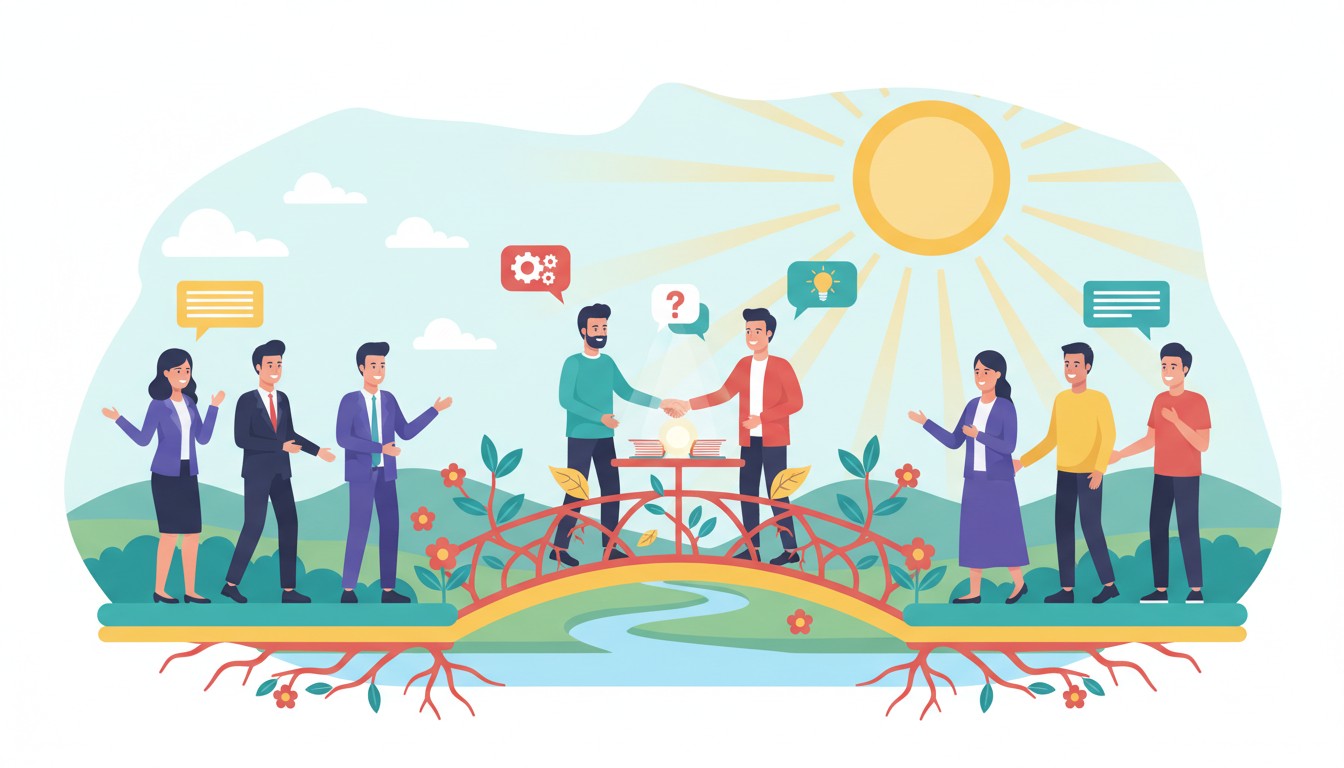
Empathize: Connect with the other person’s perspective. Empathy doesn’t require agreement, but it does create a bridge of understanding.
Apologize: When appropriate, acknowledge mistakes or misunderstandings. A sincere apology eases tension and shows humility.
Take Action: Move forward with clear, concrete steps. This final step shows commitment to constructive resolution.
The Psychology of Productive Disagreement: What Actually Works
Productive disagreement isn’t accidental—it’s a skill that can be practiced and refined. Neuroscience and behavioral psychology offer concrete techniques that bypass our defensive wiring and create genuine connection, even across profound differences.
The “Just Like Me” Technique
This deceptively simple mental reframing transforms adversaries into humans. When you feel your hackles rising, silently remind yourself: “This person has hopes, fears, and responsibilities—just like me.” They worry about their children—just like me. They want to feel safe—just like me. They fear being wrong—just like me.
This technique works because it activates the brain’s default mode network—the system responsible for empathy and social cognition. By consciously seeking common humanity, you counteract the amygdala’s threat response. You’re not surrendering your position; you’re simply creating enough psychological safety for your prefrontal cortex to re-engage.
The Power of Strategic Silence
In most heated conversations, we fill every pause with words. Strategic silence—intentionally waiting 3-5 seconds after someone finishes speaking—achieves three things simultaneously: it signals you’re actually processing their words, it creates space for them to elaborate, and it gives your own nervous system a moment to downshift from threat mode to thinking mode.
Research on therapeutic communication shows that silences as brief as three seconds significantly increase the depth and vulnerability of responses. In disagreement, this vulnerability is gold—it reveals the values and fears beneath the talking points.
Ask Better Questions
The quality of a disagreement is determined by the quality of its questions. Counterintuitively, “Why do you believe that?” often backfires—it sounds like interrogation. Better questions include:
- “What experience shaped that view for you?” (Invites story, not argument)
- “What would change your mind about this?” (Reveals openness to evidence)
- “What part of this issue worries you most?” (Identifies underlying values)
- “If we agreed on this, what would that look like?” (Shifts from problem to vision)
These questions work because they assume complexity. They signal that you’re not looking for a gotcha moment but genuine understanding. And crucially, they require the other person to think rather than recite prepared positions.
Reframing the Goal: From Agreement to Understanding
Traditional approach: Seek consensus, suppress dissent, avoid discomfort, win the argument.
Better approach: Seek understanding, embrace disagreement as healthy, sit with discomfort, build relationship.
The shift: You don’t need to agree on everything to act on something. Shared understanding creates the trust necessary for partial cooperation—and partial cooperation beats perfect agreement that never materializes.
Real-World Impact: Conversations That Actually Changed Minds
The abstract becomes powerful through examples. These case studies demonstrate how structured dialogue achieved what shouting never could.
The Pastor and the Atheist
In rural Texas, a prominent pastor and a local atheist leader became adversaries during a heated school board debate about religious clubs. Public meetings devolved into shouting matches that left both communities more polarized. Then the pastor did something unexpected: he invited the atheist to breakfast.
For six months, they met monthly, strictly observing two rules: no audience (their meetings were private), and no debate points from previous public fights. Instead, they discussed their kids, their aging parents, their shared frustration with city potholes. Slowly, they built enough trust to discuss the school issue. They discovered both wanted students to have safe spaces for identity exploration—they just disagreed on implementation. Their private understanding led to a joint proposal that passed unanimously. The public war ended because of private conversation.
The Union and the Corporation
During a bitter strike at a manufacturing plant, management and union leaders hadn’t spoken directly in months—only through lawyers and press releases. A federal mediator insisted on a single, unbroken 8-hour session with no media, no prepared statements, and no lawyers. The ground rule: each side could only ask questions for the first four hours.
For four excruciating hours, they asked questions. “What keeps you up at night?” “What would a fair deal look like to you?” “What happens if we don’t resolve this?” By hour five, they were brainstorming solutions. By hour eight, they had a tentative agreement. The questions forced them to reveal the human concerns beneath their positions, creating the empathy necessary for compromise.
The Town Hall That Actually Worked
A small Minnesota city faced a divisive debate about refugee resettlement. Previous town halls had devolved into chaos. The mayor tried a radical approach: she hired a graphic facilitator and banned speeches. Instead, residents were assigned to small, diverse tables and given 90 minutes to answer one question: “What are you most afraid of in this conversation?”
The answers were revealing. Long-time residents feared economic competition and cultural change. Newer residents feared isolation and violence. Both groups feared being called racist or un-American. Acknowledging these fears—without judgment—allowed them to craft a community integration plan that addressed real concerns. The final vote wasn’t unanimous, but it was overwhelming. And more importantly, neighborly relationships survived.
Practical Strategies: Rebuilding Dialogue from the Ground Up
Civil disagreement isn’t a personality trait—it’s a practice. Here are concrete techniques you can implement immediately.
1. Start Before You Start
Preparation for difficult conversations begins with emotional regulation. Before the conversation, identify your triggers. What specific phrases make you angry? What assumptions are you already making about the other person? Write them down. Acknowledging your biases doesn’t eliminate them, but it prevents them from hijacking your rational mind mid-conversation.
Clarify your goal. Is it to change their mind? To understand their position? To find common ground on a specific action? Vague goals like “have a good conversation” set you up for failure. Specific goals like “learn what experience shaped their view on property taxes” give you direction.
2. Create “Brave” Spaces, Not Just Safe Ones
The concept of “safe spaces” has been weaponized in culture wars, but the original idea is sound: people need psychological security to be vulnerable. However, productive disagreement requires something more: brave spaces where discomfort is expected and managed, not eliminated.
As educators at the University of Maryland note, brave spaces are co-created through discussion norms where students are “encouraged to question biases, challenge assumptions, and engage in meaningful dialogue.” This means explicitly stating: “We will disagree. We might get uncomfortable. That’s okay. The goal is to stay engaged, not to protect each other from hard truths.”
3. Master the “Pause and Paraphrase”
This is the single most effective technique for de-escalating tension. When someone finishes speaking, pause. Then paraphrase: “What I’m hearing is that you’re most concerned about fairness—that it feels like the current system punishes people who followed the rules. Is that right?”
This works for three reasons: it forces you to actually listen, it validates their emotional truth even if you disagree with their conclusion, and it gives them a chance to correct your misunderstanding. People are far more receptive to critique when they feel accurately heard first. As dialogue experts emphasize, “It’s amazing how much farther you can get when you recognize their feelings rather than jumping straight into telling them how awful you think they are.”
4. Use Stories as Data
We’re trained to believe facts change minds. They don’t—at least not directly. Stories bypass our fact-filtering defenses and land directly in our empathy centers. When debating a policy, share a specific story about a real person it affects. “My neighbor Maria, who works two jobs and still can’t afford the co-pay for her daughter’s asthma medication…” is more powerful than “15% of families in our county lack adequate healthcare coverage.”
This isn’t manipulation—it’s translation. You’re translating abstract policy into human impact, which is where moral and emotional reasoning actually happens. The best part? Stories invite stories. Your vulnerability creates space for theirs, and suddenly you’re not debating statistics; you’re sharing experiences.
5. Know When to Walk Away
Not every conversation is salvageable. Lee is explicit that dialogue with someone who isn’t acting in good faith is futile. The key is distinguishing between “good faith disagreement” and “bad faith performance.” Signs of bad faith include: constant interruption, personal attacks, refusal to answer direct questions, moving goalposts, and weaponizing your vulnerability.
Walking away isn’t failure—it’s strategic preservation of energy for conversations that can actually move the needle. As Lee notes, “I’m not advocating giving a public platform to every idea or remaining in dialogue forever with someone who isn’t willing to come to the table in good faith.” Set boundaries. Protect your peace. Then re-engage where you can actually make a difference.
The Quiet Revolution of Listening
The lost art of civil disagreement isn’t lost because it’s difficult—it’s lost because it’s invisible. You don’t get retweets for patiently listening to someone you disagree with. You don’t get accolades for asking honest questions instead of delivering zingers. The dopamine hit comes from winning, not understanding.
But the real victories—the ones that change policies, save neighborhoods, and preserve democracies—are built on a foundation of boring, unglamorous, face-to-face conversations. They happen in coffee shops, not comment sections. They require patience, not performance. They demand curiosity, not certainty.
Your choice is simple: you can be right, or you can be effective. You can collect digital trophies for your wit, or you can collect real relationships that survive disagreement. You can add to the noise, or you can rebuild the architecture of trust that makes democracy possible. The art isn’t lost—it’s just waiting for you to practice it.
Key Takeaways
Civil disagreement has eroded due to structural incentives for outrage, cognitive biases that prioritize tribal loyalty over truth, and a lack of practice in face-to-face dialogue.
Five key barriers—ego protection, team loyalty, comfort, misinformation, and worldview protection—silently derail most attempts at productive conversation.
Effective techniques include the HEAT framework (Hear, Empathize, Apologize, Take Action), “Just Like Me” reframing, strategic silence, and using stories rather than statistics.
Real-world change requires building “brave spaces” where discomfort is managed, not eliminated, and prioritizing understanding over agreement.
Anyone can rebuild dialogue skills through preparation, emotional regulation, better questions, and knowing when to strategically disengage from bad-faith actors.