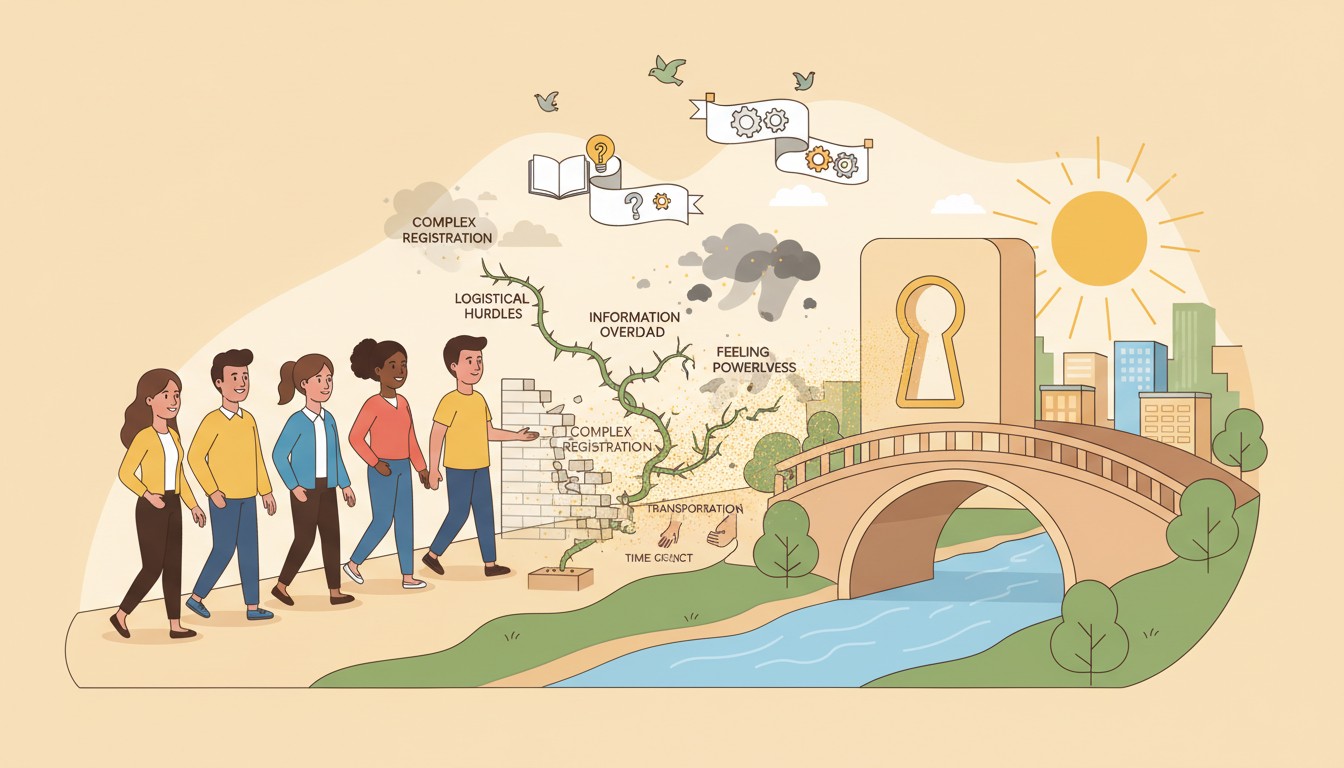
The civic engagement paradox haunts modern democracies. Millions of citizens who genuinely care about their communities abstain from voting, not from indifference but from a profound sense that their participation won’t matter. Recent surveys reveal that 21% of non-voters skip elections because they don’t feel their vote makes a difference, while 20% cite insufficient knowledge about candidates, and 18% simply dislike their options. These aren’t excuses from the disengaged—they’re rational responses from people who’ve concluded the system is rigged against meaningful participation.
The crisis extends beyond voting. Civic participation in local meetings, volunteer work, and community organizing has declined across demographic groups, creating what researchers call a democratic deficit where the loudest, most extreme voices dominate public discourse. Understanding why good people withdraw requires examining both psychological barriers within individuals and structural obstacles within systems. Only by addressing both can we rebuild a culture where civic engagement feels empowering rather than futile.
The Psychology of Disengagement: When Caring Feels Futile
At the heart of civic disengagement lies a cluster of psychological mechanisms that transform motivation into resignation. These aren’t character flaws—they’re adaptive responses to repeated experiences of powerlessness.
Learned Helplessness: The Powerlessness Trap
The concept of learned helplessness, drawn from behavioral psychology, perfectly explains why many capable, caring citizens disengage. When individuals repeatedly encounter situations where their actions seem to have no impact on outcomes, they develop a generalized sense of powerlessness. This isn’t a conscious choice—it’s a conditioned response where the brain literally learns that effort is futile.
Global issues like climate change, economic instability, and political polarization can induce overwhelming feelings of helplessness, leading individuals to disengage from civic action altogether. The perception that systemic issues are too large and complex for individual efforts to make a difference reinforces this psychological state. A citizen who’s written countless letters to representatives with no response, attended town halls where concerns were dismissed, and watched policies favor special interests over public good naturally concludes: “Why bother?”
This phenomenon creates a vicious cycle. Disengagement further weakens the responsiveness of political systems, leading to even greater disillusionment. The cycle accelerates when media coverage emphasizes negative, scandal, and conflict, reinforcing the sense that civic participation is pointless.
The Helplessness Spiral
Step 1: Individual takes civic action (votes, writes letters, attends meetings)
Step 2: Action produces no visible result or desired change
Step 3: Individual internalizes belief that “my actions don’t matter”
Step 4: Future civic engagement feels futile, leading to withdrawal
Step 5: System becomes less responsive as engaged citizens withdraw, reinforcing helplessness
Efficacy and Impact Perception: The “My Vote Doesn’t Count” Myth
The belief that individual votes don’t determine election outcomes is mathematically accurate in most cases, yet politically devastating in aggregate. This rational calculation leads to collective irrationality. When millions conclude their vote is insignificant, the resulting low turnout dramatically alters outcomes.
This perception is particularly strong among young people and those with lower incomes. Surveys show that only 57% of Gen Z adults plan to vote in upcoming elections, compared to 90% of baby boomers. The gap reflects not apathy but a gap in perceived efficacy. When you’ve seen multiple elections where your preferred candidate lost despite your participation, the evidence suggests your vote truly doesn’t matter.
The irony is that these non-voters are often the very people whose voices most need representation. Those with postgraduate degrees vote at 91% rates, while those without college degrees vote at just 71%. This participation gap ensures that policies reflect the interests of the engaged, further disempowering the disengaged.
Cognitive Overload and Complexity Paralysis
Modern civic participation demands extraordinary cognitive resources. Understanding ballot initiatives requires reading dense legal language. Evaluating candidates means sifting through conflicting information and campaign rhetoric. Navigating registration processes involves bureaucratic hurdles. For individuals already overwhelmed by work, family, and financial stress, this complexity creates a participation barrier that feels insurmountable.
Behavioral research identifies this as “perceived complexity”—when the mental model of what’s required for participation is inaccurate or overwhelming. Many potential voters assume the process is more difficult than it actually is, creating a barrier based on misinformation. A citizen who believes registration requires hours at a government office may never investigate the online alternative that takes minutes.
The Trust Deficit: When Institutions Fail the People
Trust in political institutions has collapsed to historic lows. A recent survey of social attitudes in Britain found that only 5% of people believed politicians would generally tell the truth “in a tight corner,” while 60% thought they would almost never do so. This erosion of trust creates a fundamental barrier to civic engagement—why participate in a system you believe is rigged, corrupt, or fundamentally unresponsive?
The trust deficit operates on multiple levels. Institutional trust reflects confidence in the competence and integrity of government bodies. When citizens perceive that local officials act with honesty and accountability, they’re more likely to attend public meetings, respond to consultations, and collaborate on community initiatives. When trust is absent, even well-intentioned engagement efforts are dismissed as “box-ticking exercises.”
This skepticism is particularly pronounced among those who’ve previously participated without seeing results. If individuals or communities have contributed to public processes and witnessed no change, they become unlikely to invest time again. This creates a vicious cycle where declining participation reduces institutional responsiveness, which further erodes trust.
The Trust Equation
Transparency: Clear communication about how citizen input will be used
Accountability: Clear lines of responsibility and follow-through on commitments
Consistency: Regular demonstration that participation leads to actual outcomes
Demographic and Structural Barriers: Who Gets Shut Out
While psychological barriers affect everyone, certain demographics face additional structural obstacles that make civic participation disproportionately difficult. These barriers aren’t about motivation—they’re about access.
The Income and Education Divide
Civic participation requires resources: time, money, mental bandwidth, and civic skills. People with lower incomes and less education often lack these resources, creating a participation gap that reinforces political inequality. Those earning under $50,000 annually vote at 72% rates compared to 92% for those earning over $100,000. This isn’t because they care less—it’s because survival demands consume their available energy.
Research consistently shows that rates of abstention are higher in groups from lower socio-economic backgrounds and rise in areas that are “left behind.” A 2022 report on political inequality in Britain identified growing gaps across income, education, and homeownership groups in voter turnout during 1964-2019, with non-homeowners, those with lower incomes, and those with fewer educational qualifications less likely to vote.
Education also plays a crucial role. Without information and knowledge, meaningful participation in politics becomes difficult. Civic education varies dramatically in quality, leaving many citizens without the skills to navigate complex political landscapes. This knowledge gap creates a self-perpetuating cycle where the uninformed feel too ignorant to participate, and non-participation prevents them from becoming informed.
Youth Disengagement: The Generational Gap
Young people face unique barriers to civic engagement. Among individuals ages 14 to 17, the top three obstacles are “lack of connectedness or not seeing the value in engagement” (31%), “lack of knowledge or awareness” of civic activities (29%), and not having time (28%). This reflects both structural barriers and developmental factors—teens are still forming their political identities and may not yet see how civic life connects to their personal world.
Since 1997, UK general election turnout for those aged 65 and over has consistently been at least 20 percentage points higher than for those aged 18-24. This creates “ageing democracies” where the politically active electorate skews older, potentially skewing policymaking toward older voters’ interests. However, since 2015 there has been a modest increase in youth turnout, suggesting that targeted engagement efforts can make a difference.
Health and Disability Barriers
Physical limitations and psychological issues can negatively affect someone’s capacity to engage with electoral politics. Lack of disability-friendly processes, such as inaccessible voting booths, creates direct barriers. Additionally, healthcare professionals can play a crucial role in facilitating registration and turnout by checking patients’ voting rights, assessing mental capacity, and supporting them through the registration process.
Individualism and Cultural Shifts: The Erosion of Civic Duty
Beyond personal psychology and structural barriers, broad cultural shifts have redefined how we think about civic responsibility. The narrative of “pulling yourself up by your bootstraps” emphasizes personal agency but inadvertently devalues community support and collective action. When individual success is prioritized above collective well-being, the motivation to engage in civic activities that benefit the community as a whole diminishes.
Perfectionism in political candidates also drives disengagement. Many voters, frustrated by having to choose the “lesser of two evils,” conclude that if they can’t vote for someone they fully support, they shouldn’t vote at all. This all-or-nothing thinking reflects broader cultural trends toward demanding perfection in leaders while overlooking the incremental nature of democratic progress.
This cultural shift is particularly visible among younger generations. The rise of identity politics, while important for recognizing diverse perspectives, can also contribute to social fragmentation, making it more challenging to forge a shared sense of civic purpose. The absence of compelling unifying narratives leaves individuals feeling adrift, lacking a clear sense of collective direction or motivation for civic action.
The Recruitment Gap: Not Being Asked to Participate
One of the simplest yet most profound barriers to civic engagement is that many people are never asked to participate. Research consistently shows that a major source of political engagement is recruitment—people attend political meetings, protests, or polling places because a family member or friend invited them. As one expert noted, “You’re not going to show up to the party if you haven’t been invited.”
This recruitment gap particularly affects young people and those from marginalized communities who may not have politically active social networks. When your family is struggling to make ends meet, civic participation isn’t dinner table conversation. When your friends are disengaged, you lack the social reinforcement that makes participation feel normal and important.
Political campaigns and organizations often focus on “likely voters”—those with established participation histories. This strategic neglect creates a self-fulfilling prophecy where unlikely voters remain unasked and therefore unchanged. Breaking this pattern requires intentional outreach to non-traditional participants.
Breaking the Cycle: Evidence-Based Solutions
Reversing civic disengagement requires interventions that address both psychological barriers and structural obstacles. Research by organizations like ideas42 has identified several effective strategies for transforming passive concern into active participation.
Simplify and Streamline Communication
Confusing communication creates unnecessary barriers. When organizations use jargon, bury key information, or provide overly complex instructions, they signal that participation is only for “insiders.” Effective communication uses plain language, highlights key actions, and provides clear timelines. Reducing the cognitive load required to participate makes engagement accessible to busy, stressed individuals.
Correct Inaccurate Mental Models
Many people hold false beliefs about civic participation—it’s too time-consuming, too complicated, or requires expertise. Directly addressing these misconceptions through clear, simple information can dramatically increase participation. For example, explaining that voter registration takes less than five minutes online can overcome a major perceived barrier.
Highlight Benefits and Impact
Counteract learned helplessness by demonstrating tangible impact. Showcase how community input shaped local decisions. Share stories of close elections where a few votes made a difference. Provide data on how participation leads to specific outcomes. When people see that their involvement matters, they’re more likely to engage.
Reduce Hassles and Friction
Every additional step required to participate reduces engagement. Holding meetings in accessible locations, providing online participation options, and sending meeting notes to those who can’t attend removes practical barriers. Making participation easier signals that you value people’s time and input.
Build Trust Through Transparency
Trust is rebuilt through consistent demonstration that participation leads to results. This means being honest about limitations while showing how citizen input genuinely shapes decisions. When difficult choices must be made, transparency about the process and constraints creates honest dialogue that preserves engagement for future opportunities.
From Disengagement to Empowerment
The psychology of civic disengagement reveals that non-voters aren’t lazy or apathetic—they’re responding rationally to systems that feel rigged, institutions that seem unresponsive, and barriers that appear insurmountable. The good people who don’t vote aren’t the problem; they’re the symptom of a democracy that has failed to make participation meaningful, accessible, and impactful.
Reversing this trend requires more than get-out-the-vote campaigns. It demands systemic changes that restore trust, simplify participation, and demonstrate that civic engagement genuinely shapes outcomes. It means reaching out to those who’ve never been asked, supporting those who lack resources, and rebuilding institutions that serve people, not just power.
The path from disengagement to empowerment begins with recognizing that every citizen has something valuable to contribute and that democracy only works when everyone has a voice. By addressing the psychological and structural barriers that silence good people, we can build a civic culture where participation feels not like a duty but like a privilege—a genuine opportunity to shape the world we share.
Key Takeaways
Learned helplessness and perceived inefficacy create psychological barriers that make civic engagement feel futile, even for caring citizens.
Systemic trust deficits and institutional responsiveness failures discourage participation by signaling that citizen input is ignored.
Demographic gaps in voting—by income, education, age, and health—reflect resource barriers and structural obstacles, not apathy.
Cultural shifts toward individualism and perfectionism in candidates erode the sense of civic duty and collective responsibility.
Effective solutions must address both psychological barriers (through demonstrating impact) and structural barriers (through simplifying participation and building trust).