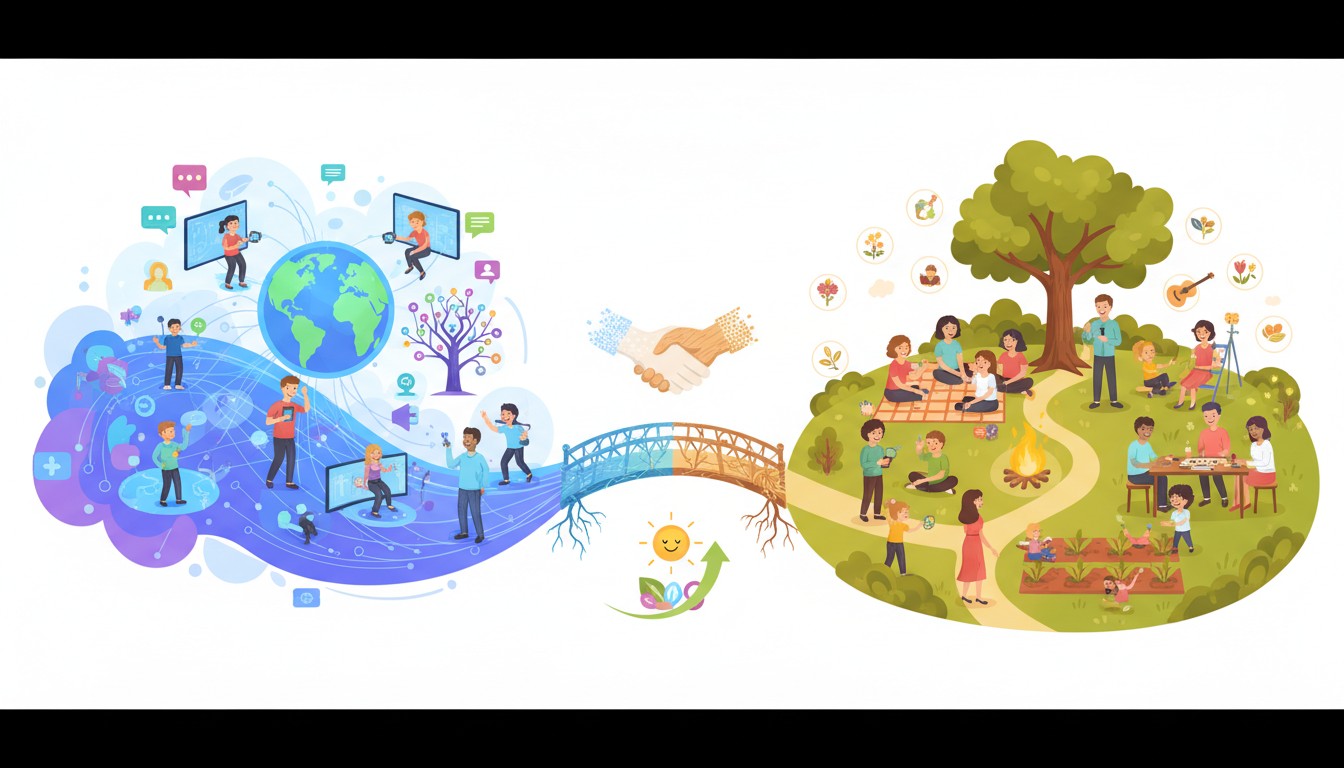
Digital Communities vs Physical Communities: What We Gain and Lose in the Evolution of Connection
The transformation of human connection represents one of the most profound shifts in social organization since the agricultural revolution. For millennia, community meant the people you could see, touch, and share physical space with—tribes, villages, neighborhoods bound by geography and necessity. The digital age has shattered these constraints, replacing them with communities formed around shared interests, identities, and values that transcend physical boundaries.
This evolution accelerated dramatically in recent decades. The internet’s early days in the 1980s saw primitive bulletin board systems connecting tech enthusiasts through dial-up modems. By the 1990s, forums and chat rooms democratized access, allowing larger audiences to participate in threaded discussions. The 2000s brought social media platforms that turned community-building into a mainstream activity. Today, immersive virtual reality platforms and sophisticated Discord servers create digital villages that feel as real to their inhabitants as any physical town square.
Understanding what we gain and lose in this transition isn’t about declaring one form superior. It’s about recognizing that each model offers distinct advantages and carries hidden costs. By examining the evolution of connection through a clear-eyed lens, we can make conscious choices about how to build our social lives in ways that honor both our need for deep roots and our desire for broad reach.
The Great Shift: From Proximity to Passion
Traditional communities formed from necessity and proximity. You lived near people, worked with them, worshipped alongside them, and gradually built bonds through repeated, often unavoidable interaction. This model had its strengths—deep roots, multi-generational relationships, shared physical rituals—but also severe limitations. If you were the only person in your village with a particular interest or identity, you lived in isolation.
Digital communities reversed this formula. Instead of geography dictating membership, shared passions became the organizing principle. A teenager in rural Kansas could find their tribe in a global gaming clan. A new parent struggling with postpartum depression could access support networks at 3 AM when local resources were unavailable. A professional in a niche field could collaborate with peers worldwide without relocating.
This shift democratized belonging. Platforms like Reddit host millions of subreddits where people connect over everything from astrophysics to zero-waste living. Discord servers create intimate spaces for real-time conversation around shared hobbies. Meetup bridges the gap, using digital tools to facilitate physical gatherings.
The Evolution Timeline
1980s: Bulletin Board Systems (BBS) connect tech enthusiasts via dial-up modems
1990s: AOL chat rooms and forums democratize access to online groups
2000s: Facebook Groups and social networks make community-building mainstream
2010s: Mobile apps enable constant connectivity and location-based communities
2020s: Virtual reality and immersive platforms create persistent digital worlds
What Digital Communities Grant Us: The Gains
Digital communities offer transformative benefits that physical communities simply cannot match. These advantages explain why billions have embraced online connection as a primary mode of social interaction.
1. Transcendent Access and Inclusivity
The most profound gift of digital communities is their ability to dissolve geographic barriers. A person with a rare medical condition can find support among thousands worldwide. LGBTQ+ youth in conservative regions can access affirming spaces. Individuals with disabilities can participate fully in communities without physical limitations. Research shows that 50% of LGBTQ+ respondents report having at least one close online friend, compared to only 19% of non-LGBTQ+ youth.
This accessibility extends beyond marginalized groups. Rural residents connect with urban professionals. Expats maintain ties to home cultures. Night owls find companionship when their local world sleeps. The digital realm operates 24/7, across time zones, making community available whenever and wherever you need it.
2. Niche Depth Over Broad Shallowness
Physical communities force breadth—you interact with whoever lives nearby, regardless of shared interests. Digital communities enable depth. Whether you’re obsessed with a specific chess opening, a rare plant species, or an obscure programming language, you can find your people. This passion-based matching creates immediate rapport and eliminates the small talk required in place-based relationships.
The sheer volume of specialized communities is staggering. Subreddits exist for topics as specific as “r/BreadStapledToTrees” and communities dedicated to supporting people through menopause. This granularity allows for authentic self-expression without the need to translate your interests for a general audience.
3. Asynchronous Flexibility
Physical communities demand synchronization—everyone must be in the same place at the same time. Digital communities liberate us from this constraint. You can contribute to a forum discussion at 2 AM, catch up on a Discord conversation hours later, or participate in a global webinar from your living room. This flexibility accommodates different schedules, energy levels, and life circumstances.
For working parents, caregivers, or people with irregular schedules, this asynchronicity is revolutionary. You don’t have to choose between attending a PTA meeting and a support group—you can engage with both digitally on your own timeline. This democratization of participation ensures that community involvement isn’t limited to those with abundant free time.
4. Enhanced Capacity for Self-Expression
Digital platforms offer multimedia tools for self-expression that physical communities rarely match. You can craft thoughtful written posts, share curated photo essays, create video content, or express yourself through memes and GIFs. This creative richness allows for nuanced communication and deeper emotional sharing.
For individuals who struggle with verbal communication, the ability to edit and refine digital messages provides a safe space to practice social skills. Shy people can contribute meaningfully without the pressure of speaking up in a crowded room. Those with social anxiety can build confidence in lower-stakes digital environments before translating those skills to face-to-face interaction.
The Hidden Costs: What Digital Communities Take Away
For all their benefits, digital communities exact significant tolls that often remain invisible until the damage is done. These losses explain why many people report feeling more isolated despite being more connected.
1. The Depth Deficit
Digital interactions often lack the emotional bandwidth of face-to-face connection. Text-based communication strips away vocal tone, facial expressions, and body language—the nonverbal cues that carry most emotional information. While video calls help, they still can’t replicate the subtle chemical exchanges that occur during physical presence.
This deficit becomes apparent in crisis moments. A Discord message of condolence, however well-crafted, can’t match the comfort of a hand on a shoulder. A celebratory emoji parade fails to capture the joy of shared champagne toasts. Over time, relying on digital connection can atrophy our capacity for emotional depth, leaving us skilled at performative empathy but disconnected from genuine feeling.
2. The Accountability Erosion
Physical communities enforce natural consequences for poor behavior. If you’re rude to a neighbor, you see them daily and must repair the relationship. Digital anonymity (or pseudonymity) removes this accountability. People say things online they’d never utter face-to-face, creating cultures of incivility that spill into real-world interactions.
The transient nature of digital membership exacerbates this problem. When you can leave a community with a click, there’s little incentive to work through conflicts or take responsibility for harm caused. This creates disposable relationships where ghosting replaces difficult conversations and blocking substitutes for boundary-setting skills.
3. The Embodiment Disconnect
Human connection evolved through physical co-presence. Shared meals, collaborative work, dancing, and mourning—all these bonding activities involve our bodies. Digital communities sever this embodied dimension, leaving us as floating heads interacting through screens.
This disembodiment has measurable consequences. Rates of depression and anxiety correlate with increased screen time. Sleep quality deteriorates when evening hours are spent on devices rather than in face-to-face conversation. The simple act of making eye contact, which releases oxytocin and builds trust, disappears when we’re staring at cameras instead of pupils.
4. The Echo Chamber Effect
Digital communities excel at connecting like-minded people, but this strength becomes a liability when it creates ideological isolation. Algorithms prioritize content that reinforces existing beliefs, gradually filtering out dissenting perspectives. What begins as a supportive community can morph into an echo chamber where extreme views go unchallenged and radicalize.
The tribalism inherent in online communities makes boundary defense a priority. Groups feel threatened by outsiders and develop us-vs-them mentalities. This dynamic plays out across the political spectrum, from tech forums to wellness groups, creating polarization that fractures broader society.
The Digital Community Paradox
The same features that make digital communities powerful also make them problematic:
• Global reach creates connection but reduces accountability
• Anonymity enables vulnerable sharing but encourages toxicity
• Asynchronous communication provides flexibility but reduces presence
• Interest-based matching creates rapport but builds echo chambers
What Physical Communities Still Offer: The Irreplaceable
Physical communities aren’t relics to be abandoned. They provide essential human nutrients that digital spaces cannot synthesize. Understanding these strengths helps us appreciate why place-based connection remains vital.
1. Spontaneous Serendipity
Physical proximity creates opportunities for unplanned encounters that digital communities require effort to replicate. The conversation sparked while walking your dog, the neighbor who helps carry groceries, the regular at the coffee shop who becomes a confidant—these micro-interactions weave the social fabric that supports mental health and creates a sense of belonging.
Research consistently shows that neighborhoods with walkable streets and local gathering spaces report stronger social cohesion and better mental health outcomes. The casual familiarity built through repeated brief contact creates a foundation of trust that makes deeper connection possible.
2. Multi-Sensory Presence
Physical communities engage all our senses. The smell of a shared meal, the sound of children playing in a park, the tactile experience of building something together—these sensory inputs create memories and bonds that screen-based interaction cannot replicate. Our bodies evolved for physical co-presence, and they respond to it in ways that bypass conscious thought.
The power of ritual demonstrates this strength. Graduation ceremonies, religious services, weddings, and even town hall meetings use physical gathering to create shared emotional experiences. The synchronization of movement, speech, and emotion in these settings generates collective effervescence—a sense of group consciousness that digital spaces struggle to achieve.
3. Natural Accountability and Repair
When you share physical space with people, you must learn to navigate conflict and repair relationships. You can’t simply block a neighbor who annoys you. This necessity builds emotional intelligence, compromise skills, and resilience. Physical communities teach us that relationships require maintenance and that temporary discomfort is worth the long-term stability of social bonds.
The interdependence of physical communities also fosters reciprocity. You help your neighbor shovel snow; they watch your house while you’re away. These exchanges aren’t transactional—they build a web of mutual obligation that strengthens over time. Digital communities lack this enforced interdependence, making relationships more disposable.
4. Exposure to Diversity and Difference
Physical neighborhoods, especially in urban areas, force contact with people different from yourself. You share sidewalks, public transit, and local businesses with individuals from varied backgrounds, ages, and beliefs. This exposure, while sometimes uncomfortable, builds tolerance and cognitive flexibility.
Digital communities, by contrast, make it easy to avoid difference entirely. You can curate your feeds to see only confirming viewpoints, join groups that share your exact identity, and never encounter the challenging perspectives that spur growth. While place-based diversity can be frictional, that friction polishes rough edges and expands worldviews.
The Limitations of Place-Based Bonds: What We Lose in Physical Communities
Physical communities, while valuable, carry inherent limitations that digital communities were designed to solve. Recognizing these constraints helps explain why the shift to digital connection felt so liberating for many.
1. Geographic Constraints and Isolation
Physical communities limit your social pool to whoever happens to live nearby. If you’re the only person in your small town with a particular passion, you either suppress that part of yourself or live with profound isolation. This constraint is particularly harsh for individuals with non-mainstream identities or interests.
The tyranny of distance also means that moving for work, family, or adventure severs social ties. Lifelong friendships can crumble simply because of a cross-country relocation. Digital communities maintain connection across space, allowing relationships to persist despite physical separation.
2. Social Rigidity and Exclusion
Physical communities often enforce conformity through subtle social pressure. The gossip network in a small town, the judgmental glances in a suburban neighborhood, the unspoken rules of a rural community—these mechanisms can stifle individuality and force people into narrow roles. Breaking from expected behavior risks ostracism in a system where you can’t easily find alternative social groups.
Digital communities offer escape valves. You can maintain your place-based identity while exploring alternative selves online. This freedom is particularly valuable for individuals questioning their identity, recovering from trauma, or simply seeking a break from local expectations.
3. Limited Access to Resources and Expertise
Physical communities restrict access to specialized knowledge and support. If you’re dealing with a rare health condition, your local community may lack anyone with relevant experience. If you’re learning a complex skill, local mentors might be unavailable. Digital communities democratize access to expertise, connecting you instantly with people who’ve walked your path.
This resource limitation extends to professional networking. In a small town, career opportunities are finite. Digital communities open global job markets, mentorship possibilities, and collaborative projects that would be impossible locally.
4. Time and Energy Demands
Physical communities require significant time investment. Commuting to gatherings, attending lengthy meetings, participating in rituals—these activities consume hours that many modern adults simply don’t have. The expectation of physical presence creates barriers for people with disabilities, demanding jobs, or caregiving responsibilities.
Digital communities offer efficiency. You can check in during a 10-minute break, contribute meaningfully without leaving home, and engage at whatever level your energy allows. This flexibility makes community participation sustainable for people whose lives don’t fit traditional 9-to-5 schedules.
The Community Comparison Matrix
Physical Communities Excel At: Spontaneity, embodied presence, natural accountability, diverse exposure
Physical Communities Struggle With: Geographic constraints, social rigidity, limited resources, time demands
Digital Communities Excel At: Global access, niche matching, flexibility, resource democratization
Digital Communities Struggle With: Depth deficit, accountability erosion, disembodiment, echo chambers
The Hybrid Model: Crafting a Balanced Connection Diet
The false dichotomy between digital and physical communities obscures a more nuanced reality: the most fulfilling social lives integrate both approaches strategically. The hybrid model recognizes that different needs require different community types.
Think of your social life as a diet requiring various nutrients. Digital communities provide specialized vitamins—niche interests, global perspectives, flexible support. Physical communities supply foundational proteins—embodied presence, spontaneous interaction, deep bonds. A healthy social life needs both.
Successful hybrid models use digital tools to enhance physical connection rather than replace it. A neighborhood uses a WhatsApp group to coordinate potlucks and share safety alerts. A running club organizes through Strava but meets weekly for in-person jogs. A professional network conducts virtual mentorship sessions between in-person conferences.
The key is intentionality. Use digital communities for what they do best: maintaining long-distance friendships, exploring niche interests, accessing specialized resources. Use physical communities for what they do best: building deep local bonds, experiencing embodied presence, developing accountability skills.
Digital-to-Physical Pipeline
One powerful hybrid strategy is the digital-to-physical pipeline: use online platforms to find your people, then transition to in-person connection. Meetup groups exemplify this approach, connecting online but gathering offline. Friendship apps like Bumble BFF facilitate initial digital matching, then encourage coffee dates.
This pipeline solves the biggest challenge of adult friendship formation—finding people who share your interests—while preserving the irreplaceable benefits of embodied presence. It leverages digital efficiency for the search phase and physical richness for the relationship-building phase.
Practical Strategies for the Modern Community Navigator
Navigating the modern community landscape requires new skills. Here are evidence-based strategies for building a healthy social ecosystem.
1. Conduct a Community Audit
Assess your current social landscape. List all communities you belong to, both digital and physical. Rate each on: depth of connection, frequency of interaction, satisfaction level, and alignment with your values. Identify gaps—are you missing local connections? Lacking niche interest groups? This audit reveals where to focus your energy.
2. Implement Digital Sabbaths
Designate one day weekly for digital community abstinence. Use this time for physical world engagement—walk in your neighborhood, visit local businesses, attend in-person events. This practice prevents digital communities from crowding out physical ones and reminds you of the unique value of embodied presence.
3. Set Intentional Boundaries
Establish clear rules for digital community participation. Limit the number of active groups to prevent overwhelm. Set specific times for checking community platforms rather than constant monitoring. Create “no-phone zones” in your home where physical interaction takes priority. These boundaries preserve mental energy for meaningful engagement.
4. Cultivate Local Anchors
Identify three physical anchors in your neighborhood: a coffee shop, a park, a library, a community center. Visit these spots regularly at consistent times. Familiarity breeds connection. The barista who knows your order, the fellow dog walker you see each morning, the librarian who recommends books—these micro-relationships create the fabric of place-based community.
5. Use Digital Tools to Strengthen Physical Ties
Leverage technology to enhance, not replace, local connection. Create a neighborhood group chat for safety alerts and recommendations. Use calendar apps to coordinate in-person gatherings. Share photos from local events to build collective memory. The goal is making physical community easier to maintain, not using digital tools as a substitute.
Your 30-Day Community Balance Challenge
Week 1: Audit your current communities and identify one gap
Week 2: Join one new community (digital or physical) that fills that gap
Week 3: Attend one in-person gathering and initiate one digital conversation
Week 4: Evaluate which communities energize you and which drain you, then adjust accordingly
The Future of Connection: Blended Realities
The evolution of community doesn’t end with our current hybrid model. Emerging technologies promise to further blur the lines between digital and physical. Virtual reality platforms already create immersive social spaces where avatars interact in ways that mimic physical presence. Augmented reality will overlay digital information onto physical spaces, creating new forms of hybrid interaction.
Yet the core human need remains unchanged: we crave authentic connection that makes us feel seen, understood, and valued. Technology can facilitate this, but it cannot replace the fundamental chemistry of embodied presence. The future likely belongs to those who use digital tools to find their people, then courageously cross the threshold into physical space to build lasting bonds.
The challenge ahead isn’t choosing between digital and physical communities. It’s developing the wisdom to know which tool serves which purpose, the discipline to maintain balance, and the courage to show up fully—both online and in person. In this blended future, community becomes not a place you go, but a practice you cultivate across all the spaces where humans gather.
The Connection Renaissance
We stand at a unique moment in human history, blessed with tools that can connect us across any distance yet cursed by the isolation these same tools can create. The solution isn’t rejecting technology or romanticizing the past. It’s embracing a conscious, integrated approach to community building.
Use digital communities to find your people, access specialized knowledge, and maintain relationships across distance. Use physical communities to deepen bonds, experience embodied presence, and build local resilience. Let each form compensate for the other’s weaknesses while amplifying its strengths.
The evolution of connection isn’t finished. We’re active participants in writing the next chapter. Choose wisely, engage fully, and remember that the deepest human need—to belong, to be seen, to matter—can be met in both pixels and person. The art is knowing when to reach through the screen and when to reach across the table.
Key Takeaways
Digital communities offer unprecedented access, niche matching, and flexibility but sacrifice depth, accountability, and embodied presence.
Physical communities provide spontaneity, multi-sensory experience, and natural accountability but suffer from geographic constraints and social rigidity.
The hybrid model—using digital tools to find people and physical interaction to deepen bonds—offers the most sustainable approach to modern social life.
Intentional strategies like community audits, digital sabbaths, and local anchor points help maintain healthy balance between online and offline connection.
The future of community lies not in choosing between digital and physical, but in developing wisdom about when to use each form of connection.